Tag Archives: Bridge Street

Bridge Street Historic District: Homes, School, Span Connected A Community

Werner Liepolt is a longtime resident of Bridge Street, and a former Westport teacher. He writes:

As Westporters prepare for Thursday’s state Department of Transportation meeting about the Cribari Bridge (November 12, 7 p.m., Town Hall auditorium),
a look at the Bridge Street National Register Historic District can help clarify what’s at stake.

The National Register nomination shows how the bridge, houses, stone walls and a former school tell the story of a neighborhood that grew around the river
crossing.

That history can help residents assess CTDOT’s presentation, ask specific questions, and submit informed comments by November 27.
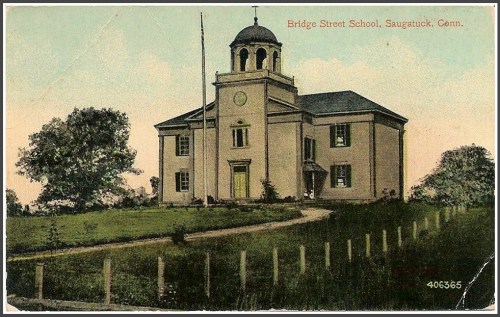
The original Bridge Street School. It later became Saugatuck Elementary; it is now The Saugatuck co-op housing.

Westport residents and the Representative Town Meetings’s Cribari Bridge Subcommittee still need clear information from CTDOT and the Federal Highway Administration about how the preferred alternative and other
feasible options could adversely affect the historic district.

The agencies should:

  • Identify the 10 properties and 1 dock that CTDOT indicated last April could be affected by right-of-way acquisition, including possible use of eminent domain.
  • Provide studies assessing potential changes in truck traffic, noise, vibration and diesel pollution.
  • Clarify whether the Area of Potential Effects has been revised to include the entire Bridge Street National Register Historic District.
  • Provide updated visual assessments that show views when trees are bare, and from higher ground.

With this information, residents and consulting parties could propose specific measures to avoid, minimize or mitigate adverse effects.

The Frederick Hotchkiss House dates to 1876.

Bridge Street tells a story larger than the history of its houses. Its winding roadway, low stone walls, former school and iron swing bridge record how Westport grew from separate settlements into a connected community.

Together, these features form a historic landscape whose significance rests on the relationships among its parts.

The Bridge Street Historic District nomination, prepared by architectural historians at the Public Archaeology Laboratory, describes approximately 22.46 acres extending from the western bank of the Saugatuck River east to Compo Road South, with a branch along southern Imperial Avenue.

It identifies 28 contributing buildings and 3 contributing structures, including the bridge. Its period of significance stretches from 1809 through 1945.

The district’s oldest building, the Delancy Allen House at 192 Compo Road South, predates Bridge Street itself. Built in 1809, it recalls a time when much of the land between Compo Road and the river belonged to the Allen family.

Delancy Allen House, Bridge Street

Before a local crossing existed, residents on the east side faced an inconvenient journey to reach Saugatuck’s businesses and railroad station. The
river connected Westport to maritime commerce, while also dividing its neighborhoods.

The nomination traces the neighborhood’s development to the Allen family’s donation of land for Bridge Street in 1869, and the establishment of a river crossing.

Those changes opened land for subdivision and residential construction. The present swing bridge followed in 1884, replacing the earlier crossing.

Bridge and neighborhood consequently developed as parts of the same story: the crossing made the residential district possible, and the district preserves evidence of the community that grew around it.

The Bridge Street Bridge once carried trolleys.

Today’s William F. Cribari Memorial Bridge remains the district’s most recognizable structure.

Its iron trusses frame the river crossing. and mark the transition between Saugatuck and Bridge Street. The nomination explains that substantial rehabilitation in the early 1990s changed the bridge’s structural system, leaving the historic trusses supporting their own weight above a newer platform.

Nevertheless, it identifies the bridge as a contributing resource and an integral
part of the neighborhood’s development. The bridge had already been individually listed in the National Register in 1987.

East of the crossing, the houses reveal successive generations of residential architecture.

The 1884 Rufus Wakeman House. 

Italianate, Queen Anne, Colonial Revival, Craftsman, and other styles give the district variety within a generally consistent domestic scale. Porches, projecting bays, decorative shingles, wood clapboards and traditional windows distinguish individual buildings.

Setbacks, vegetation, fences and retaining walls connect them into a recognizable streetscape.

The inventory also includes more modest 20th century residences.

The Anna E. Dolan House at 12 Bridge Street, built in 1932, contributes to the district alongside its 19-century neighbors. This range matters: the neighborhood records and preserves continuing development across generations.

The Anna Dolan House was built in 1932.

Some of its most significant features stand close to the ground. The nomination identifies the Bridge Street System of Stone Walls as a contributing structure in its own right.

Portions may date to the roadway’s layout around 1869; others reflect later replacement and repair.

Sections appearing original are identified in front of 12 and 20–24 Bridge Street, and along the south side of 192 Compo Road South. These walls help define the roadway’s historic edges. and the relationship between public passage and private property.

The former Saugatuck Elementary School at 35 Bridge Street adds another dimension. Its 1931 building represents the neighborhood’s educational and civic life, while its later conversion to Westport’s affordable housing illustrates continued use of a substantial community landmark.

Former Saugatuck Elementary School, now co-op housing. 

The nomination’s photographs also document the adjoining athletic fields open to the public, placing the school within its broader setting.

The historians found that the district retained integrity of location, design, setting, workmanship, materials, feeling and association.

Their assessment recognizes a coherent neighborhood whose historic character survives through both buildings and surroundings.

For Westport residents, that provides a practical way to understand what deserves attention when major infrastructure changes are proposed: the bridge, homes, walls, roadway, and setting belong to an interconnected place.

1886 Orlando Allen House.

Residents can use this nomination and its property inventory to support specific Section 106 comments by November 27, the extended deadline communicated by RTM subcommittee chair Melissa Levy.

In your comment, identify the historic feature, explain how the project could affect it, and request a specific measure to avoid, minimize or mitigate that effect — for example, protecting stone walls, monitoring construction vibration, or evaluating traffic-related changes to the district’s setting.

Ask that agreed protections be incorporated into the project’s Memorandum
of Agreement, with responsibility, timing, and follow-through clearly stated.

Email: James.Barrows@ct.gov; Copy: Mandy.Ranslow@ct.gov
Subject: Project 0158-0214 – Section 106 Mitigation Request – [your address]
Mail: ATTN: James Barrows, Connecticut Department of Transportation
2800 Berlin Turnpike, P.O. Box 317546, Newington, CT 06131-7546

Project documents and updates: https://portal.ct.gov/Cribari-Bridge

(“06880” has covered the Cribari Bridge controversy since we began in 2009. We’ll continue to do so — with reader support. Please click here to donate to your hyper-local blog. Thank you!)

[OPINION] Say Yes To “No Through Trucks”

Shannon Taylor and her husband purchased their Bridge Street home in 2022, where they live with their 2 young children. Walks, stroller rides and scooter trips to Saugatuck restaurants and Luciano Park have made her aware of the neighborhood’s traffic and pedestrian safety challenges. These experiences inspired her to advocate for practical solutions that protect the families who live, walk and play in the area. She writes:

For years, Westport residents have debated the future of the historic Cribari Bridge. Should it be rehabilitated or replaced? How do we preserve its character, while ensuring it remains safe?

But beneath these disagreements, one concern has emerged with remarkable consistency: We do not want tractor-trailers using Bridge Street and the surrounding neighborhoods as an alternative to I-95.

I live on Bridge Street with my family. Like many neighbors, I worry about what happens if a reconstructed bridge makes our residential streets an attractive shortcut for heavy commercial traffic.

I am not opposed to necessary improvements to the bridge. But I am opposed to allowing my family’s safety, and the safety of our neighborhood, to depend entirely on the physical limitations of a 142-year-old structure.

Traffic is tight, on the Cribari Bridge. 

As it turns out, Connecticut already has a process designed to address this exact concern. The Office of the State Traffic Administration can establish “No Through Trucks” restrictions on qualifying roads.

These restrictions can prohibit trucks from passing through a community while allowing vehicles with legitimate local destinations, including deliveries and moving trucks, to continue accessing the area. Most importantly, this process is separate from the decision to rehabilitate or replace the bridge.

State Department of Transportation project manager James Barrows II confirmed that a “No Through Trucks” restriction is an available option, and has already been discussed by the project team.

However, the project team cannot initiate the process itself. A formal request must come from Westport’s Local Traffic Authority, currently the Board of Selectpersons.

Once requested, OSTA would investigate roadway conditions, including width, curves, sight lines, traffic volumes and surrounding development, to determine whether a restriction is justified.

There is even local precedent: Portions of Route 136, including a section in Westport, already have approved “No Through Trucks” restrictions. Approval is certainly not guaranteed, but this seems like a reasonable path.

In 2019, Westport had an opportunity to pursue this exact solution. Instead, it chose to wait. At its February 13 meeting, the Board of Selectpersons considered authorizing then-1st Selectman Jim Marpe to request “No Through Trucks” restrictions for Bridge Street, Compo Road South and Greens Farms Road.

According to the meeting minutes, the board determined that pursuing the restriction was premature while the Cribari Bridge rehabilitation project was still ongoing. By a unanimous 3–0 vote, it tabled the discussion “until a date to be determined.”

Compo Road South, between Post Road and Greens Farms Road/Bridge Street (Photo/John Videler for Videler Photography)

That was nearly 8 years ago.

Since then the bridge debate has continued, proposals have evolved, and residents have repeatedly expressed the same concerns about heavy commercial traffic. Yet I recently received confirmation from OSTA that no formal request has been received for a restriction in this area.

In other words, we postponed a potential solution because we were still debating the bridge. And nearly 8 years later, we’re still debating the bridge.

It’s time to separate these 2 conversations.

With CTDOT preparing to present its selected bridge alternative on November 12 (7 p.m., Town Hall), this question feels particularly urgent.

At Monday evening’s RTM Transit Committee meeting, I raised this alternative and was encouraged by the response. Committee chair Melissa Levy and other RTM members expressed interest in examining how the town could pursue enforceable truck restrictions, rather than relying solely on bridge design.

The RTM has already demonstrated overwhelming agreement on this issue. In March 2026 members voted 20–1, with 4 abstentions, in favor of a resolution calling for improvements to the bridge, while maintaining a height restriction to prevent tractor-trailer access.

Cars were (very) briefly banned from the Cribari Bridge last month, during the Walk Bike Westport Bridge to Bridge ride.

That vote suggests something important: Even among residents and representatives who disagree about the bridge’s future, there is substantial common ground when it comes to keeping heavy through-truck traffic off our neighborhood streets.

A “No Through Trucks” designation would not resolve every concern about the bridge. It would not eliminate the need to consider preservation, environmental impacts, traffic circulation or pedestrian safety. Any restriction would also require a thoughtful enforcement plan. But it could address one of the most contentious issues independently of the bridge’s ultimate design.

We should not have to choose between a safe, functional bridge and safe residential streets.

I have written twice to First Selectman Christie and the Board of Selectpersons requesting clarification about the 2019 proposal, and asking whether the town would consider initiating an OSTA review. As of this writing, I have not received a response.

The Board of Selectpersons — currently Amy Wistreich, Kevin Christie and Don O’Day — serve as Westport’s Local Traffic Authority.

I appreciate the RTM’s willingness to examine this alternative. But ultimately, the authority to initiate the state review rests with the town’s Local Traffic Authority.

This is where Westport residents can make a difference.

If you believe our neighborhood streets should be protected from unnecessary heavy commercial traffic, ask 1st Selectman Christie and the Board of Selectpersons to revisit the proposal tabled in 2019, and formally request an OSTA investigation.

Contact your RTM representatives, too. Ask them to support this effort, and encourage town leadership to act. Whether you favor rehabilitation or replacement, historic preservation or modernization, this is an issue on which we can work together.

We are not asking the state to guarantee a particular outcome. We are asking our town leadership to initiate the process so the state can evaluate the merits, examine the traffic and safety data, and determine whether a restriction is warranted.

Let’s stop treating a structural height limitation as our only protection against heavy commercial traffic.

Westport has spent years making clear what we don’t want.

Now it’s time for all of us to ask for what we do want.

(“06880” Opinion pages are open to all. Send submissions to 06880blog@gmail.com. To support “06880” with a contribution, click here.)

Dramatic Police Chase: WPD Video

The Westport Police Department does a great job of informing the public about danger. If there’s an imminent threat — human, weather-related, whatever — we know about it.

But an incident last week — involving a car chase through crowded streets — received little attention. Because the WPD was an assisting agency (not the lead); because the suspects were quickly apprehended with no further danger to thepublic, and because the investigation is ongoing, there was no press release.

For witnesses though, it was quite a scene.

The incident began when the Westchester County Police Department notified the Connecticut State Police of a vehicle wanted on felony charges.

The driver evaded state troopers, but they monitored the vehicle using live traffic cameras.

Westport Police were advised that State Police lost visual contact around I-95 Exit 17.

Officers spotted it near the intersection of Bridge Street and Riverside Avenue.

Dramatic dashcam footage obtained by “06880” shows the suspect vehicle (black car, left) barrel through the red light on Riverside Avenue at Bridge Street.

After backing up and turning, the vehicle races across the Cribari Bridge.

Police pursued the vehicle across the Cribari Bridge, and onto Imperial Avenue.

On Bridge Street near Imperial Avenue, the suspect vehicle (center) weaves through — and strikes — both an oncoming police car (with lights flashing), and a motorist who had pulled to the right.

With at least one tire blown, the suspect drove dangerously on the left side of the road, before coming to a stop on Otter Trail.

The suspect drives on the wrong side of Imperial Avenue, narrowly missing an oncoming car.

He continues to drive erratically on Imperial. Pieces of the car litter the road.

The driver halts on Otter Trail …

Two occupants — a male and female — were apprehended. The male was found to be the subject of multiple active arrest warrants. One was for burglary; several were for failure to appear in court after other arrests.

… and attempts to flee. He is quickly apprehended.

The male was turned over to Connecticut State Police for arrest processing relative to the active warrants. The female was not immediately charged.

The investigation is still active. Westport Police will seek an arrest warrant for charges against the male, including evading responsibility in 2 motor vehicle accidents, and failure to stop when signaled.

Friday Flashback #510

A lot of people spent a lot of time stuck in yesterday’s fireworks traffic, heading to and from Compo Beach.

Even at non-holiday times, the light at the Compo Road South/Greens Farms Road/Bridge Street intersection can be long. There’s plenty of opportunity to look around.

What we see is the I-95 overpass. It seems like it — and Greens Farms Road — have always been there.

But for decades before the “turnpike” construction in the 1950s, the road came in at a different angle.

There, on the southwest corner, sat Ken Montgomery’s grocery store.

When the state of Connecticut planned the new route, his building was in the way.

He tried to relocate to a lot he owned on Bridge Street, across from what was then Saugatuck Elementary School (now The Saugatuck co-op housing), yet was rebuffed.

So one day in the mid-1950s, Ken’s store was demolished.

(Westport Town Crier photo courtesy of Mary Palmieri Gai)

Ken hoped to return with a new store in the same vicinity, once the highway was completed. In the meantime, he went to work at his mother’s (similar) grocery store, not far away by Old Mill Beach.

He never returned.

Instead, he took over from his mother. For many years, he operated “Ken’s” — aka “Grub’s” (IYKYK).

Today, it’s Old Mill Grocery & Deli by Romanacci.

And there is not a trace of Ken’s original store — or the original Greens Farms Road — underneath the I-95 overpass.

(Friday Flashback is one of “06880”‘s many regular features. If you enjoy this — or anything else on our website — please consider a tax-deductible contribution. Just click here. Thank you!)

[OPINION] Traffic Apps Care About Algorithms, Not Neighborhoods

As a longtime Bridge Street resident, Werner Liepolt has a front-porch view of traffic — including the vehicles that apps like Waze send past his house. He writes:

Take a look at Westport the way a navigation algorithm does.

I-95: Thursday, March 26, 9 p.m.

It sees not a collection of neighborhoods — but a network.

Because that’s how today’s traffic actually moves.

From the Waze-eye view, the logic is clear. Waze sees traffic speed and volume, but it doesn’t reliably see or respect local rules and human factors that shape safe and appropriate traffic patterns.

Waze emojis and avatars — “Moods” — represent “Wazers:” happy, fast, or stuck in traffic. Other icons indicate real-time reports, crashes, hazards and police.

Waze does not consistently indicate local thru-truck prohibitions. Neither school bus stops nor routes are accounted for. Ditto cyclists, crosswalks and pedestrian activity.

And Waze of course has no way of measuring or reporting long time and cumulative effects of traffic noise, pollution, aesthetic impact or vibration damage.

Waze also ignores narrow streets and historic districts — for example, the Bridge Street National Register Historic District.

The Cribari Bridge is not isolated. It connects directly to a sequence of roads that carry traffic eastward through Westport.

From the Waze eye view, the logic is clear.

The William F. Cribari Memorial Bridge connects Riverside Avenue’s commercial district directly to Bridge Street (Route 136), feeding traffic into a residential corridor that continues inland. What appears to be a local crossing is, in fact, a key link in a broader east–west route.

Now look a few miles away.

Individually, these are routine infrastructure projects.

Together, they form something much more consequential.

Just east of Westport, the Sasco Creek Bridge sits on Greens Farms Road near the Post Road and I-95 Exit 19. The Connecticut Department of Transportation proposes removing a major constraint at the eastern end of the same corridor.

CTDOT is:

  • Likely increasing load capacity at Sasco Creek. The design drawings show a full-capacity structure capable of carrying legal truck traffic.
  • Removing geometric constraints and increasing load capacity at the Cribari Bridge, making it capable of handling legal truck traffic.

Yet the Environmental Assessment of the Cribari Bridge assumes trucks will not use this route — without analyzing what happens once both bridges in this corridor are upgraded,

That creates a continuous, higher-capacity east-west route from Fairfield on the Old Kings Highway through Westport on Greens Farms Road and Bridge Street to Saugatuck — closely paralleling I-95 between Exits 18 and 19.

This is not speculation. It is visible on the map. The Sasco Bridge CTDOT Project 0158-0218 is already underway. The hearings concluded in 2021.

They concluded about the time the Environmental Assessment for CTDOT project 0158-0214 (the Cribari Bridge) was being written. Now the hearings and time for public comment on that project will end on April 17.

Combined, these CTDOT projects should broaden the Cribari Bridge Area of Potential Effect to the entire I-95-Greens Farms Road corridor.

Navigation apps do not consider whether a road is “appropriate” for through traffic.

They calculate the fastest route.

When I-95 backs up — as it often does — these systems will route drivers off the highway, send them across Sasco Creek, through Greens Farms and Bridge Street, over the Cribari Bridge, and back toward the highway or local destinations.

Once weight limits and geometric constraints are removed, this corridor becomes accessible, continuous, and visible to routing algorithms.

At that point, it will be used.

The Environmental Assessment for the Cribari Bridge suggests that trucks and through-traffic will not find this route “desirable.”

But that assumption belongs to an earlier era.

Today, traffic patterns are shaped not just by drivers, but by software. And software does not share local sensibilities.

Nowhere does the Environmental Assessment meaningfully examine:

  • The combined effect of upgrading both bridges
  • Diversion from I-95 during congestion
  • The role of real-time navigation systems
  • Impacts on residential streets and safety

Instead, the project is evaluated as if each bridge exists in isolation. It does not.

If this corridor begins to function as an alternative to I-95, the consequences will be felt across Westport:

  • Increased traffic through residential neighborhoods
  • Safety concerns for pedestrians and cyclists
  • Noise and air quality impacts
  • Changes to the character of a federally recognized historic district

These are precisely the kinds of indirect and cumulative effects that federal law requires agencies to consider.

No complex modeling is needed to understand the risk. The map already shows:

  • A connected route
  • Fewer constraints
  • A faster alternative to a congested highway
  • Numerous Waze alternative routes from the Post Rd and through residential neighborhoods south of the Post Road

The question is not whether traffic will use the corridor. The question is why the state has not fully evaluated that possibility.

Public comment on the Cribari Bridge project is open through April 17. Submitted comments make a difference and must be counted under FHWA regulations. Comments can be submitted here or by voicemail: (860) 594-2020. (reference State Project No. 0158-0214). Written comments can be mailed to: James Barrows, 2800 Berlin Turnpike, P.O. Box 317546, Newington CT 06131-7546.

(Our “Opinion” pages are open to all. Email submissions to 06880blog@gmail.com. To support our work, please click here. Thank you!)

[OPINION] Explaining The Cribari Bridge Process

As a Bridge Street resident, Werner Liepolt has followed the Cribari Bridge project closely. He writes:

Many people in Westport wonder: Could this project change the kind of traffic that moves through our neighborhood — especially trucks?

It’s a legitimate question. And it’s more important than it might seem, because the answer is not just a matter of opinion or preference. It is supposed to be part of a federal review process.

Westport has been here before. From the construction of I-95 to earlier debates over the bridge itself, residents have long wrestled with how large infrastructure decisions affect the character of their neighborhoods. Past leaders have emphasized the importance of seeing full information and hearing public input before major decisions are made.

The Cribari Bridge. (Photo/Wendy Crowther)

That expectation — that process should be clear, transparent and responsive — remains just as important today.

Four key groups are involved in the process.

The Connecticut Department of Transportation (CTDOT) designs the project and prepares the Environmental Assessment, and identifies potential impacts (traffic, right-of-way, neighborhood effects).

The State Historic Preservation Office reviews impacts on historic properties and districts, and participates in Section 106 consultation.

The Federal Highway Administration ensures compliance with federal law; oversees environmental and public review, and must consider and respond to public comments before decisions are made.

The public (residents and consulting parties) provides comments and local knowledge; raises concerns, and becomes part of the official record agencies must consider.

Each of these roles matters. The process works best when every part is carried out fully and transparently.

One way to make sense of the process is to translate the terminology into plain language.

A federal law (the National Environmental Policy Act)requires that before a project is approved, agencies must look carefully not just at what will be built, but at what may change because it is built.

That includes traffic patterns, safety, noise, and how a place is experienced over time.

So when residents ask whether a new bridge might change traffic — possibly including truck patterns — that is not outside the process. It  is the kind of question the process is supposed to answer.

When there is an issue on I-95, traffic backs up on Bridge Street. (Photo/Werner Liepolt)

At the March 19 public hearing, another issue brought the question of process into sharper focus.

It surprised many to hear that approximately 10 properties and a dock may be affected by right-of-way acquisition. Yet no map or specific identification of those properties was presented.

Moments like that can be unsettling — not because projects never have impacts, but because understanding those impacts is essential to meaningful public participation.

When information emerges late or without clear context, residents may wonder whether they are seeing the full picture, or how their own property or neighborhood might be affected.

That too is part of what the review process is intended to address: ensuring that potential impacts are clearly identified and available for public understanding before decisions are finalized.

Because Cribari sits within the Bridge Street Historic District, another federal requirement also applies: Section 106.

Bridge Street is part of a Historic District.

This part of the process asks a different but related question: How might a project affect not just a structure, but the character of a historic place?

To answer that, agencies define an Area of Potential Effects — the area where the project could reasonably have an impact.

If a project could change traffic patterns beyond the immediate footprint of the bridge, it is reasonable to ask whether the area being studied should also be broader.

If right-of-way acquisition is under consideration, it may also be appropriate to consider whether those properties should be clearly identified and included in the analysis.

There is also a sequence to how these decisions are supposed to be made. The process is not decide → build → address concerns later.

Instead, it is meant to proceed in this order:

  1. Avoid impacts where possible.
  2. Minimize impacts where they cannot be avoided.
  3. Mitigate impacts as a last step.

If that sounds like common sense, it is. It is also federal regulation.

At a December 18 meeting, discussion appeared to move quickly toward potential mitigation measures associated with a replacement bridge. Options such as relocating the existing structure were raised, and demolition was referenced as an alternative.

While mitigation is an important part of the process, it is intended to follow a full consideration of ways to avoid or minimize impacts. When the conversation centers on mitigation before those earlier steps are clearly resolved, it can give the impression that key outcomes are already taking shape, rather than remaining open to evaluation.

The Cribari Bridge is 143 years old. (Photo/Robbie Guimond)

A petition requesting federal oversight of this process has gathered about 1,500 signatures in a matter of weeks.

The purpose of that petition is sometimes misunderstood. It is not asking that a particular outcome be imposed, nor is it opposing infrastructure improvement.

Rather, it reflects a shared concern that potential impacts — especially those that extend beyond the bridge itself — be fully and transparently evaluated before decisions are made.

It is a request that the existing federal review process be applied as intended.

As the Cribari Bridge project has evolved, the design has become more defined and more aligned with current engineering standards. That is a natural and expected part of any infrastructure project.

At the same time, some residents are asking whether the analysis of potential impacts — particularly indirect effects like changes in traffic — has evolved at the same pace.

That is not an argument against the project. It is a question about whether the process is keeping up with the project.

It is also understandable that some residents feel the process can be difficult to follow, or that decisions may be moving ahead of public understanding.

At the beginning of the March 19 public comment session, attendees were directed to provide comments at tables for transcription. As the session unfolded, speakers instead came forward to the podium to offer comments directly.

Moments like this can add to uncertainty about how best to participate. Clarity in how public input is received is an important part of ensuring that residents feel their voices are heard — and that their comments become part of the official record.

The public comment period exists for exactly this reason. It is one of the few points at which residents can ask that questions be fully addressed before decisions are finalized, rather than after.

Home page of the Connecticut Department of Transportation Cribari Bridge website.

The comments residents submit become part of the official record that federal agencies are required to review and respond to.

That is how the process is designed to work. It works best when people use it.

You do not need to master the terminology, and you do not need to agree with your neighbor on every point.

But if you are concerned about how this project could affect traffic, safety or the character of the neighborhood, there is a simple and meaningful way to participate: Ask that the impacts be fully studied before decisions are made.

Even a short, clear and respectful comment helps ensure that those concerns are considered as part of the process. Comments become part of the official record that federal agencies must review and respond to before moving forward

In the end, this is not only about a bridge. It is about how decisions are made, how places are understood, and how communities participate in shaping what comes next.

That participation does not require expertise — only a willingness to ask the right questions at the right time.

Public comment on the Cribari Bridge project (#0158-0214) is open through April 17. Comments can be made online (click here); by email (James.Barrows@ct.gov); voicemail (860-594-2020), or mail (James Barrows, 2800 Berlin Turnpike, Newington, CT 06131).

To learn more about the Cribari Bridge project, click here.

(“06880” Opinion pages are open to all. Email submissions to 06880blog@gmail.com. To support our work, please click here. Thank you!)

[OPINIONS] 2 Views On Cribari Future

Werner Liepolt and Robbie Guimond live a few hundred yards apart. They are separated by the Saugatuck River — and by what to do about the Cribari Bridge, which links their 2 neighborhoods.

Today, both offer their views on the future of the 143-year-old span.

==================================================

Werner Liepolt lives in the Bridge Street Historic District. He writes:

I have worked with the Connecticut Department of Transportation (CTDOT) on the Cribari Bridge project since 2016.

Not against them — with them.

So have several other Westport residents. Many of us served on the Project Advisory Committee as consulting parties recognized by the Federal Highway Administration, representing different groups in town.

I live in the Bridge Street National Register Historic District, which the Westport Historic District Commission and the Connecticut State Historic Preservation Office nominated for National Register status in 2017.

1884 Rufus Wakeman House, in the Bridge Street Historic District.

I am not sorry that we worked with CTDOT.

But I am sorry that CTDOT has not worked more closely with the community on one central concern: truck traffic.

Throughout the PAC meetings, consulting parties repeatedly asked a simple question: If the Cribari Bridge is rebuilt or altered, how will the project prevent the residential neighborhoods of Bridge Street, Imperial Avenue, Greens Farms Road, South Compo Road, and Saugatuck Ave nue from becoming a bypass route for trucks avoiding I-95 congestion?

To date, none of the project alternatives presented by CTDOT address that question.

The 143-year-old Cribari Bridge is not wide or high enough to handle large trucks. (Photo/Patricia McMahon)

The Environmental Assessment prepared for the project runs more than 160 pages, with hundreds more pages of appendices. Yet the analysis largely assumes that changes in bridge height, width, and weight capacity will not significantly alter traffic patterns.

Many residents believe that assumption deserves closer examination, and that CTDOT needs a No Trucks option.

The Cribari Bridge sits within a federally recognized historic district. Under federal law, projects affecting historic districts must consider not only direct impacts to structures, but also long-term, indirect and cumulative effects on the district’s setting and circulation patterns.

Changes that could alter traffic composition — including the potential for heavier vehicles — are part of that evaluation.

In my petition, now signed by over 1,400 people, I asked for something simple: open hearings before decisions are made, and federal oversight to ensure that the protections applied to historic districts are properly followed.

That request still stands.

The upcoming CTDOT meeting on March 19 (6 p.m., Town Hall auditorium) is an opportunity for residents to ask the questions that have not yet been fully addressed.

One of those questions is straightforward: Should Bridge Street and the surrounding historic district become a route for heavy truck traffic — or should Westport insist on solutions that prevent it?

Whatever one’s answer, the question deserves to be asked — and answered — before decisions about the bridge are finalized.

(Click here to submit comments on the Cribari Bridge to the Connecticut Department of Transportation.)

================================================

Robbie Guimond lives on Riverside Avenue, where he owns a marina. He writes:

After 4 decades at the marina, it’s obvious I value public access to the Saugatuck River, The potential loss of the Cribari Bridge weighs heavily on me.

Over the last 10 years I’ve been  deeply involved with this process. It has highlighted various perspectives that deserve investigation.

More traffic analysis is one. I believe the Connecticut Department of Transportation has approached these options from as neutral a perspective as possible.

Even with their past “adaptive reuse” and the less than perfect results, I feel they are looking for the best outcome for the town.

One view underneath the Cribari Bridge (Pier 2) …

After reviewing the Environmental Assessment and literally hundreds of public blog comments, it is clear that losing the historic bridge is unpalatable to the many who are vocal.


However, it is also evident that CTDOT intends to take action.

From my perspective, there are 2 paths forward:

1. No Build. This means the repair of pier 2, along with minor repairs to the truss and other needed areas.

Yes, the electric box will go, but the different heights of the horizontal truss members might have a posted height of around 13′ 4″.

I believe one is sagging to 13′ 7″-ish, thus preventing tall tractor trailer trucks while still allowing our Fire Departments ladder trucks. This option also avoids a temporary span in The Bridge restaurant’s lot, and extends the span’s life by approximately 15 to 25 years with minimal disruption beyond some channel closures.

2. Full Replacement: If CTDOT deems the first option out of the question, a full replacement is the only other reasonable alternative. The current bridge has already undergone many modifications, and further aggressive changes will only diminish what remains of its character and lead to a 13′ 6″ marked height.

… and another (the pedestal the span swings on). (Photos/Robbie Guimond)

While the pros and cons of a full replacement are debatable, one point is non-negotiable: The town administration, with its Representative Town Meeting- suggested Bridge Committee must maintain strict control over every detail of the design — including location, height, air gap, crosswalk improvements at Wilton Road, and Compo Road South’s desperately needed left turn signal — as this new structure will likely stand for the next century.

I am hopeful that either option can lead to a successful outcome,  I guess time will tell.

(“06880″‘s Opinion pages are open to all. Email 06880blog@gmail.com with submissions. To donate to this hyper-local blog, please click here. Thank you!)

[OPINION] Stop DOT’s Cribari Bridge Plan!

Werner Liepolt lives in the Bridge Street Historic District. Valerie Seiling Jacobs is a member of Save Westport Now.

Both have closely followed deliberations over the future of the 135-year-old Cribari Bridge. Long stalled — like traffic heading to it — the state Department of Transportation has recently shown new interest in a replacement. Werner and Valerie write:

We’ve all seen it: traffic backed up on Bridge Street across the Cribari Bridge, distracted drivers with out-of-state plates checking their smartphones, and the line of cars clogging Riverside Avenue and Greens Farms Road.

It was bad in 2015, when the Connecticut Department of Transportation first started talking about fixing the historic swing bridge. But it’s only gotten worse since COVID.

The stream of traffic coming from I-95 is remorseless, especially in the morning. Pity parents trying to shepherd their youngsters across the street to catch the school bus. or commuters trying to get to the railroad station. A drive to Compo Beach during the summer can put you on Bridge Street for half an hour.

Bridge Street traffic: 7:40 a.m., May 29, 2025. (Photo/Werner Liepolt)

You know all this. You live here. And that’s exactly why Jim Marpe, our former first selectman, refused to vote to release the money for a DOT study.

He recognized that DOT was likely to recommend building a new, state-of-the-art bridge, one that would be tall enough to accommodate 18-wheelers and thus invite even more I-95 spillover and Waze traffic.

But here’s the rub: our current first selectwoman seems oblivious to the problem. Last year she voted to release $4.1 million to the DOT to begin work on the project.

On May 15, DOT held its first meeting in Westport about the bridge since 2018.

William F. Cribari Bridge. (Photo/Ferdinand Jahnel)

Of all the  neighbors, only registered “stakeholder” Werner Liepolt was invited to attend, although the public was not. In the invitation, the DOT noted that there had been “significant developments” concerning the project.

At the meeting, however, we learned the only “developments” appear to be that:

  1. The DOT has been asked by Tooker to do a traffic study on the Saugatuck side of the bridge only, presumably to accommodate the proposed Hamlet development, which she supports; and
  2. DOT is now officially recommending that we build a new, bigger bridge — one that will be weight-bearing and tall enough for 18-wheelers.

Needless to say, the stakeholders in the room were outraged. We reiterated what we had said in 2018: that a taller bridge will invite more traffic and trucks when I-95 backs up.

Matthew Mandell, a Representative Town Meeting member, wanted more information on how to obtain an exemption from current building specs, a request that Valerie Seiling Jacobs of Save Westport Now echoed.

She also asked if DOT had considered the impact of increased traffic on air quality — especially given Westport’s ongoing ozone issues. (They had not.)

Maggie Dallal and other young mothers described how difficult it is to cross Bridge Street to get their kids to the bus stop.

School bus crawls along Bridge Street: 7:47 a.m., May 29, 2025. (Photo/Werner Liepolt)

John Suggs, of the Westport Preservation Alliance, reminded DOT that the bridge is listed on the National Register of Historic Places, and that Bridge Street is an official “Scenic” route, 2 designations that entitle us to special dispensation.

And Paul Lebowitz, chair of the Planning & Zoning Commission, reminded everyone that the traffic and truck problem had been discussed at the 2018 DOT meeting.

A potential solution had been floated then: building a bridge that would look like the current bridge (e.g, it would have ornamental trusses), but would not be tall enough to accommodate 18-wheelers.

What happened to that idea? Lebowitz wanted to know.

The DOT seemed flummoxed by the crowd’s reaction, perhaps because none of them had been at the 2018 meeting (all those folks have since moved on).

Still, they insisted that a new bridge would not invite more truck or other traffic. In fact, they claimed that a new bridge would actually speed up traffic and reduce idling time, apparently ignoring the fact that everyone would still need to get through the intersection at Riverside and Bridge Street.

Moreover, they seemed to think that trucks would not choose this route even if I-95 backs up.

The Riverside Avenue side of the Cribari Bridge.

Are their memories so short that they do not recall how the fiery crash on I-95 in 2024 prompted hundreds of trucks to cut through Westport? Everyone in the area remembers how our police department had to stop truck traffic due to 18-wheelers jumping the sidewalks.

It’s true that the DOT reps at the front of the auditorium “duly noted” many of the concerns we raised, implying that they would look into those matters. At the very end of the meeting however, in a complete ambush, the chief DOT engineer for the project — who had apparently been in the audience all along but had not previously identified himself — took the microphone and made it clear that DOT intends to build a new bridge that will accommodate all truck traffic — thereby making a mockery of his junior colleague’s “duly noted” promises.

At this past Thursday’s Traffic and Pedestrian Safety meeting, we stood together with residents of the area and insisted that the Westport Traffic Authority demand comprehensive surveys and plans for traffic abatement and resident safety from DOT before any decision is made about the Cribari Bridge.

We must stand together as a community, and tell our first selectwoman and DOT that anything  less is unacceptable.

We deserve to have a voice in what happens in our community.

(If you agree, please email contactsavewestportnow@gmail.com to add your name to the roster of residents who will save the town from this hasty, dangerous, foolish plan.)

(The Opinion pages of “06880” are open to all. Please send submissions to 06880blog@gmail.com)

Roundup: Rudolph & Johnny Marks, Christmas Miracle, Nikki Glekas’ Decor …

If it’s Christmastime, you’re hearing holiday songs: “Rudolph, the Red-Nosed Reindeer.” “Rockin’ Around the Christmas Tree.” “Have a Holly Jolly Christmas.”

And — just as regularly — you’ll read or hear a light news item about tunes like those.

Yesterday, it was the New York Times’ turn. They turned the spotlight on Johnny Marks, the talented (Jewish) man who wrote all 3 of the songs I mentioned above.

And who for decades had a home on Green Acre Lane, off Compo Road South.

The Times piece focuses on Rudolph. It describes the back story (Marks wrote the song nearly a decade after his brother-in-law created the Rudolph character for a Montgomery Ward promotion); the stats (when Marks died in 1985, there were 500 versions, with 150 million records sold); the reasons for the tune’s popularity and endurance (“It’s a relief from the genre’s usual themes of home, nostalgia and romantic love; its tempo is faster than some Christmas songs of that era, and even the average pop song of the past 60 years; the lyrics are so concise that the story is heard twice and the melody three times in a single play; it’s easy for kids to sing, since the tune travels less than an octave; and the song’s “natural cheerfulness is pretty indestructible across genres.”

The newspaper story does not mention Marks’ Westport connection. Nor does it note another one: Daniel Tashian, the Grammy-winning Nashville songwriter and producer, is the son of Barry Tashian, founder of the fabled Remains band (who toured with the Beatles), and his wife Holly. Both are Staples High School graduates.

For some unknown reason, the Times quotes Daniel Tashian as a Rudolph expert.

He “compared the song to a ‘couture garment,’ so expertly stitched that the underlying handiwork is invisible. But for him, it’s more than mechanics: It’s a ‘rebel’s anthem.’”

Tashian added: “I was just a little half-Armenian kid and I neverIt’s Ch felt like I fit in with all the other kids in the school. I saw myself as Rudolph.”

You may love hearing “Rudolph” — Gene Autry’s version, or any other, ranging from Ella Fitzgerald, Dolly Parton and Ray Charles to the Temptations, DMX and the Chipmunks; as the Times notes, “it has been bebopped, soul-infused, tranquilized, saddled with twang, rocked, rapped and made to cha-cha” — or you may hate it.

But after tomorrow, it goes into hibernation for 11 months.

Then — like all those other Christmas chestnuts — we’ll hear Johnny Marks’ most memorable song once again.

(Click here for the full New York Times piece. Hat tip: Fred Cantor)

Johnny Marks

================================================

It’s a Christmas miracle!

Facebook’s Westport Front Porch page regularly contains posts like this: “Someone backed into my car in the [fill in the blank] parking lot today at [fill in the time], and left without leaving a note. If you saw anything, please contact me.”

Yesterday was quite different.

A woman wrote: “Dear Post Road shoppers. My passenger side mirror hit someone’s mirror while they were parked in the area of Patagonia.

“Getting back around via Main Street to drive past that area to try and assess which car mirror it may have been was challenging, given all the traffic.

“My mirror snapped closed and has no damage. other than a slight black scuff mark. I notified Westport PD.

“If you were parked in this area around 3:45 and your mirror was damaged, – please PM me!”

This is indeed the most wonderful time of the year.

The driver’s mirror.

=================================================

Yesterday, “06880” featured Nikki Glekas’ Bridge Street home, as part of our feature on Westport’s very cool holiday-themed decorations. (She’s a pro: The restaurateur/caterer/entertaining expert owns Nikki Glekas Collective.)

Nikki Glekas’ Bridge Street home. (Photo/Andrew Colabella)

“06880” is in good company. Over the weekend NBC’s “Open House” highlighted it too.

They were lucky enough to go inside. Here’s one look at the spectacular decor:

Want to see more? Click below for a full tour.

==================================================

Looking for a last-minute Christmas gift?

Or one for the 8 nights of Hanukkah? Or perhaps an end-of-year tax-saving gift?

Donate to the Compo Beach Playground Renovation project. You can make a general contribution, or buy a specific item (like a swing, suspension bridge or picket).

Volunteers are less than $75,000 from their 2024 fundraising goal. Donations will last for decades.

Click here for more information, including how to contribute.

==================================================

Just in time for the holidays, the Y’s Men of Westport and Weston’s “Westport … What’s Happening” podcast returns.

Click below to hear Jen Tooker’s take on how town and local organizations reach out and help people in need.

==================================================

Sure, it’s Christmas Eve.

But this Halloween remnant is still hanging around.

Deservedly, our “Westport … Naturally” feature shows with a mantle of snow.

(Photo/Jerry Kuyper)

=================================================

And finally … once you saw the story about Johnny Marks, you knew this was coming:

(It’s Christmas Eve! Set out cookies and milk for Santa. Join in reindeer games. And click here, to support “06880.” On behalf of your hyper-local blog, Rudolph thanks you.)

Joy To The (Westport) World

2024 has been quite a year.

From the fractured national political landscape to fraught local controversies, folks are on edge.

But hey — it’s the holidays!

Let’s put aside our differences. Let’s slow down. Let’s appreciate, with delight and gratefulness, all the brightness in our lives.

Including our neighbors, who go out of their way to light up the lives of all who pass by.

Whatever their views, on whatever we will argue about after the new year.

West Parish Road (Photo/Kristen Habacht)

North Avenue, across from Staples High School. (Photo/Jennifer Kobetitsch)

Timber Lane. off Roseville Road. (Photo/Celia Campbell-Mohn)

A special message, on Compo Road North. (Photo/Eric Bosch)

This 18th-century one-horse open sleigh was a gift from A.E. Hotchner’s wife, when Rick Benson bought the author’s family home. Rick restored it to its present 21st-century beauty. It’s parked now on Compo Hill. (Photo/Rick Benson)

Green’s Farms Congregational Church. (Photo/Lynn Untermeyer Miller)

Main Street. (Photo/Andrew Colabella)

Vani Court, off Compo Road South. (Photo/Andrew Colabella)

Bridge Street (Photo/Andrew Colabella)

Hillandale Road. (Photo/Lynn Untermeyer Miller)