A Bridge Too Near

Westporters might have read recent “06880” posts about the possible reconstruction of the Route 57 bridge near Cobb’s Mill, and not cared. It won’t happen for several years. Besides, it’s Weston.

Well, this news strikes closer to home.

There’s a good possibility the North Avenue bridge over the Merritt Parkway will also need work. Patching, waterproofing, possible full deck repair — all are on tap for the 72-year-old art deco span.

The North Avenue Merritt Parkway bridge.

Because it’s not over water, there are fewer environmental issues — so it will probably come up for work sooner than Route 57.

North Avenue is a major Westport thoroughfare, carrying 2300 vehicles a day. More importantly, it’s an important accessway to 4 schools: Staples, 2 middle schools and Coleytown El.

Construction could take 8 months. Detours would last for 4 of them.

Westporters will have to find another way to get to school.

And Cobb’s Mill.

Improved Terrain

Less than 2 weeks ago, Crescent Road was under siege. Overflow parking, trash and noise from the new Terrain was making life unbearable for residents of that once-quiet street looping peacefully behind the new store, from McDonald’s to the fire station.

Cliff Montagna wrote “06880.” Calmly but none-too-pleasedly, he stated his case.

Almost instantly, the police and Planning and Zoning went to work. Today, Cliff emailed this:

Just wanted to post an update on the very improved situation here on Crescent Road.

I understand Police Chief Dale Call had a discussion with the Terrain management team, and many of our safety concerns have been addressed. Big thanks to Chief Call for your help!

Our school bus can now get down Crescent Road. There is no more parking up and down the road or in our driveways.

I do think we should consider petitioning the P&Z to activate the 47 reserve parking spaces for this site.  There are 6 or 7 parking spots around back that are filled in with storage items and unable to be used, and the Terrain staff employs a valet parking system as the existing parking is just not adequate.  It’s a thought.

Thanks again, Dan.

Well, I’d like to take credit. But the praise goes to our police department, the folks at P&Z, and Terrain’s management.

Hey, Washington: Are you listening? This is the way government and the private sector are supposed to work.

It’s called “common sense.” And “cooperation.”

Calm reigns at Terrain.

Westport Leads; LA Follows

Mostly, whatever Westport’s got, Los Angeles has more.

People. Beaches. Traffic.

But for nearly 4 years we had something LA did not: a ban on plastic bags.

Last week, the Los Angeles City Council voted 13-1 to phase out plastic bags at supermarkets over the next 16 months. It’s the largest US city to do so.

The LA ban differs somewhat from Westport’s. Theirs covers supermarkets only; our, all retail stores.

And Los Angeles will charge customers 10 cents for each paper bag. Here, they’re free.

But while the California vote seems almost archaic to us now, it’s instructive to look back at 2008. The RTM vote made Westport the 1st town in Connecticut — and one of the few in the country — with such an ordinance.

Many Westporters were not pleased. What about garbage bags, lawn and leaf bags, UPS bags, even sandwich bags? some smirked. (Well, they should be banned too, proponents countered.)

Paper bags are even worse for the environment than plastic! one side said.

Billy Ray Cyrus finds a good use for plastic bags.

There were arguments that better recycling of plastic bags would serve the same purpose, with less hassle. That plastic is not the real problem — littering is. Even that plastic bags are necessary to pick up dog poop.

Is this really an ordinance that does good? opponents asked. Or does it just feel good?

I have no hard evidence, but it seems many Westporters regularly tote cloth bags into supermarkets. Certainly, lots of local businesses and non-profits make them available, as part of their marketing and branding efforts.

But the bottom line is this: Despite all the naysayers, we adapted quickly. These days, getting plastic bags at stores outside Westport is almost as surprising as seeing smokers.

Soon, nearly 4 million Angelenos will realize what 25,000 Westporters have known for years: Like it or loath it, the plastic bag ban works.

Cobb’s Mill: Part 3

Saturday’s post on the possible closure of the Route 57 bridge — a main gateway to the newly reopened Cobb’s Mill Inn — did not cause the stir I thought it might.

Maybe Weston’s telegraph operator was off for the weekend.

Here are a few more details, from an engineer who appears to know something:

“Bridge No. 01023” (to use its official state number) has been placed on a list of bridges needing rehabilitation. A study report is being prepared, and engineers are performing a hydraulic analysis.

Construction would start in 5 to 8 years. Many bureaucratic steps remain between today and 2017 (or 2020). Two major ones are funding and priorities.

The engineer stresses that there is no safety concern with the bridge. Routine inspections have identified, however, that it is showing its age. It was built around 1933.

The engineer — thinking ahead — hopes residents will weigh in on the choice between detouring traffic (for an expedited construction schedule) or maintaining traffic (and taking a long time to construct a new bridge).

Route 57 has no viable detour. It is an important route to Georgetown, and a major conduit to Weston center.

In the meantime, the road — and the bridge — to Cobb’s Mill Inn are open. Use them!

“The Sound & The Saugatuck” — Go See It!

For years, the Westport Historical Society has mounted educational, informative exhibits. They’re on manageable topics — Longshore, local cartoonists, Westporters and TV — because, let’s face it, it’s a volunteer-run museum with not a lot of space.

But the current exhibit is huge — in scope of geography, sweep of time and importance.

“The Sound & The Saugatuck” opened last week. It runs through September 1, and whether you’re a history buff, geology freak, nature lover, environmentalist or someone who has ever driven across the river or enjoyed the beach, it’s not to be missed.

Using stunning modern aerial photos and seldom-seen black-and white shots; maps; artifacts; even fish and animals — and with plenty of explanatory (but not overwhelming) text — the exhibit covers 9,000 years of geologic, natural, economic, political, demographic, social, ecological and conservation history.

In a word, it’s fascinating.

For example, I’d heard that ferries crossed the Saugatuck. But I didn’t realize how important they were to daily life and commerce. And I didn’t know that George Washington used them twice here, in 1756 and ’75. (In 1780 and ’89 he traveled through what is now Westport by carriage.)

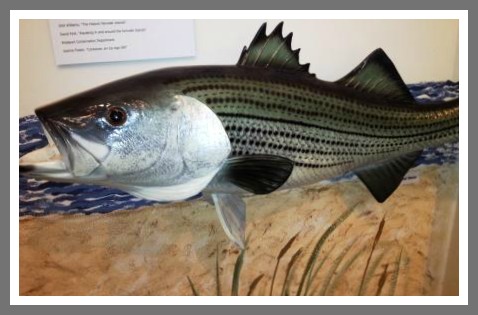
One small part of the WHS exhibit.

I never thought about the impact our bridges have on tidal floods, soil and water chemistry, and plant and animal habitats. Or the impact of the foul-smelling, polluting Riverside Avenue tannery that discharged waste into the river.

I did not understand how much the geography we believe is “natural” has been altered by dredging, damming, diversions and landfill.

There are panels on the glacial era, Indians, Dutch coastal exploration, shellfishing, maritime commerce, hydropower milling and manufacturing, modern recreation and more. In a nod to very recent history, there’s important info on the stormwater impact of Hurricane Irene.

And, of course, plenty on the amazing Sherwood Mill Pond.

A fantastic look back at the Sherwood Mill Pond.

There are shout-outs to our beaches (including oft-forgotten Burying Hill), marinas, islands like Cockenoe — and the Black Duck. (What was the barge before it served burgers and brew? A bait shop. And — don’t laugh — a dress consignment store.)

Back in the day, Compo Beach boasted portable bathhouses.

Speaking of the beach: I learned that in 1902 the town won a lawsuit asserting it — and not Compo Hill landowner David Bradley — had control of the beach. Seven years later, authorities demolished “unsightly shacks and tents in the Bradley Street section, dispersing vagrant squatters and rat-infested filth and trash.”

Now that’s the kind of historical exhibit I like!

“The Sound and the Saugatuck” covers the, um, waterfront. In fact, there’s only one thing missing:

No back story on the vessel mired in the Saugatuck River mud, just west of the Bridge Street bridge.

I’ve seen it for years. And, judging from many brief glimpses, it looks like it’s been there for centuries.

(“The Sound & The Saugatuck” runs through September 1 at the Westport Historical Society, 25 Avery Place. The WHS is open Monday through Friday, 10 a.m.-4 p.m.; Saturdays, 12-4 p.m. For information, call 203-222-1424.)

Cockenoe Island from the air — one of many amazing photos exhibited at the Westport Historical Society.
New York, New York: A Wonderful Start-Up Town

When the New York Times needed an entrepreneur to illustrate today’s story on the city’s increasing allure for tech start-ups, it turned to Doug Imbruce.

The 1999 Staples graduate “want­ed to start an in­ter­ac­tive video com­pa­ny in 2009, (yet) he had no luck find­ing in­vestors in New York,” Joshua Brustein wrote.

So he moved to Sil­i­con Val­ley — where ven­ture cap­i­tal­ists were re­cep­tive to his pitch — and found­ed Qwi­ki.

But in Feb­ru­ary, he de­cid­ed that be­ing so far away from the na­tion’s big me­dia com­pa­nies was sti­fling his start-up’s growth. So he moved back to New York, bring­ing the com­pa­ny with him. Qwi­ki, with 15 em­ploy­ees, now op­er­ates out of a So­Ho loft space.

Doug Imbruce

“We went to Sil­i­con Val­ley be­cause they un­der­stood how big we want­ed to get,” Mr. Im­bruce said, “and we moved back to ful­fill that prom­ise.”

The piece goes on to describe New York’s advantages over Silicon Valley — prox­im­i­ty to the me­dia, ad­ver­tis­ing and fash­ion in­dus­tries, for example (important now that the tech industry is focusing more on consumer products), as well as the “myopia” in the Valley.

Venture capital financing is changing too, the Times says.

When Mr. Im­bruce sought in­vest­ment for Qwi­ki in New York in 2009, his pitch fell flat. He did even­tu­al­ly find a Cal­i­for­nia-based in­vestor who of­fered to back the com­pa­ny, but on­ly if Mr. Im­bruce moved west and im­mersed him­self in the Sil­i­con Val­ley scene. He agreed, and soon found in­vestors to be much more re­cep­tive, to the tune of $10.5 mil­lion in fi­nanc­ing.

What even­tu­al­ly drew Mr. Im­bruce back to New York was the grav­i­ta­tion­al pull of the ma­jor me­dia com­pa­nies. Soon af­ter ar­riv­ing in New York, Qwi­ki be­gan meet­ing reg­u­lar­ly with ABC to dis­cuss how the net­work could use Qwi­ki’s tools. Last week, the two com­pa­nies an­nounced a part­ner­ship.

Memorial Day 2012: Westport On Parade

Happy Memorial Day!
Who doesn’t love a parade?

The start of the parade.

Al’s Angels — one of the many civic organizations to march (or ride).

The Y’s Men’s float was, as usual, spectacular. This one honored Korean War veterans — complete with freezing mist.

Middle school musicians keep the beat.

Buck Iannacone (left), this year’s grand marshal, poses with his son and granddaughter. Buck’s great-grandchild was born 10 days ago.

CLASP celebrated 30 years of service to people with disabilities.

Staples junior Tyler Jent sings “America the Beautiful,” framed by the doughboy statue and flag at half-staff.

The next generation celebrates past ones.

Lt. Col. Armas’ Compelling Memorial Day Video

On 9/11, Thomas Armas was a Marine. When the World Trade Center collapsed, most people ran for their lives. He ran toward it. Marines, he says simply, are trained to help.

Lt. Col. Armas went on to serve 3 tours of duty, in Iraq and Afghanistan.

Last week, he told his story on our high school’s TV show, “Good Morning Staples.”

Videos featuring service members are a Memorial Day tradition at Staples. Students in TV Production class spend long hours interviewing; selecting photos and music, and weaving together a compelling, instructive film, which is shown in every class.

The iconic photo of Thomas Armas, carrying a wounded woman from the World Trade Center.

This year’s video is one of the best.

With gentle prodding from senior JJ Mathewson, Armas describes that day at Ground Zero, and life in war zones.

But just as compelling are his insights into what it all means.

“People don’t give their lives for their country,” Armas says. “They give it for their hometowns.” That means, he explains, that Americans should have fun on Memorial Day. Going to the beach, a ballgame or barbecue is exactly why men and women have given their lives: so we can enjoy life.

However, he adds, we also have an obligation to give back.

Lt. Col. Thomas Armas during his “Good Morning Staples” interview.

As a Rye native — growing up in an environment very similar to Westport — he “was given the best childhood a person could have.” He gave back what he could by joining the military. He tells Staples students they don’t have to do that — but they should find some way to contribute to their community and their country, using their time and talents to better the lives of others.

The Staples Media Lab’s 2012 Memorial Day video is vitally important. It’s well researched, loving produced and richly rewarding.

It takes less than 15 minutes to watch.

But the lessons may last a lifetime.

Click below to view:

Planting Flags, Unearthing History

A Westport parent writes:

Dan, thanks for sharing stories about Westport’s Vietnam veterans.  It is essential for younger generations to be reminded of the bravery and sacrifices of our own townspeople.

I have to share with you the sense of pride expressed by the Westport Boy Scouts who spent 4 hours yesterday distributing flags to the graves of veterans all over town.

The Scouts were proud to honor these brave men and women, whose sacrifices helped safeguard our nation and allow it to grow in prosperity and security.

Assumption Cemetery on Green’s Farms Road looks great, thanks to local Boy Scouts.

To me, it was an incredibly important reminder of how history comes alive for our young people, and how much they marvel at and appreciate the sacrifices of those who came before them. I thank the VFW and Scout leaders for giving them this opportunity.

Some newer Scouts were surprised to discover that such a large number of Westporters have served our country in the armed forces, and wondered how many untold stories could be shared with their generation.  The boys also were impressed to see the physical resting sites of Wheelers and Sherwoods, and the founders of Staples and Bedford, whose contributions also resonate so strongly in their everyday lives.

We will visit the Westport Historical Society to find more information to answer their questions. And hopefully, when we march tomorrow morning, the boys will have the chance to talk with the veterans who, because of their service to our nation, are able to participate in the well-earned festivities.

Memorial Day To-Do List

Things to do tomorrow:

  1. Go to Memorial Day parade.
  2. Watch veterans, cops, bugle corps, kids/grandkids/random kids march; cheer for all.
  3. Gather entire family. Go to Veteran’s Green opposite Town Hall; find grassy spot.
  4. Turn off cell phone. Listen to speeches.
  5. Really, really listen to speeches.
  6. Find a veteran. Thank him or her.
  7. Go home. Enjoy the rest of the day.
  8. Oh, yeah. Pause from time to time to reflect.