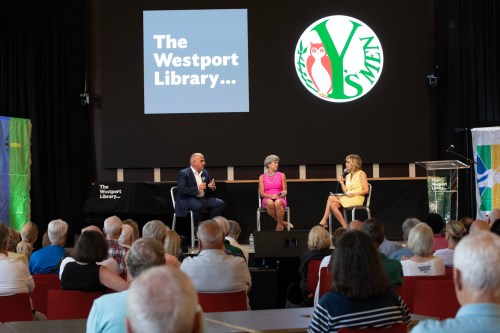
Clarence Hayes has lived in Westport for 6 years. A senior vice president in global technology at Bank of America, he manages its user-facing data networks, and associated $225 million budget.
He has been married for 39 years, and has 2 daughters and 5 grandchildren. Two attend Kings Highway Elementary School. He helps with after-school tutoring and swim team practice.
A gardener and amateur naturalist, he is very familiar with Westport’s natural habitat. He takes advantage of, and values, the town’s many amenities, including the beaches and parks, Longshore golf, pool and skating rink, Levitt Pavilion, Library and Earthplace.
But, Clarence wonders:
What is the Westport vision?
As a relative newcomer to town and recent follower of town events on this blog, I’d like to offer a general challenge to my new hometown: Set a long term plan, and be more ambitious.
What could Westport be like, not only for me in a few years’ time, but for my grandkids, and beyond that for my grandkids’ grandkids? We should have a 50- year plan. It should be visionary. The town can have something to measure its progress against every year.
I followed one of my daughters – with a couple of my grandkids in tow — when they moved to Westport 6 years ago. They show no intention of ever moving again, nor will I. This town has amazing assets. With continued improvement, I can imagine Westport as #1 on a “Best Places to Live in the USA” list.
What I observe in the debates over the Parker Harding Plaza evolution, and the Long Lots School direction, and numerous one-off Planning & Zoning Commission decisions, are piecemeal challenges confronting what appear to be irreconcilable differences of opinion. Parking vs. green space; a convenient sport facility vs. a community garden; new development vs. river views; pro-car vs. anti-car; etc.

Parking? Green space? What’s our vision — for downtown, and our entire town? (Photo/Susan Leone)
Of course, not all differences can be reconciled. Choices are required. But I think more of those differences could be reconciled, and a higher quality overall result achieved, if we were more ambitious, and made bigger decisions based on a long- term vision.
Bigger decisions could mean, for instance, instead of minor tweaking of access and marginal rearrangements of which piece of existing Westport property is paved or green, we could look at working with developers to exchange town property for jointly developed major changes.
For example: multi-story/underground parking; taking control of becoming compliant with state affordable housing mandates by the town co-investing and controlling those housing units to achieve some bigger contribution to Westport quality of life; complete conversion of downtown to pedestrian only (basically an outdoor mall more attractive than SoNo or Trumbull); reclaiming all of the waterside for public benefit with walking paths and green space designed across all of downtown which will be used more widely, as opposed to patchworks that sit idle due to lack of connection.
I could go on.
I’d love to see what my fellow citizens imagine as a visionary future; compare it to mine – and debate how to merge these futuristic visions into something that could unite a broad majority of voters around a feasible plan.

A few years ago, architects were asked to imagine the Westport of 2050. Mike Greenberg thought about a way the town could become more neighborhood-oriented. This is a detailed view of the Roseville/ Long Lots/North Avenue/Cross Highway quadrant.
Without such a comprehensive long-term plan, I think the town risks frittering away its comparative advantage, foreclosing opportunities with short-term decisions, and not getting maximum bang for the buck with town tax revenue.
I think it better to consciously define our “brand” and decide what we want the town to be — with ambitious goals — than to leave it to the ongoing happenstance of decisions constrained by short-term implications, and the sense that there isn’t money or a way to achieve something better.
Call to action: The selectwomen’s office, together with the Representative Town Meeting, formally institute a “Westport Vision” process that engages the public and is primarily driven by public input, and has the objective to:
- Document guiding principles for future development of the whole range of town assets – the “who we are” statement;
- Lay out a range of futuristic visions to challenge our ambitions – something to get excited about, and stimulate debate;
- Then, based on that vision, work backward to define and then prioritize ambitious steps that can be taken by relevant town boards and committees for action, to start that long-term journey.
Let’s make Westport the best place to live in the country, for us and our descendants.


 The purpose of an RTM meeting is to consider actionable items within the RTM’s purview. The purpose is not to provide a public forum for a discussion of any topic that 20 or more electors wish to discuss in a televised meeting in the Town Hall auditorium. There are other venues and forums for such discussions.