Tag Archives: Green’s Farms

Roundup: Susie’s House, A Better Chance, Playground Volunteers …

After months of renovations, Susie’s House reopens April 1.

The 124 Compo Road North residence is run by Homes with Hope. Named for former director Susie Basler, it provides stable, affordable living for 6 young women ages 18 to 26 who are homeless, or at risk of homelessness.

At Susie’s House they’ll get back on their feet through education and employment, eventually moving on to independent living. Each woman will have a mentor, community support and case management.

Community members are invited to a pre-opening tour next Saturday (March 22, 10 a.m. to 3 p.m.). To RSVP, email events@hwhct.org.

Susie’s House

==================================================

For nearly 25 years, A Better Chance of Westport has provided education, a home, mentors, and opportunities for a powerful future to smart, self-motivated, creative and very cool young men of color, from around the country.

It’s one of our town’s best non-profits. Hundreds of Westporters have volunteered, in a variety of important roles. And they’ve gotten as much from the ABC scholars as they’ve given.

The “Dream Event” is A Better Chance’s annual fundraising gala. Along with the food, drinks and auction items, there’s something more: inspiring speeches, from the current scholars, and those who have graduated and gone on to great success.

This year’s event is April 26 (6:30 p.m., Westport Library). Click here for tickets, and more information.

Then-current and past A Better Chance scholars, at a previous Dream Event.

==================================================

The renovation of the Compo Beach playground is just a few weeks away.

Just like during its construction in 1989, and first renovation in 2006, it’s a community project.

Whether you’re a parent whose kids use it, or used to when they were younger — or even if you have no kids’ connection to this great Westport attraction — organizers are looking for volunteers to help.

Professional builders, skilled volunteers, unskilled hands — all are welcome to sign up for slots.

All volunteers will receive a playground t-shirt! Breakfast, lunch and dinner will be served by community vendors.

There’s a “KidZone” on site for children (potty-trained, please!). 12- and 13-year- olds can help out there.

14-17-year-olds are welcome on the build site. They cannot handle tools, but there are many other ways to help.

Click here to snag a spot, and to learn more.

In 1989, scores of volunteers helped build the playground.

==================================================

Yesterday’s Roundup gave a shout-out to Thursday’s Westport Book Shop gala.

Since 2021, the Jesup Green store has provided jobs, training, and a great place in the community to people with disabilities.

One highlight of the Westport Library event was a short video. The stars are employees themselves.

They describe the confidence and joy they get out of serving customers, learning new skills, and earning a paycheck.

As the video notes, Westport Book Shop is a place where “people’s stories shine” — in countless ways.

Click below (or click here), to enjoy this powerful video, produced by Westport’s own The Visual Brand:

==================================================

I would not have thought there’s a lot of litter in the neighborhood around Greens Farms Road, Maple Avenue South and Clapboard Hill Road.

Then again, I don’t live there.

Dan and Nicole Donovan do.

Every few months, they take a walk with a garbage bag.

A large one.

Yesterday, their 1-mile walk yielded 10 pounds of trash.

Ten pounds!

Dan Donovan, with his Greens Farms neighborhood trash.

The most common item by far, Dan says, was alcohol bottles, with the little nips.

Thanks, Dan and Nicole, for picking up after so many inconsiderate folks.

It’s a good thing you don’t live near Compo Beach!

==================================================

Earthplace’s 4th annual Beer Garden (April 26, 4 p.m.) has something for everyone — of all ages.

Adults enjoy a self-guided trail walk with craft beer tastings, while kids sample sparkling drinks, and participate in arts and crafts.

The beer garden includes food trucks, s’mores, lawn games, and a selection of full-size beers available for separate purchase. Click here for tickets, and more information.

S’mores at the Beer Garden.

================================================

Weston Field Club has reopened.

The private club closed in November, after “financial irregularities” caused what the board president called an “existential crisis.”

With a new general manager, there’s an open house today (Saturday, 1 to 3 p.m., 38 Ladder Hill Road South, Weston). They’ll show off their facilities, and describe their programs like aquatics, racquet sports, trap shooting and camps.

Weston Field Club is also offering summer trial memberships, for $3,000 and $5,000. Click here for the website. Click here for more details, from Weston Today.

(Photo courtesy of Weston Today)

==================================================

Compo Beach is once again getting ready for prime time.

Crews are  redistributing and smoothing sand, in preparation for the can’t-come-soon-enough great weather.

This was the scene a couple of days ago, at South Beach:

(Photo/Matt Murray)

==================================================

The Aspetuck Land Trust is ready for an active spring, both live and online.

Lunch & Learn: “Assisted Plant Migration Helps to Expand Our Native Plant Palette for Climate Change” (March 28, 12 noon, Zoom webinar). How can we help plant species move north as temperatures rise? Explore the role humans play in helping move plants, as well as helping animals move more freely to aid in seed dispersal.

Plant Sale (Opens for Members April 4). ALT’s spring and fall native plant sales feature hard-to-find native plants, trees, shrubs and perennials. Plants are ordered online, and picked on weekends at the Caryl & Edna Haskins Preserve. Click here to join or renew membership.

Vernal Pool Walk with Edward Pawlak (April 12, 10 a.m., Trout Brook Valley Jump Hill Preserve; click here to register).

Earth Day Weekend Ephemeral Wildflower Walk with Vernal Pool Expert Anthony Zemba (April 19, 10 a.m., Trout Brook Valley Jump Hill Preserve; click here to register).

Anthony Zemba leads a wildflower walk.

==============================================

It may be a (sub)urban legend, but I’ve heard that Violet Lane is named not for the flower, but for someone whose last name was Violet.

On the other hand, today’s “Westport … Naturally” image shows that there indeed are violets on the small road off Myrtle Avenue.

(Photo/Sal Liccione)

Which raises these important questions: Is there myrtle on Myrtle Avenue? And was it named for the plant, or a woman called Myrtle?

==================================================

And finally … in honor of Westport’s violets (story above):

(There’s a mystery about Violet Lane. But there’s none regarding “06880.” We’re your hyper-local blog, here for you 24/7/365 — and we rely on you for support. Please click here to help. Thanks!)

Friday Flashback #404

Among Bill Scheffler’s many hobbies, one of the most interesting — for “06880” readers, anyway — is his collection of postcards.

Dating back to days when they were simple, inexpensive means of communication (and perhaps demonstrating, long before social media and FOMO, that the sender was having a great time), Scheffler’s postcards show scenes of Compo Beach, the Post Road, and a variety of inns.

There are also many private homes. Occasionally they bear names; more often, just an identification like “Greens Farms” or “Saugatuck.”

Here are 3. Most likely, the handsome houses succumbed long ago to the teardown trend.

But if you recognize any of them — or know their back story — click “Comments” below.

“Residence of Jas. Dunne, Sr., Greens Farms, Conn.”

“Residence of Mrs. H. B. Hobson, Green (sic) Farms, Conn.”

The simple message on the other side of the Hobson card, 104 years ago.

There is no identifying information on this postcard. However …

… it was mailed in 1911 from Saugatuck, to “Miss D. Adams,” in Greens Farms (no address given). Could she be related to the Adams Academy family, who lived on Long Lots Road? Or was she Dorothy Adams, longtime principal of the Bridge Street (later Saugatuck) Elementary School?

(Friday Flashback is one of “06880”‘s many regular features. If you enjoy this — or anything else on our website — please consider a tax-deductible contribution. Just click here. Thank you!) 

Rivers Ran Through It

It’s been 3 days since Saturday’s rain.

The few-hours-long deluge wasn’t a particularly significant weather event — not compared with, say, Superstorm Sandy or Hurricane Isaias.

But it was enough to flood much of Westport.

Nyala Farm

72 hours later, it’s easy to forget the rivers and streams that overflowed their banks, the waterfalls that cascaded out of nowhere, and the soggy basements.

But — as several residents have pointed out — what happened after a couple of inches of rain is really our new normal.

Muddy Brook, at Greens Farms Road.

Construction that changed the natural topography of our town, the felling of trees, the installation of pavement — all contribute to more (and more dangerous) floods in Westport.

Water needs someplace to go. We can either help it, or let it run its course.

Nico Eisenberger and Robin Bates have lived in Westport for 10 years. When there’s a big rain, Robin heads out to see how all the little rivers and ponds — some hidden, some not — take on new forms.

On Saturday, Nico says, “we saw some of the biggest changes we’ve ever seen here. I know there have been bigger wet weather events,  but this was definitely up there.”

Here — before the weekend recedes too far in the rear view mirror, and also before the next rains — are a few reminders that, in the memorable phrase: “Mother Nature bats last.”

Kowalsky Farm on Clapboard Hill Road. (All photos/Robin Bates)


“06880” Podcast: Art Schoeller, Greens Farms Association President

Greens Farms is where Westport began, over 300 years ago.

It’s changed a lot since then. But Greens Farms is still a neighborhood of open spaces, water and woods.

That it’s remained that way — despite the addition of a railroad station, private school, and the town’s first large complex — is due in large part to the vigilance of the Greens Farms Association.

The other day, I chatted at the Westport Library with its president, Art Schoeller, about his role, his neighborhood, and his town. He offered an inside look into what it takes for a community to retain its character. Click below to watch:

(“06880” is a blog — and a podcast. To support our work, please click here. Thank you!)

Painting The Town Yellow

Debra Kandrak’s one-woman crusade to paint the town yellow is paying off beautifully.

Every autumn for 4 years, she has used a wide variety of outlets — social media, emails, and of course “06880” — to encourage Westporters to plant daffodils.

She brings her message to friends, strangers, town organizations and committees and businesses.

Her ask is simple: “Paint the Town Yellow.”

Every spring around this time, we are blessed with the results of her — and their — work.

This year, the gorgeous yellow flowers are everywhere.

From neighborhoods like Greens Farms to the Westport Library, around mailboxes and street signs, by the Cribari Bridge, in traffic islands and at the entrances to Staples High and Bedford Middle Schools, Debra’s yeowoman efforts pay off for all of us.

As perennials, each year brings more and more explosions of color. Here are just a few examples of Debra’s efforts:

Near the police station.

Jesup Road

Imperial Avenue.

Compo Beach.

Sherwood Island Connector.

Weston Road, near Cross Highway.

Nevada Hitchcock Garden, Weston Road and Cross Highway.

Debra Kandrak’s adopt-a-spot, on Prospect Road and Greens Farms Road.

Debra Kandrak’s own Greens Farms barn …

… and her garden.

(“06880” is often inspired by Westport’s beauty. If you’re inspired by our hyper-local blog, please click here to contribute. Thank you!)

Friday Flashback #343

Last week’s Friday Flashback showed Ken Montgomery’s Old Mill store — one of several predecessors of the current Old Mill Grocery & Deli.

It had been his mother’s market. He joined her, after his original place — on the corner of Bridge Street and Compo Road South — was demolished, to make way for the new Connecticut Turnpike (now called I-95).

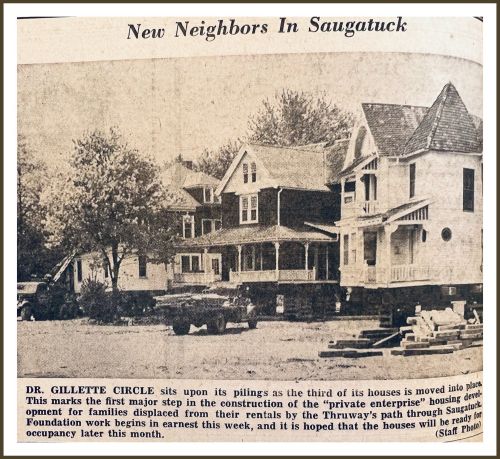
I’d never seen a photo of it. Then, just days after that Friday Flashback, Pamela Docters posted an old Westport Town Crier newspaper clipping on Facebook:

As the caption notes, Ken wanted to move the “retail landmark” to property he owned opposite the old Saugatuck Elementary School (now The Saugatuck co-op housing complex). His request was denied.

The caption also says that he hoped to return with a new store once the highway was finished.

That never happened. But the Old Mill store was good to him.

And Ken was good to his town. When he died, he left a $500,000 gift to the Westport YMCA.

Pamela posted a couple of other fascinating doomed-by-the-thruway photos.

This one, from June 7, 1956, shows houses moved to Dr. Gillette Circle.

Dr. Gillette Circle is off Davenport Avenue, which itself is accessed by Ferry Lane West off Saugatuck Avenue — adjacent to I-95 Exit 17.

Indian Hill Road — also part of the neighborhood — is now sliced in two by the highway. It once connected, all the way north to Treadwell Avenue.

Dr. Gillette Circle is once again buffeted by change. The 157-unit Summit Saugatuck development is a few yards away, on Hiawatha Lane Extension.

As for I-95, recent state Department of Transportation work has radically altered the landscape first created when the turnpike was built. It took 70 years for trees and vegetation to grow. Now it’s all gone.

Of course, as thruway construction took place Saugatuck was not the only neighborhood affected. Another photo posted by Pam shows a Greens Farms home — already 125 years old — being moved 700 feet away from the new route’s right-of-way, to Turkey Hill South.

The Connecticut Turnpike cut a wide swath through Westport. It changed Saugatuck forever, and made an enormous impact everywhere else.

Three-quarters of a century later, most of us cannot imagine life here without it.

But there are still Westporters, and former residents, alive who do.

(If you enjoy our Friday Flashbacks, please consider supporting “06880.” Click here — and thank you!)

Unearthing History

Who is buried at Burying Hill Beach?

Local lore says it’s Native Americans.

Dr. Robert Liftig isn’t so sure.

A writer and teacher who has lived in Westport for almost 50 years, he recently retired after 4 decades as a Fairfield University professor. His courses focused on local Colonial history.

He’s done quite a bit of, um, digging, The small Greens Farms beach is beloved by many. Like others throughout town, they’ve often wondered about its name.

Burying Hill (top-center), and beach of the same name. (Drone photos/Brandon Malin)

First, some background.

In 1637, a band of Pequots — burned out of their Groton home — were chased by English settlers to a swamp between what is now the Southport Dunkin Donuts and Equinox. (A small memorial commemorates the Great Swamp Fight, the last battle of the Pequot War.)

They were burned and hacked to pieces in what Liftig calls the continent’s “first intentional genocide.” (A leader, John Underhill, is the man for whom Underhill Parkway is named.)

With the area safe for colonists, Thomas Newton, John Green and Henry Gray obtained a land grant to settle the area in 1648. Daniel Frost and Francis Andrews joined them soon. Andrews came from upstate; he, with Thomas Hooker and others, had founded Hartford in 1635.

The group were known as the Bankside Farmers (for Bankside, England, where some of the 5 came from). The area was later named for one of those 5: Greens Farms.*

An early map of Green’s Farms. The Bankside Farmers’ lands ae shown on Long Island Sound, next to “Burial Hill.”

Andrews hired a servant: 12-year-old Simon Couch. A few years later the boy married Andrews’ daughter Mary. He worked as a tailor, ran a horse saloon, and bought Andrews’ widow’s farm. At his death in 1688, age 53, Simon Couch was a wealthy man.

He also bought Forest Point, a “beautiful hill overlooking the sea.” It became a cemetery — perhaps for Andrews, along with Couch himself, his family, and some of their slaves. (It is unclear whether those slaves were Blacks or indigenous people.)

Liftig cites an excerpt from the book “History of Fairfield.” Simon Couch was

buried in land belonging to him at Forest Point, looking out upon the Sound, which he had set apart as a family burial place and which was long known as the Couch Burial Hill.

This spot could be pointed out until within the last few years [date of publication unknown], but now almost every trace of the tombs & graves have been obliterated.

Liftig believes Andrews — one of the founders of Hartford — is also there: buried below where the beach toilets are now located.

Bathrooms and lifeguard offices, at the top of Burying Hill. (Photos/David Squires)

Simon Couch, meanwhile, is listed on Find A Grave as occupying “Plot #1.”

When Green’s Farms Congregational Church established its first cemetery (at the current corner of Greens Farms Road and the Sherwood Island Connector) in the early 1700s, subsequent Couches were buried there. (One stone honors “Thomas Couch lost at sea, taken by French or pirates.”)

The family grew quite wealthy, from the triangle trade. One branch moved to North Carolina. Another Captain Thomas Couch married into the Boone family, and moved to Kentucky.

Liftig has found that the Couches — and Daniel Boone — are related to his daughters Anya and Dorothy.

Liftig himself grew up in Avon, Connecticut. He joined the Peace Corps, met a “pretty Kentucky girl,” and married her. They moved to Westport.

Delving into the history of his town, he was stunned to find that his wife’s ancestors lived here.

He was even more surprised to learn of the Couch connection to Burying Hill Beach. His daughter Dorothy had a summer Parks & Recreation job, working at the front gate.

The entrance to Burying Hill now floods often. (Photo/Sally Fisk)

Parks & Rec administers the beach because in 1893, the town of Westport purchased the property for a picnic area. Ten years later, they added the swale nearby (called “Ye Olde Battleground”) — between the “burial hill” and what later became the Bedford (and later Harvey Weinstein) homes.

The Couches later married into the Bedford and Jesup families, Liftig says.

But when he inquired about the possibility of a plaque memorializing the bodies buried in the hill — including, possibly, a founder of Hartford — he was told there is no proof.

Cars should not drive on Burying Hill. It is a historic burial ground. (Photo/Rusty Ford)

Yet an old Westport Historical Society publication, “Buried in Our Past,” says:

We can surmise that the Couches shared the hill with some of the early settlers — the Greens, Andrews [sic], Frosts and Grays.

In his book “Greens Farms,” George Penfield Jennings, states he remembers seeing many gravestones on the hill, but by the time the State Legislature established the area as a town park in 1893, only one broken marker remained.

Now that marker is gone. Burying Hill has the distinction of being the first park on the Connecticut shoreline recognized by the State.

Neither Parks & Rec, the Westport Historical Commission nor the Westport Museum for History & Culture confirms Liftig’s findings.

But he is convinced: The burials in Burying Hill Beach are real.

And historic.

(Dr. Robert Liftig can be contacted directly: boblif@aol.com)

*Should there an apostrophe, making it Green’s Farms? That’s been a question ever since. 

(There’s plenty of history in Westport’s hills and beaches. “06880” unearths it all. Please click here to support our work. Thank you!)

There Goes The Neighborhood

Sure, you live in Westport.

But you also live in Greens Farms. Maybe Coleytown. Or Saugatuck.

Those are a few of the neighborhoods that make up our town. Some are long established, predating our founding in 1835. Some are newer, the result of growth or realtors’ whims.

All are part of ‘06880.”

Karen Scott knows Westport neighborhoods as well as anyone. A co-founder of KMS Partners @ Compass, the other day she took me on a (phone) tour of town.

The Mid-Fairfield County Board of Realtors defines 13 distinct Westport neighborhoods. Besides the 3 mentioned above, there are a few everyone recognizes: Old Hill and Compo Beach, for example. Some are less well known, like Red Coat in the far northwest, Long Lots, Roseville/North Avenue and Compo South (see map below).

(Map courtesy of Mid-Fairfield County Board of Realtors)

A couple are new. Hunt Club (from the Fairfield border and Cross Highway west to Bayberry and south to the Post Road) and Compo Commons (the smallest of all, more commonly known as Gault).

But 2 caught my eye. One is In-Town. The area between the Merritt Parkway, Saugatuck River, Post Road and Roseville Road — with, among others, North Compo and all its side streets — has, with the influx of families from Manhattan and Brooklyn, suddenly become very desirable.

They like the proximity to downtown — they can walk there in theory, if not practice. Until recently though, no one lived “In-Town.” They just lived “close to town.”

Washington Avenue, an “In-Town” neighborhood. (Photo/Google Street View)

The other relatively new name is “Saugatuck Island.” When I was a kid, there was just “Saugatuck Shores.” (And houses there were among the cheapest in Westport. Some were not winterized. Who wanted to live way out there, anyway?!)

But a while ago — no one is sure when — some residents living beyond the wooden bridge decided to become even more exclusive than what had then become the already prestigious Saugatuck Shores.

Hence “Saugatuck Island.” One long-time and embarrassed resident cringes every time she hears it. But there it is, complete with a large sign at the entrance. (Fun fact: No other Westport neighborhood has an actual “entrance.”)

(Photo/Gene Borio)

Karen Scott says that neighborhoods are a good way to describe Westport. “Everyone has preferences,” she notes. “Some people want land, not neighbors. Others don’t want a lot of land. Some prefer near the beach, or close to town. Some want to be close to amenities. Some want to be close to the train station, I-95 or the Merritt” — though with COVID, commuting convenience is less of a concern these days.

The hot real estate market has cooled the “neighborhood” concept a bit, she says. “When there aren’t a lot of homes for sale, some people say, ‘I don’t care. I just want to be in Westport.'”

The neighborhood concept itself has evolved (and become more formalized). At one time, Karen says, areas of town were designated by school districts. (That was probably easier when there were 3 junior highs — Bedford [now Saugatuck Elementary School], Coleytown and Long Lots — rather than just 2 middle schools, located a mile from each other.)

The Long Lots neighborhood has been “sub-divided.” It now includes the Hunt Club area.

As a realtor, Karen Scott is used to describing Westport’s 13 “official” neighborhoods, then squiring clients around to those that sound interesting.

Some buy in neighborhoods they took a quick liking to. Others end up in ones they did not originally consider.

But for all its different neighborhoods, Westport is really one big small town. And most people, Karen says, find “joy and happiness” all over, once they’re here.

Wherever that is.

Friday Flashback #237

As the real estate market continues to sizzle, Seth Schachter sends a couple of reminders that Westport has long been a favored destination.

And that realtors have long used lots of prose to sell homes.

The September 1925 edition of “Country Life” noted that “Amid century old trees … there is an old Colonial home available to him who seeks the peace and seclusion of the old order, together with the improvements of the present day.”

The 9-room, 2-bath (!) house featured old-fashioned fireplaces. However, it was also “equipped with electricity.”

The property included a large barn, old smokehouse and trout stream. Plus, of course, 49 acres of woodland and open fields.

All yours, for just $27,500.

Much has changed in the past 96 years. For example, Westport is now further from Grand Central than 75 minutes.

A second ad, also from “Country Life,” highlighted a “Charming Island Estate in the exclusive residence colony at Green’s Farms, Connecticut.”

The 35-acre waterfront property boasted 2 houses, “large stone garage with housekeeping apartments for chauffeur and gardener,” a stable, large poultry plant, piggery, well-stocked aviary, greenhouse and boathouse; beautiful sunken garden, extensive vegetable garden, and broad, sweeping lawns, meadows and wooded land.

The main house, with 6 mater bedrooms, had 4 servants’ rooms (in a separate wing). The smaller included 3 master sleeping rooms, plus double maids’ rooms.

The clincher: “Owner wiling to divide if required.’

Pics Of The Day #1183

A collage of Greens Farms traffic islands (Photo/Bob Weingarten)