TEAM Westport Teen Essay Contest Winners Tackle Racism

When TEAM Westport announced the topic for its 9th annual Teen Diversity Essay Contest, a small group had their say. They did not like it.

Now the high school students have had their say.

They responded to the prompt —

In 1,000 words or fewer, describe what you would like to explain to people in your community who avoid or struggle with talking about race, or acknowledging system racism, or who apply a “color blind” approach to issues —

with passion, power and insights.

The contest was open to anyone in grades 9-12 who lives in Westport, or attends a public or private school here. An awards ceremony was held last night, at the Westport Library.

Junior Ian Patton won 1st place — and $1,000 — for his essay, “How to be a Good White Person.”

Patton writes: “The white presence, even if it’s not in the majority, is the baseline, the standard. White people living within this society don’t have to do any work to figure out their identity. They can live comfortably without thinking about race.”

Being white, he says, “allows me to expect certain treatment and be unaware, or ignorant rather, of the feeling of being treated as less than.”

Patton adds: “When we lash out or shut down after being made uncomfortable, that is evidence of the work we have to do. And white discomfort is dangerous. It’s what causes so many potential allies and accomplices to shy away from activism. lf we can’t handle being held accountable, and if we can’t learn about our history and reality without feeling personally attacked, we are useless to the fight against white supremacy.”

TEAM Westport Diversity Essay Contest winner Ian Patton (3rd from left) with (from left) 1st Selectwoman Jen Tooker, Staples High School principal Stafford Thomas, TEAM Westport chair Harold Bailey Jr., superintendent of schools Thomas Scarice, and Westport Library director Bill Harmer.

Second place — and $750 — went to junior Colin Morgeson. Describing himself as of “white and minority descent,” he tackles the fraught topic of critical race theory.

“Tribalism,” he says, “naturally leads people to avoid race-related discussions.” But “racism is an illness, an affliction of the soul that our country has long struggled to vanquish, and a disease that will probably never be completely eradicated.” To treat it, “citizens need to make an active effort, and this begins with awareness of systemic racism and its effects.”

We need humility, level-headedness and compassion when talking about race, Colin writes. And “through discussion, we take the first step into becoming the heroes of our stories.”

Sophomore Leigh Foran won third place, worth $500, for “Embracing Privilege to Tackle Racism.” (An hour earlier, she won 1st place: in the mile, for the Staples track team.)

She says, “Many white people feel that privilege undermines their success and is solely meant to put them down. But using this discomfort to avoid conversation impedes progress.”

Conversations about race are not meant to “expose” white people, Leigh writes. A “color-blind” approach to combating racism won’t work. And, she says, having white privilege is “not a character flaw.” However, “learning to embrace conversations, instead of denying the discomfort, is a step more of us can take.”

Essay winners (from left) Leigh Foran, Colin Morgeson and Ian Patton.

You can read — and reflect on — the 3 winning essays below. (To read the winners of all 9 TEAM Westport essay contests, click here.)

1ST PLACE: “HOW TO BE A GOOD WHITE PERSON” (Ian Patton)

I don’t identify with my race. My whiteness is inherently a part of who I am and
how I move through the world, but the way I see myself, mind and body, has next to nothing to do with my race.

When I look in the mirror, I recognize my face, my hair, my
skin. But I don’t see whiteness.

This isn’t a claim that I’m somehow race-blind. There’s a difference, for me at
least, between identifying with your race and identifying as your race. The former implies a deeper connection to the label, one that means the additional connection to a community.

But whiteness doesn’t come with a community. We have the ability to ignore
our race and develop a cultural identity completely separate from it simply because we are treated as the default. We see people that we’ve been taught to think look like us everywhere, and they see us as “like them.”

That’s part of what it means to live in a white supremacist society. The white presence, even if it’s not in the majority, is the baseline, the standard. White people living within this society don’t have to do any work to figure out their identity. They can live comfortably without thinking about race.

Ian Patton

We don’t have to think about race. That’s an opportunity afforded uniquely to
white people. We’re intrinsically seen as complete individuals, but this construction of identity separate from race means that we lose individual facets as well as the access to a community. The construct of race benefits us, and so questioning it doesn’t come naturally, and most importantly, it’s uncomfortable.

Given a head start and an advantage in every walk of life, we’re desensitized to the feelings of white privilege. I notice it when I’m taught by a nonwhite teacher, and suddenly whiteness doesn’t dominate the classroom. I notice it when looking at a collage of presidents, and the 44th stands out while the others spark no reaction. I notice it when I hear someone I know say something racist, but I don’t know how to respond.

My whiteness allows me to expect certain treatment and be unaware, or ignorant rather, of the feeling of being treated as less than.

Essentially, white thresholds of comfort are much different from systematically
oppressed racial minorities’, especially when it comes to discomfort around race- related topics. Being able to discuss and think critically about race is a skill, one that doesn’t come naturally because race isn’t natural.

Non-white people gather a lifetime’s worth of personal experience that makes them experts on racism, and by extension experts on white people. On the flip side, white people can safely live without caring about systemic racism. We can live our entire lives and still be uninformed.

The white experience doesn’t enable its people to understand race, it just enables us to enforce racism on to the next generation. We have lifetimes of experiences that teach us to, subconsciously or consciously, view people who look different from us as different from us.

Challenging these implicit biases is difficult for everyone, but especially white people who haven’t fully worked through their own relationships with race. We have to acknowledge that our brains are wired in ways that hurt entire communities, but that can easily trigger fragility responses. Especially when our ignorance causes harm to the people of color around us.

When we lash out or shut down after being made uncomfortable, that is evidence of the work we have to do. And white discomfort is dangerous. It’s what causes so many potential allies and accomplices to shy away from activism. lf we can’t handle being held accountable, and if we can’t learn about our history and reality without feeling personally attacked, we are useless to the fight against white supremacy.

White people, you don’t have to be perfect at everything you do. ln fact, wanting
to be the perfect white person is a symptom of white supremacy. But you can want to be good. What you need to do is understand that your imperfections are going to cause harm. Your mistakes will cause harm. And the first step towards improving yourself is to look at yourself and where you’re lacking.

Work through your thoughts, and feelings, and traumas, and prepare yourself for the hard conversations, the conversations that need to happen. White people as a community need to come together and help each other through our racism. We need to reclaim our own identities beyond and through our whiteness, so that we can live and work as fuller human beings. We need to call each other out on our racism, because we’re the ones who won’t be hurt by the microaggressions and self-defensiveness that follows.

Racism was created by people who look like us, so we need to do the work and fix it. lt’s a responsibility.

=======================================================

2nd PLACE: “VILLAINS OF OUR STORIES” (Colin Morgeson)

“What’s wrong with talking about race?”

It was an ordinary lunch period at Staples High School, and on this particular day, my friend and I had elected not to share amusing stories or interesting developments from our lives; no, instead we had decided to discuss racism and education.

For the past 10 minutes, I had been trying to understand why he was adamantly opposed to schools teaching kids about inequalities present in society today. If today’s kids are soon entering such a society, what should stand between them and learning about topics related to the very nature of their world?

My friend was quick to answer my aforementioned question: “Because kids shouldn’t be taught to hate each other.”

The entire discussion had been prompted by a rather contentious subject: critical race theory. You’ve heard about it in the news, or maybe you’ve seen the signs around town, or maybe you’ve even been vocal about your belief on whether or not it belongs in the classroom.

CRT is a simple concept: Race is a social construct, and racist elements are present in American institutions. I’ve always found the debate around CRT uniquely fascinating, because no matter your stance on the issue, everyone seems to agree that it’s an especially divisive issue. Such a simple concept has long been the subject of nationwide debates, and even today, politicians move
to ban CRT from their states’ school curriculums. Clearly, the subject strikes a very particular chord with the masses, triggering particularly potent emotions.

Both my friend and opponents of critical race theory place focus on the inherent ties between societal racism and pride. Indeed, as humans, conversations about our race — people that look like us, people that have experienced things like us, people that are treated like us –-have a certain gravitas, naturally prompting us to defend the honors of those that are similar to us, and it is from this that concerns of “hating each other” spring.

When white people read about the legacies of the Founding Fathers falling under question, it’s only natural that their collective sense of pride feels under attack. When minorities read about the persistence of the wealth gap, it’s only natural that pride compels them to feel indignation.

As someone of both white and minority descent, I’m fortunate enough to have been exposed to multiple sides of racial issues, but large swaths of the population exist in more homogenous communities. For someone who’s spent their entire life surrounded by people like them, why wouldn’t other racial groups become
the villains of their story?

This complex, conflict-prone landscape of tribalism naturally leads people to avoid race-related discussions entirely. But should they?

Racism is an illness, an affliction of the soul that our country has long struggled to vanquish, and a disease that will probably never be completely eradicated. It certainly won’t vanish of its own accord; no, in order to properly treat it, citizens need to make an active effort, and this begins with awareness of systemic racism and its effects.

The wealth gap, hate crimes, and police brutality won’t disappear with plenty of water and a good night’s rest; no, citizens need to be aware of these issues, and awareness is born from discussion. Without discussion, without acknowledgement, without action, we allow the malady to roam unchecked, spreading through the cells that are our communities and taking root in the body that is the United States of America.

Whether we like it or not, the illness will continue its merciless rampage, and the
symptoms will persevere. Every now and then, a flare-up will occur, temporarily drawing attention towards some poor soul who has been gripped by the disease.

Of course, this can’t go on forever: such an ailment is unsustainable. Do you know what happens when an infection goes untreated? Catastrophe.

If pride serves to inflame the disease, then perhaps the proper anti-inflammatory agents in our conversations are humility, level-headedness, and compassion. People shouldn’t be taught to hate each other, but that doesn’t mean we can’t acknowledge the world we reside in, faults and all, in order to make it better.

My friend has reservations about the teaching of systemic racism in our schools, but as someone who represents a racial minority himself, he recognizes the need for our society to commit to fighting discrimination. Furthermore, his willingness to share his views and experiences with me proves that despite concerns of divisiveness, he accepts the need to communicate about race in an environment he knows is receptive.

Indeed, talking about societal racism is essential, and though it’s not always easy, a proper approach can turn potential divisiveness into productivity. Through humility, we can accept the reality of our world, past and present. Through level-headedness, we can understand that it’s our actions that ultimately define us. Through compassion, we can empathize with the plight of others, and seek to cure our world as best as we can. Through discussion, we take the first step into becoming the heroes of our stories.

=======================================================

3rd PLACE: “EMBRACING PRIVILEGE TO TACKLE RACISM” (Leigh Foran)

I don’t think we can talk about race without talking about privilege. Without exploring the extensive systematic disparities and historic inequities that have plagued people of color for centuries. Because privilege is both a cause and effect of racism, genuine conversations about race inevitably coalesce into deeper discussions. They force people to acknowledge their own privilege, and this can be an uncomfortable and jarring experience. As such, conversations about
race can be difficult because recognizing privilege can feel like a personal attack.

White privilege has been a long-standing fixture of American society. However, many people get defensive when the conversation tums to this topic. I recently heard a parent in town express his concern that discussing the idea of white privilege in school would make his children question themselves. He said, “I don’t want them feeling bad because they’re white.”

I was disappointed when I heard this, because his perspective represents a widely held misconception. Many white people feel that privilege undermines their success and is solely meant to put them down. But using this discomfort to avoid conversation impedes progress. This type of thinking prevents people from coming to grips with the reality of white privilege; we have to break through these fears to have meaningful discussions.

To prompt more people to join in on the conversation, I think it is important to acknowledge the following truths:

First, conversations about race and privilege are not meant to “expose” white people. These discussions may feel like a direct attack on oneself, one’s achievements, or one’s success. But in reality, having conversations about race and privilege isn’t about vilifying advantaged groups.

In her groundbreaking essay “White Privilege: Unpacking the Invisible Knapsack,” Peggy Mclntosh writes, “I have come to see white privilege as an invisible package of unearned assets which I can count on cashing in each day, but about which I was ‘meant’  to remain oblivious.”

Nowhere does she imply that acknowledging privilege is meant to demonize white people. A conversation about race is not a personal attack; instead we can use this dialogue to understand privilege. This will allow us to develop a more equitable community.

Second, the ironic quality of privilege is that its absence triggers our awareness, not its presence. Mclntosh calls white privilege “an invisible weightless knapsack of special provisions, maps, passports, codebooks, visas, clothes, tools and blank checks.” People who have privilege oftentimes aren’t aware of the way it helps them, oblivious to the unearned advantages they have over others. But people of color are very aware that they lack the same resources and face more implicit bias than their privileged counterparts. Knowing this, conversations are essential to understanding one’s own privilege.

Leigh Foran

Third, conversations about race are not complete without acknowledging privilege — the ways race disadvantages some while it puts others at an advantage. Most people are outraged by the blatant ways race can be a disadvantage – how people of color are subject to atrocious hate
crimes.

But a holistic approach to stopping racism also requires solving a more subtle problem, one of privilege. A true commitment to rooting out systemic racism takes more than outrage at hate crimes — it takes acknowledging and talking about privilege.

This is largely why the “colorblind” approach to combating racism doesn’t work. It fails to address the inherent advantages certain groups in society possess. By viewing everyone as the same, we ignore how white Americans enjoy privileges denied to people of color. We will fall under the false impression that we live in a meritocratic society, unable to address the inequitable impacts of privilege.

Fourth, the silence surrounding privilege is the key problem here. Constant denials and stigmatization of the issue keep privilege invisible, an unseen contributor to the vast systemic racism present in American workplaces, educational facilities and communities. But we can use conversation to remedy this and shatter the silence.

There is a burgeoning need for more conversation about race. Most people who have privilege aren’t aware of it; so we can create a more conscientious community by discussing the social, political, economic and cultural impacts of privilege.

Finally, having white privilege is not a character flaw. Like the father who was concerned about his kids, discussing privilege makes too many people feel like a figurative finger is being pointed at them, accusing them of perpetuating bias and hatred. They get defensive, and reject the assumption that they are apart of the problem. It’s time to change the way we see privilege.

Conversations are not meant to blame or call people out — they help us understand the causes and impacts of racial inequity.

In spite of all this, so many approach conversations about race with emotionally charged opposition and discomfort. This form of defensiveness hinders the conversation, making it harder to explore privilege and combat racism through civil discourse. Some deny the existence of privilege, citing that many white people have struggled and worked hard to achieve success. But the idea of privilege is not meant to undermine the fact that many white people have overcome difficulties and worked hard to earn their achievements. Simply put, privilege is a congenital advantage, separate from what someone earns or achieves during their lifetime.

It’s easy to decry hate crimes or to make a social media post condemning racist violence. But this is not enough. Too many hide behind the superficial mask of outrage, but don’t take action. Addressing the systemic racism in our society requires a deeper response, and we can use conversation as the starting point in fighting privilege and driving systemic change. We cannot achieve the next phase of racial equality without conscious, purposeful involvement. Learning to embrace conversations, instead of denying the discomfort, is a step more of us can take.

Conversations about race expose privilege, and having the courage to engage is crucial.

Pic Of The Day #1813

Beauty, simplicity — and the colors of Ukraine — at Temple Israel Friday night services. (Photo/Lauri Weiser)

Long Lots Welcomes A Hero Home

It’s always fun to return to your old elementary school.

Especially if it’s as an Olympic champion.

Fifteen years ago, Julia Marino was a Long Lots student. This morning — now an Olympic silver medalist — she was back.

Before the assembly, Julia and her mother Elaine posed with an “Einstein” costume the Olympian wore in 3rd grade.

Energy was high, as nearly 600 students, staff, central office administrators and PTA members gathered in the auditorium for the first school-wide meeting since COVID struck 2 years ago.

With the Olympic theme playing and Mark Carmody — her former phys. ed. teacher, still at the school — serving as host, Julia came on stage to thunderous applause.

Host Mark Carmody read student questions. Julia Marino answered them all, with honesty and humor.

Video clips showed Julia on her 2nd spectacular slopestyle snowboard run. Students also saw her great display of sportsmanship, piling on the New Zealand athlete who had just edged her out for the gold medal.

“Everyone wants to win. You go to the Olympics to get gold,” Julia told the crowd.

“But it’s so important to be there for your friends. Even if they do better than you, it’s great to support them.”

Superintendent of schools Thomas Scarice and Julia’s mother Elaine enjoyed the assembly.

Julia answered students’ questions too. They ranged from the names of former teachers, her birthday (September 11) and whether she’s married (no) to her favorite part of the Olympics (“hanging out with my friends from different countries”), what she’d do if she weren’t snowboarding (film and photography), her favorite subjects at Long Lots (PE and art), whether she’s still friends with Long Lots kids (yes!), her other sports (soccer, basketball, softball, skateboarding and more), her favorite video games (Nintendo Switch and Mario Kart), her biggest challenge (overcoming fear of hitting big jumps), and advice to new snowboarders (“get butt pads — you’ll fall a lot”).

After gifts of flowers and a Long Lots swag bag, principal Kim Ambrosio unfurled a sign honoring the Olympic champion. It will hang in the gym.

Principal Kim Ambrosio (far right) and the new sign.

The assembly ended with Julia joining in, as students sang the school song.

Once a Lion, always a Lion.

Julia Marino’s 5th grade writeup, in the Long Lots yearbook. How many elementary school students’ dreams come true?!

Roundup: Salad Winners, Staples Fencers, SpongeBob …

=====================================================

Over 1,000 salad-eaters cast votes in the Westport Weston Chamber of Commerce’s month-long Great Westport Salad Contest.

And the winners are …

  • Best Caesar Salad: Romanacci
  • Best Chef Salad: Joe’s Pizza
  • Best Cobb Salad: La Plage
  • Best Deli Salad: A&S Fine Foods
  • Best Greens Salad: The Porch
  • Best Make Your Own Salad: Parker Mansion
  • Best Mediterranean Salad: Manna Toast  
  • Best Unique Salad: Capuli.
  •  Honorable Mention (coming within 5 votes of the winner): Calise’s

Winners received plaques to hang. Each winner will also offer a free  salad to eight lucky voters who won the lottery in the category they voted for.

=======================================================

Ruth Steinkraus Cohen was a remarkable woman.

A Juilliard-trained pianist and teacher; a singer, editor, radio host and activist; secretary to Eleanor Roosevelt at the World Federation of the United Nations Association; founder of the International Hospitality Committee of Fairfield County, and Westport’s jUNe Day celebration; publisher of the worldwide “United Nations Calendar for Peace”; music chair of the Friends of Music for almost 40 years; co-founder and/or noard member of the New York Chamber Soloists, Performers of Connecticut, the Opera Company of Boston, Opera New England, Young Audiences of Connecticut, and Westport’s Art Advisory Committee — it’s no wonder our town’s downtown bridge is named for her.

The Steinkraus name is in the news again — at least, the real estate news.

A trust owned by the Steinkraus family (including Ruth’s late brother Bill, a 1968 Olympic equestrian gold medalist) has listed their amazing “Grand Great Island” property — off the Darien coast — for sale.

Located on a 60-acre island, it includes a stable, riding rings and grand house (called a “villa”), plus a whiskey and wine cellar with contents dating back to Prohibition.

Called “the largest private island ever to be offered for sale on the East Coast,” it can be yours for just $100 million. Click here for details. (Hat tip: Wendy Crowther)

Great Island, now up for sale by the Steinkraus estate.

======================================================

Congratulations to the Staples High School fencing team — the state champion fencing team, that is.

What? You didn’t know Staples had a fencing team?!

That’s okay. This is their first year. Eight fencers, coached by Jim Roberts, competed against 9 schools in the state tournament last month, at North Haven High. The Wreckers edged Fairfield 5-4 for the title.

Congratulations to junior Gleb Syomichev, sophomores Max Piterbarg and PJ Loranger. Fencing club co-founder Anna Pan, a senior, helped out.

(From left): Gleb Syomichev, PJ Loranger, Anna Pan and Max Piterbarg,

=======================================================

There’s lots of recycling in “The SpongeBob Musical.” When the curtain rises this weekend on Coleytown Company’s spring show, the middle schoolers will have incorporated it into their sets.

Working with art teacher Linda Kangro, students took Jordan Janota’s designs and built them all out of garbage and recycling donated by the community.

Kangro let the youngsters into the recycling and trash, and told them to use their imaginations. The result will be something to see. No word, though, on whether they’ll recycle the set to use in the next show.

(“The SpongeBob Musical” will be produced Friday, April 8 (7 p.m.); Saturday, April 9 (7 p.m.) and Sunday, April 10 (1 p.m.). Click here for tickets.

Eli Abrams (as Perch Perkins) with recycled “coral” on the proscenium.

=======================================================

Play ball!

This year marks the 40th season for the Boss Boys’ Sunday morning softball game. They play at the field behind Town Hall, with stretching and batting practice from 9 to 9:30, and a game afterward.

They’re looking for new players. The cost is $30 for the season; it covers bats, balls, scoring books and “maybe a holiday barbecue.”

Interested? Email bryan.alix@gmail for details.

When this photo was taken in 1992, the Boss Boys’ softball game had already been going for 10 years. It’s lasted 30 more since.

=======================================================

Former Westporter Jack Grogins — known for his quick wit and passion for tennis, jazz music and rare books — died last week. He was 91.

The Norwalk native and University of Connecticut graduate (undergraduate and law school) enlisted in the Navy in 1956. He went on to practice in the field of insurance defense at the Hartford Insurance Company in 1958.

Jack started his own law practice in 1961. He also served for many years as a part-time prosecutor for the Bridgeport Circuit Court.

As a young man, Jack taught tennis and competed in tournaments around Connecticut. He continued into his 60s, ranking among the top tennis players in the Connecticut Senior Olympics.

He realized his life-long dream with his appointment as a Superior Court judge in 1994. He remained in that position until 2001, when he became a judge trial Referee. Jack remained a highly respected jurist until his retirement in 2018.

Jack was predeceased by his wife Marilyn. He is survived by his daughter, Judge Auden Grogins (Ian), sister-in-law Arlene Glotzer, niece Helen Glotzer, and cousin Molly Passero and her 4 children.

Funeral services will be held tomorrow (Tuesday, April 5, 10 a.m., Abraham L. Green & Son Funeral Home, Fairfield). The family will receive visitors prior to the service, at 9 a.m. Shiva will be observed tomorrow from 5:30 to 7:30 p.m. at the family residence.

Jack Grogins

=======================================================

We can never get enough osprey photos. Today’s “Westport … Naturally” image was taken yesterday. Carolyn Doan writes: “The Fresh Market osprey is bringing nesting material, while she sits in the sun. It’s all part of the mating phase.”

(Photo/Carolyn Doan)

=======================================================

And finally … on this date in 1964, the Beatles occupied the first 5 — five! — spots on Billboard’s Hot 100. They’re below, from #1 to #5.

But that’s not all. They Fab 4 had another 7 songs on the charts that week: “I Saw Her Standing There” (#31), “From Me to You” (#41), “Do You Want to Know a Secret” (#46), “All My Loving” (#58), “You Can’t Do That” (#65), “Roll Over Beethoven” #(68) and “Thank You Girl” (#79).

Yeah, Beatlemania was a thing.

PS: I don’t care how old — or young — you are. These songs put a smile on everyone’s face.

Brian Mayer: Report From Poland

Brian Mayer

Kings Highway Elementary, Bedford Middle and 2006 Hopkins School graduate Brian Mayer is a New York tech executive.

But these days, he’s in Przemsyl, Poland. He’s helping deliver supplies for Ukrainian refugees, and the army.

So far, he’s raised more than $10,000 from friends and family.

Here is Brian’s first report, sent to all who donated:

Writing to you from border with Ukraine. Thank you all for your donations so far.

Fundraising is proving a lot easier than sourcing the supplies needed. We gave out 130+ power banks that you all donated in about 3 minutes flat, and those were the only ones we could even find to buy today.

Tourniquets, power banks, thermal underwear (it’s snowing right now in Poland), and most housing in Poland and elsewhere in the EU are all in short supply. I hear 30,000 people are still coming across the border every day.

A screenshot from Brian Mayer.

Thousands of Ukrainians are going back, too. We hear stories of landlords in Odessa demanding rent, bosses calling people back to work, etc. It’s a fluid situation, with lots of needs on both sides of the border.

There is almost no official supply effort everything is volunteer driven. The train station staff doesn’t speak Russian or Ukrainian, and don’t seem to know anything about where trains are going or how to find buses. This is a tiny border town and is completely overrun. Very few police keeping order. People help friends, and friends coordinate efforts from the inside.

It’s overwhelming being here. It feels like a war zone in itself. We’re waiting now for the next train to come from Lviv — it’s already 7 hours late. When it arrives, an army of volunteers from all over Europe is here to help people find housing, food and medical care. There’s a great team from the UK I’m connected with, a team of Russian language masters students who are all here. One of them is putting me up tonight in their hotel, so I will drive back to Warsaw tomorrow.

My companion today, Jonathan, is a Montreal-based Polish-Canadian documentarian who spent 10 years telling the story of Polish refugees from WWII and where they settled (click here for his doc). He’s making a doc about the refugee crisis here and with Syrians on the border with Belarus, where his family is originally from. It feels like both of us are chasing our family history.

On the phone, a former work colleague of mine in Lviv tells me his wife and children are safe in Poland. He wasn’t worried about their safety in Lviv, but he didn’t want his kids to see what was happening.

“This isn’t just about Ukraine” he tells me, “this is the whole world. If you only knew…it’s so senseless.” He says the biggest needs right now are “dozens” of HD tablets of a certain model needed to work their artillery equipment, and vacuum medical systems for bullet wounds.

I hear that people in Kharkiv are running a civilian brigade. They need humanitarian aid and medicine, especially insulin and injectable pain killers. Refugees crossing the border need power banks to charge their phones to contact their families and find lodging.

Everyone needs something different. We’re trying to source thermal imaging drones right now for the defense effort. All the ones in Europe are sold out.

Another report from Brian.

We’re meeting families who traveled for 3 weeks from the east of the country under heaviest bombardment. This is the second wave of refugees, meaning the ones who survived hell and managed to get out. The first wave got out fast and early; they had money and connections in Europe.

The people in this wave all have stories to tell. A woman, her mother and daughter came from Cherniv where the mother’s cancer clinic was bombed. They had to get to Germany to see a doctor. We put them on a private train bound for Prague, donated by a Czech businessman. It runs supply trips to Lviv, then brings refugees back.

Another grandmother-mother-daughter set (there are lots of these; all the sons of Ukraine are at war) is a family of professors. The grandmother taught for 60 years before Covid. The mother is also a professor, and speaks great English. I buy her coffee. We talk as she waiting for hours to buy train tickets. She made her daughter take school books instead of her toys.

One of the few young men I met was about 15, here from outside Chernobyl with his mother. He tells stories of bombings every night, except the few days when Biden was in Poland. His Russian “friends” are in denial that there’s a war on; they call him a liar. This apparently isn’t uncommon.

He and his mom are on their way to France, to stay with a family that volunteered to host them. Everyone has their own story. I listened to a lot of crying tonight. It’s emotionally draining. I have to keep a calm composure.

I’m fielding donations and coordinating supply drop-offs, in between running errands for refugees who need help. Jonathan and I carried a woman’s bags a couple of blocks to get her to her friend’s aunt.

Hundreds of refugees don’t have immediate next destinations, and sleep in the train station. People need transport to the makeshift refugee center set up at the Tesco in town. They recently started offering outdoor showers to refugees. It’s below 40 degrees outside. The government has done basically nothing.

A scene from the train station.

The donations help tremendously. The most serious supply needs will need to be sourced from increasingly difficult (and expensive) options. Prices keep going up. My efforts for the next week will focus on securing and transporting supplies to refugees on the ground, and getting supplies to our partners in Ukraine who need them. I

It’s 1:30 a.m. now. All of the trains have left for the night. They’ll start again at 4 a.m. I got some late-night shawarma for dinner and am crashing in a volunteer’s hotel room. I made many new friends today. Will send more updates tomorrow from Warsaw.

(Direct donations can be sent via PayPal and Venmo to: @bmmayer. Brian will give a full accounting of funds when he returns. You can follow him on Instagram: @not.my.brand)

Officials Okay Outdoor Dining+

Two years ago, in the early days of the pandemic, indoor dining was banned. Restaurants grew desperate.

Moving with unprecedented speed, town officials okayed outdoor dining in areas like Church Lane and Railroad Place.

It was such a hit, they allowed it again last summer.

Now it’s back for a third year. And it will continue for at least 2 more after that.

Outdoor dining on Church Lane. (Photo/Dan Woog)

Last week, the Planning & Zoning Commission voted 6-1 in favor of a text amendment that gives even more space to outdoor tables and chairs. The previous allotment was 25% of a restaurant’s indoor space. It’s now 75%.

Restaurants can also use a neighbor’s property, with permission.

The Board of Selectwomen gave their okay too. And rather than go through the process every year, they extended approval through 2024.

Maxx Crowley — president of the Westport Downtown Association — is thrilled.

“Church Lane is a key piece of downtown,” he says, referring to the short road that — closed to traffic — has turned into a street festival. Spotted Horse, Manna Toast and Pink Sumo serve al fresco; bands play, and everyone strolls.

Musicians play …

“There’s a real sense of community” when cars are banned, Crowley says. “There’s excitement and life, especially at night.”

And, Crowley notes, it’s not only restaurant owners who benefit. “People sit or walk, they see all the shops, and they want to go in and explore. Walkability is the key to retail.”

… and so do little kids. (Photo/Jordan Schur)

Church Lane’s closure will last through November 6.

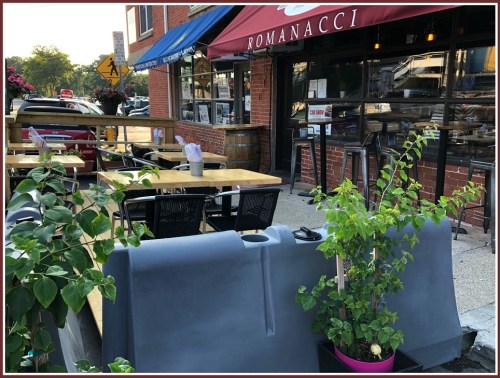
Saugatuck — Westport’s “other” downtown — is another hot spot for outdoor dining. The Selectwomen approved the continued use of parking spots by Romanacci’s and Tarantino. Two nearby restaurants may also apply.

Outdoor dining is here to stay. It’s one of our town’s newest, and most popular, traditions.

Now all we need is the weather to enjoy it.

Romanacci’s outdoor dining, It’s since moved several yards east.

Pic Of The Day #1812

Westporters say: US stands with Ukraine (Photo/Arlene Yolles)

Photo Challenge #379

Everyone loves Compo Beach.

Swimming, sunning, grilling, boating, kayaking, strolling, volleyball, the playground — what’s not to like?

Canada geese.

Those nasty, snarling, pooping-everywhere creatures are the bane of our beach existence.

A while ago, a nearby resident posted a sign on the gate between Ned Dimes Marina and the adjacent grassy area.

“Goose Control. Please close!” it said.

The idea was to keep geese confined to one area (which part is unclear).

It doesn’t work. Some people fail to close the gate. Plus, geese fly.

That sign was last week’s Photo Challenge. Matt Murray, Dan Vener, Rich Stein, Rod Rodriguez, Ralph Balducci, Judith Reid, Yvonne Ferris, David Feig, Pete Powell, Pat Saviano and Lawrence Joel Zlatkin all knew exactly where to find it. (And the accompanying goose turds.)

Click here to see Les Dinkin’s photo. And here’s a bonus feature: a photo from last summer, of a goose who may or may not give a shit about the little sign.

(Photo/Elisabeth Levey)

Now it’s on to today’s Photo Challenge. If you know where in Westport you’d see this, click “Comments” below.

(Photo/Roy Fuchs)

Roundup: Easter Egg Hunt & Tree, Beach Dunes & Dogs, Tyler Hicks …

===================================================

The Great Lawn at Saugatuck Church hosts lots of events. Social justice rallies, blessings of animals, plant sales — you name it, it’s there at one of Westport’s most visible and handsome sites.

Yesterday, it was an Easter egg hunt. Hundreds of youngsters raced around, finding thousands of eggs.

The afternoon was organized by WestportMoms — the multi-platform social media group, not a generic bunch of mothers —  with volunteer support by Boy Scout Troop 36.

Great hunt, on the great lawn. (Photo/Craig Patton)

Want Mark Mathias’ video version? Click below:

=======================================================

Speaking of Easter:

For 15 years, 1971 Staples High School graduate Jalna Jaeger has decorated a tree on her property (3 East Avenue in Norwalk, not far from Stew Leonard’s).

It’s an homage to Ostereierbaum — the German tradition of filling trees and bushes with Easter eggs. It’s always colorful and fun.

This year, it sends a message.

Most of Jalna’s eggs are blue and yellow: the colors of Ukraine.

Many Americans are doing what they can to show support for that embattled nation. But Jalna’s Ostereierbaum tree may be the only one like it anywhere.

Jalna Jaeger’s Easter egg tree. (Photo/Lynn Untermeyer Miller)

======================================================

As Russian troops retreat in parts of Ukraine, the horrors of their occupation are only now beginning to be known.

One of the world’s first looks at what the invaders did — and left behind — comes today in the New York Times. A story headlined “‘This is True Barbarity’: Life and Death Under Russian Occupation” describes the past month in Trostyanets, a strategically located town that soldiers finally fled a few days ago.

“A monthlong Russian occupation reduced much of the town to rubble, a decimated landscape of mangled tank hulks, snapped trees and rattled but resilient survivors,” the Times says.

The piece is accompanied by more than a dozen photos from Tyler Hicks. The Pulitzer Prize winner graduated from Staples High School in 1988. Click here for the full story and photos.

Svitlana Grebinyk’s home was left in disarray after being inhabited by Russian soldiers during the occupation of Trostyanets. (Photo/Tyler Hicks for the New York Times)

Entire blocks of homes were destroyed in Trostyanets, after Russian occupation. (Photo/Tyler Hicks for the New York Times)

======================================================

There was plenty of action yesterday at Sherwood Island State Park.

Michele Sorensen — Friends of Sherwood Island’s next president — organized volunteers to plant beach grass. It helps revitalize the dunes, and prevents erosion.

They’ll return over the next few weeks. But they need others. Click here to help, via Signup Genius.

Restoring dunes at Sherwood Island. (Photo/Ilene Mirkine)

=====================================================

How’s this for a warm-and-fuzzy, pooch-friendly photo?

(Photo/Roseann Spengler)

Unfortunately it was taken at Compo yesterday — the day after dogs were prohibited from all town beaches.

Hopefully the woman was unaware of the rule, not flouting it.

She and her buddy can return October 1.

=======================================================

Today’s “Westport … Naturally” image features a strong, handsome eagle. They’re hard to photograph well. But Steve Halstead nailed it.

(Photo/Steve Halstead)

=======================================================

And finally … on this date in 1865, Union forces captured Richmond, Virginia, the capital of the Confederate States of America.

Just over 100 years later the Band included that pivotal moment, in Virgil Caine’s lament — though he puts the date as “May the 10th”:


Westport Fill-Up: It’s A Gas

Last month, Governor Lamont signed emergency legislation — passed unanimously by the state Senate and House — suspending Connecticut’s excise tax on gasoline from April 1 to June 30. The state collected 25 cents per gallon.

The legislation says that retailers’ failure to reduce the per-gallon price of gasoline by that amount will be considered an “unfair or deceptive trade practice.”

Westport Weston Chamber of Commerce director Matthew Mandell decided to see which local gas stations followed the rules.

He took photos of several Westport gas stations on the Thursday evening of March 31, then again on the afternoon of April 1.

The Shell station across from the Westport Country Playhouse dropped its prices by 25 cents …

Mandell says: “WCBS radio reports that stations pay the tax upon delivery of their fuel, so prices might not come down until the next delivery.

“Nonetheless, the majority of stations did indeed change their prices — some 20 cents, some 25 cents, some even 30 cents.

“Some did not change their price at all.

“What should also be noted is the difference in prices overall — up to $1 per gallon — and that some places have different prices for cash and credit transactions.”

Here are the stations in Mandell’s cross-section:

  • Citgo  $4.13 to $3.88: 25 cents
  • Cumberland Farms Hillspoint Road:  $4.13 to $3.93: 20 cents
  • Cumberland Farms Bulkley Avenue South: $4.13 to $3.93: 20 cents
  • Exxon: $4.23 to $3.93: 30 cents
  • Mobil: $5.27 to $5.27: no change
  • Phillips: $4.29 to $3.99: 30 cents
  • Shell downtown: $4.09 to $3.84: 25 cents
  • Shell Maple Avenue South: $4.87 to $4.87: no change
  • Sunoco Riverside: $4.29 to $3.99: 30 cents

… while the Shell near Maple Avenue showed no change.