Tonight’s bad weather has forced the postponement of the scheduled Long Lots School Building Committee meeting.
The new date is Thursday, January 11, at 6 p.m. in Town Hall Room 307/309.

Tonight’s bad weather has forced the postponement of the scheduled Long Lots School Building Committee meeting.
The new date is Thursday, January 11, at 6 p.m. in Town Hall Room 307/309.
A new agenda has been posted for tonight’s Long Lots School Building Committee meeting (Tuesday, January 9, 6 p.m., Town Hall Room 307/309).
It includes a discussion and update of the elementary school renovation project:
Public comment (30 minutes) will follow, as time allows.

The latest Long Lots Elementary School plan.
==================================================
Congratulations to Staples High School Class of 2020 graduate Jake Thaw, and his University of Michigan Wolverines: national championships, after last night’s big win over Washington!

=================================================
Staples High School wrestling parent, booster club founder and former Wrecker wrestler and coach Terry Brannigan writes: “’It’s not what you gather, it is what you scatter.'”
“That was John Chacho’s message to a packed house at Foxwood Casino in 2013. Former wrestlers came from around the country to celebrate the legendary Staples coach’s induction into the National Wrestling Hall of Fame.
“For Coach Chacho, his message is not merely a punchline delivered from a podium. It is a lesson he attributes to his mother, and the drumbeat for his life.
“John has touched the lives of generations of Westporters through his work in the Westport school system, and his favorite tool: wrestling.
“This Saturday, Staples hosts the annual John Chacho Dual Meet Tournament. It begins at 9 a.m. in the fieldhouse, and runs through mid-afternoon. We invite everyone to stop by and say hello to Coach Chacho.”
Terry nailed it. John is a Westport treasure. Seeing him on Saturday will make your day — and his.

Coach Johnn Chacho
==================================================
There were a couple of errors in yesterday’s mention of the League of Women Voters’ “Pie & Politics” event. Here is the correct information:
Three local politicians will discuss Hartford’s impact on Westport, at a League of Women Voters “Pie & Politics” pizza event.
The January 23rd (7 p.m., Pizza Lyfe) evening features State Senator Ceci Maher, and State Representatives Jonathan Steinberg and Dominique Johnson.
The pizza is free for League members and guests, and there’s a suggested donation of $10 for the public. RSVP by January 18th: lwvwestportct@yahoo.com.

==================================================
Play With Your Food — the popular play-reading and talkback series — returns to MoCA next Tuesday (January 16, noon to 1:30 p.m.), with 3 very different shows.
Plus: boxed lunches from The Porch at Christies and Meli Melo Crêperie.
Plays include:
Can’t make MoCA on the 16th? Play With Your Food heads to the Pequot Library in Southport January 17, and the Greenwich Arts Council the 18th.
Click here for details, tickets, and the full 2024 schedule.

==================================================
Verso University — the Westport Library’s lifelong learning program– offers a diverse array of January/February courses. They include:

Alfred Hitchcock comes to the Westport Library. Well, at least a course about him does.
==================================================
Westport’s Business Network International chapter — the 2nd largest in the state — invites interested business networkers to a Visitors Day on Thursday, January 18 (7 to 9 a.m., United Methodist Church).
The group consists of only business per profession — for example, one financial advisor, one realtor, one chiropractor.
Categories open for this neeeting include estate attorney, landscaper, interior designer, printer, salon, personal trainer, restaurant, hotel, home inspector, home security, photographer, caterer or bakery, commercial/residential cleaner, commercial real estate, florist, event/wedding planner, travel/tour operator, automotive repair, physical therapy, promotional projects, and professional writer.
During the latest calendar year, the group passed over $1.6 million in closed business.
Pre-registration is required. Email debralommascout@gmail.com. For more information, click here.

=================================================
One of Jazz at the Post’s most popular performers — Westport’s own Melissa Newman — returns this Thursday (January 11; shows at 7:30 and 8:45 p.m.; dinner begins at 7; VFW Joseph J. Clinton Post 399; $15 cover).
The Westporter will be joined by guitarist Tony Lombardozzi, bassist Phil Bowler and drummer Bobby Leonard.
Her shows are sure to sell out. Reservations: JazzatthePost@gmail.com.
==================================================
Westport Police announced yesterday that a federal grand jury in New Haven has returned an indictment charging Neil Lott, 50, of Westport, with wire fraud related to a misappropriation scheme.
“As alleged in the indictment and statements made in court, from 2017 until August 2021, Lott was a 51 percent owner of Pacific Atlantic Handling Services, a baggage handling company based at John F. Kennedy International Airport.
In August 2021, Lott was terminated from PAH for cause. However, in November 2021, he opened a business bank account in the name of PAH without PAH’s knowledge or authorization.
On November 30, 2021, Lott deposited into this account a US Treasury check in the amount of $477,167, paid to the order of PAH, for an Employee Retention Tax Credit.
Lott was released on a $350,000 bond. If convicted of wire fraud, he faces a maximum prison term of 20 years.
“An indictment is not evidence of guilt. Charges are only allegations, and a defendant is presumed innocent unless and until proven guilty beyond a reasonable doubt.
“The investigation is being conducted the US Postal Inspection Service, the Treasury Inspector General for Tax Administration, and the Westport Police Department, with assistance from the Port Authority Police Department.”

==================================================
Margaret Carey Coley — the wife of William Booth Coley, of the Coley family of Westport and Weston — died Friday, surrounded by her family. She was 75.
Her family says: “Margaret loved spending time with her family, especially her beloved granddaughters. She also enjoyed visiting with and giving treats to her grand-dogs. She was an avid reader, and loved to research and discuss family genealogy. She also loved to keep up with her favorite sports teams (Mets and Red Sox), and current events.
In addition to her husband of 45 years, she is survived by her daughter Michelle (Richard) Corcoran of North Haven; granddaughters Madelyn and Molly Corcoran; her brother Robert (Carolyn) Carey of Jamesville, New York, and several nieces, nephews and cousins. She was predeceased by her brother John J. Carey Jr.
Margaret’s family thanks the Stratford VNA and Assisted Living Services for their care, with a special thank you to the ICU doctors, nurses and other staff at Yale New Haven Hospital for their care and compassion during her final week
A parlor service is set for Thursday (January 11, 10:30 a.m.; Porto Funeral Home, 830 Jones Hill Road, West Haven. Family and friends may call Thursday morning at 8:30. In lieu of flowers, memorial contributions may be made to ALS United Connecticut, 4 Oxford Rd. Unit E4, Milford, CT 06460.

Margaret Coley
==================================================
And finally … yay, us!
On this date in 1788, Connecticut ratified the US Constitution. We became the 5th state of the original 13 colonies to join the Union.
(Celebrate Connecticut’s birthday with a donation to our state’s — well, at least our town’s — favorite hyper-local blog. Just click here. Thank you!)
Westporters are wishing a quick recovery to our neighbor, Michael Bolton.
In a note to fans yesterday, the worldwide pop star revealed he was diagnosed with a brain tumor just before Christmas. He was operated on immediately.
“Thanks to my incredible medical team, the surgery was a success,” he said on Facebook. “I am now recuperating at home and surrounded by the tremendous love and support of my family.”
Bolton will take a “temporary break” from touring, he added. Click here for a full story. (Hat tip: Leah Nash)

Michael Bolton
==================================================
The next meeting of the Long Lots School Building Committee is Tuesday (January 9, 6 p.m., Town Hall Room 307/309).
After an executive session to discuss contracts, a work session will include “possible modifications to plans and benchmarking.”
The public is welcome to attend, but may not participate in the work session.

Discussion continues on the Long Lots Elementary School project.
==================================================
Cobs Bread opened this morning. They replace Jersey Mike’s, in Compo Acres Shopping Center between Trader Joe’s and Pokeworks.
The “artisan bread” chain has over 700 franchises in Australia, New Zealand and Canada, with a smaller presence in the US.
Two other Connecticut locations are Stamford and Greenwich. Click here for the company website (and the menu).

(Photo/Sal Liccione)
===============================================
A box truck struck a utility pole on Post Road East yesterday morning, near Colonial Green.
Power and cable access was knocked out to nearly 600 customers in the downtown area.
Kudos to Eversource and Optimum, for their near lightning-quick response. Both restored service in about an hour.
Thanks too to the Westport Police, who quickly blocked off and diverted traffic between Compo Road, and Imperial and Myrtle Avenues.

Crews working on Post Road East utility pole. (Photo/Sal Liccione)
================================================
Though car thefts have declined recently in Westport, vigilance is still needed.
Ray Broady sends along a brief video from Ring (click here to see). It was posted by someone at the Westport train station, who saw a car pull up next to a parked vehicle.
A man jumped out and attempted to open the doors of several cars.

This is NOT what was filmed at the train station.
==================================================
44 Compo Cove — perhaps the most-photographed house in Westport, standing proudly and oblivious to hurricanes and nor’easters for over a century just over the pedestrian bridge from Old Mill Beach — has also drawn plenty of attention as its new owners have begun the process of renovating and moving it a bit from the shore.
This was the scene yesterday, as workers began to place it in its new location:

(Photo/Matt Murray)
==================================================
This is not the first pileated woodpecker to be featured in our “Westport … Naturally” series.
But it may be the most active. Here he is, mid-peck:

(Photo/Paul Delano)
==================================================
And finally … David Soul, half the star of the 1970s hit TV show “Starsky & Hutch,” died Thursday. He was 80.
He also had a #1 hit in 1977, with this song:
Click here for a full obituary.
(“06880” is your reader-supported source for hyper-local news. Please click here to support our work. Thank you!)
Yulee Aronson is a licensed professional engineer, with 40 years of construction management and project controls experience, overseeing many high-profile and complex projects. He says, “I have never encountered a construction problem that couldn’t be overcome.”

Yulee Aronson
Locally, Aronson has worked on the reconstruction of Staples High School and the William F. Cribari Bridge, and the chlorination building at the wastewater pollution facility. Other projects include Penn Station access, the reconstruction of La Guardia Airport, and the Baltimore Potomac Tunnel replacement.
As the Board of Finance prepares to debate the Long Lots Elementary School construction project, he writes to them:
The Long Lots School Building Committee has come before you, requesting the next round of funding to commence the design based on the recommendations from the feasibility study. It appears that such a request is prematurely bypassing several important steps.
Per proper procurement protocols, such large appropriation needs to be performed following a competitive RFP process. The contract with Svigals Partner Architects — the firm that completed the feasibility study (Phase I) — notes:
In Phase II (separate contract) the Town will utilize the collective team to prepare the final design documents for the ultimate construction solution. Final Construction documents are expected to be completed by August 30, 2024. In Pase II the A/E team is expected to do the following services. While desirable to keep continuity of the A/E between phases, Phase II will be a separate RFP process.
Has the LLSBC been empowered to sidestep the proper procurement process? And how would the lack of competitive procurement be seen by the state, from whom Westport would be seeking reimbursement?
Considering that Long Lots may become the most expensive single project in Westport’s history, we need to make sure that this next step is performed with proper governance and oversight.
It is also prudent to examine how it all started, and how the scope of the authority of the LLSBC may have expanded beyond its original charter.
It began with the development and issuance of the Building Assessment Report at the end of February 2023. It was followed by the RFP process for Phase I scope, and culminated with the issuance of the contract to Svigals Partner Architects in May.

Long Lots Elementary School is 70 years old. It was designed as a junior high.
The scope of work for Phase I was limited to the conceptual design of the school building and parking.
Sometime in the summer this scope was suddenly expanded without proper authorization to include planning for the athletic facilities, based on the study performed by the Parks and Recs Department. Who placed the School Building Committee in charge of the planning for the Parks Department? A
And how is the school renovation/replacement project now required to satisfy the needs of Parks and Rec, who previously stated that they don’t have the funding to expand their facilities, yet now this expansion is going to take place as a part of the school construction budget?
The School Building Committee extended their reach by deciding to relocate the Westport Community gardens from their existing location to another site, all as a part of the school construction umbrella and budget.
The town of Westport already has a committee that deals with the town-wide design and construction projects, looking at them holistically and not through a narrow lens of a single project. Considering the complexity and the mixed use of the existing site, is the School Building Committee the best group to chart our course forward? Or should we use the resources that we already have, namely the Public Site & Building Committee?
During public hearings, many respected professionals have pointed out that the time and scope limitations of the feasibility study did not allow hired professionals to “dive into details” of various options.

Option “C,” presented as the best plan by the Long Lots School Building Committee.
Here are just 2 examples that come to mind.
What united these alternative options was the preservation of all of the existing uses on site, while providing more protection to the neighbors from unwanted noise and light pollution, and also allowing more rainwater to be absorbed in place during construction and beyond. In addition, all these proposals were less expensive.
In no way are the above options proposed here the “ultimate solutions.” The conversation about which option is best for the town would be resolved when other qualified design firms would be allowed to compete on cost of design and projected costs of construction for their respective designs, and managed by the properly authorized town committee.
Ken Bernhard knows Westport. He’s lived here for decades, and seen a lot.
He spent 8 years representing our town in Connecticut’s General Assembly, rising to assistant minority leader. He was 3rd selectman from 1987 to ’89, then served on the Zoning Board of Appeals.

Ken Bernhard
The longtime Westporter has been a board member of the Westport Library, Visiting Nurse & Hospice of Fairfield County, Westport Weston Chamber of Commerce, Norwalk Human Services Council, Earthplace, Westport Historical Society, Levitt Pavilion, Aspetuck Land Trust, Fidelco Guide Dog Foundation, and Connecticut League of Conservation Voters,
Further afield, he has worked with Syrian refugees, and in Ukraine. Ken writes:
I believe Westport is confronting a critical issue that requires the immediate attention of our town leaders — specifically, the divide between those supporting the preservation of our Community Gardens, and those who want to construct a new Babe Ruth playing field.
Advocates for both sides agree that there is a need for a new school. But the necessity for and, more importantly the location of, another ball field is debatable.
The hyperbole on both sides undermines us as a community.
Unquestionably, the Long Lots School Building Committee did its work thoroughly and honestly. But the allegations that it did not adequately involve some of the stakeholders soon enough, that it exceeded the scope of its mission, that the recommendation to remove the gardens was preordained, and that the process was possibly flawed, are resonating among Westport residents.
If we don’t address this directly, and before the political approval process commences, we will have failed to maintain the sense of fair dealing and honest brokering that defines how Westport manages its affairs.
Please recall instances where compromise and good governance prevailed in years past: resolving the Arts Center lease at Green Farms Elementary School, dogs at Compo Beach, the acquisition and then use of Winslow Park, construction of the Senior Center, creation of the Wakeman Farm complex, and building the Compo Beach playground, to name a few.
I recommend that the administration appoint an impartial, respected group of citizens to review the process; listen to LLSBC members, neighbors, and community garden advocates, and hopefully render an opinion regarding gardens vs. a playing field that everyone can accept, and that will help the approval process to proceed with minimum rancor and distrust.
It would not take a great deal of time, might speed up the hearings, won’t cost anything, and could avoid possible litigation.

Construction of the Compo Beach playground began in 1986 only after a court injunction was lifted.
Yesterday, Representative Town Meeting member Seth Braunstein told “06880” that after careful examination, he now supports the Long Lots School Building Committee’s decision to adopt “Option C,” for a new structure.
Westport Community Gardens chair Lou Weinberg responds:
A new Long Lots Elementary School can and should be built while preserving, in their current location, the Westport Community Gardens and the Long Lots Preserve. Nobody is trying to delay or stop a new school from being built. This is not a Gardens or school issue. This is a Gardens and school issue.
We understand that you’ve been given a lot of information by the Long Lots School Building Committee. They have expertise in architecture and engineering, and were appointed by our First Selectwoman. They have volunteered a lot of their own time, and that is to be commended.
To those who believe that the main focus of the Long Lots project should be the kids: You’re right.
The LLSBC was tasked with getting a new school built. They are not a land-use planning committee. The decision to place a ballfield over the Gardens and part of the Long Lots Preserve came from them. It was not part of the Board of Education specifications that were given to them. The proposed ballfield will not serve the educational or physical needs of the Long Lots students.
The decision to put a ballfield over the Gardens has been in the works for many months. We know that the LLSBC has been involved in this decision through communications with the Parks & Recreation Department and other athletic groups in town.
The Long Lots School Building Committee’s recommendation for a new school.
While we don’t know the full extent of what discussions took place, we know that the Westport Soccer Association has been significantly involved to the point of offering money to Parks & Rec to ensure that synthetic turf get added to the project to increase their field usage.
We know that our Parks Department, under Jennifer Fava, has been working to get a ballfield located at Long Lots, at the expense of the 20 year old WCG and parts of the LL Preserve. It is hurtful, and we believe it is wrong.
If the First Selectwoman believes it’s possible to create a bigger/better community garden at Baron’s South, she can certainly locate the ballfield there. It’s centrally located and more convenient for everyone in town.
The artificial turf proposed for the ballfield would not exacerbate the flooding experienced by the neighbors adjacent to the Gardens. Those neighbors would also be unaffected by the lights and the noise.
Additionally the traffic, which will undoubtedly get worse in the Long Lots neighborhood, would be somewhat mitigated. Instead of having a new garden created on questionable soil, the questionable soil can be covered with artificial turf, without disturbing it, and satisfying a need for a new ballfield in town. That is a solution where everyone wins.

The Long Lots Building Committee recommended this site at Baron’s South for the relocated Westport Community Gardens. (Photo/Morley Boyd)
The decree that the Gardens are going to be destroyed anyway, because they are part of a construction site and probable staging area, was made by the LLSBC at the 11th hour.
What would this committee do if there were 4 homes located where the Gardens are? They would find a way to get a school built. They would find staging areas elsewhere, like Baron’s South or the Sherwood Island connector, or they would maximize efficiencies on site.
There has been no peer review of the options generated by the LLSBC for this $100 million dollar project, and now we are shoving this option through the town governing bodies at a rapid clip.
Covering the Gardens with a ballfield, especially an artificial turf field, would be environmentally devastating. It goes against everything we are trying to teach our kids about being good stewards of the environment.
The Westport Community Gardens and LL Preserve are nationally awarded, first-in-class properties. They are models of sustainability and environmental stewardship. They are unique ecological gems in Westport. The biodiversity in these 4 acres is the result of 20 years of carefully tending to the land. We have cleared the land, removed the garbage, eradicated invasive plants that were devastating the property, and planted hundreds of native trees, shrubs and wildflowers. The Garden is an organic acre of native trees, shrubs, and thousands of perennials. It is home to literally thousands of native bees and other important pollinators, insects and birds.
The WCG membership (120 families representing approximately 300 residents) has a significant portion of older residents. The Gardens provide them with one of the best passive recreational activities known.
The offer to create a new community garden at Baron’s South to make it more convenient for our seniors rings hollow. A new garden there would still not be within walking distance of the Senior Center. Many of our older members will not be willing to put in the incredible amount of work it will take to build a new garden. We don’t need any new amenities. A Port-a-Potty has served us just fine for the last 20 years.

Westport Community Gardens.
The WCG is a community that has developed over 20 years. It is vibrant, active, and does not just serve the garden members themselves. We donate food through Grow a Row, support the Westport Garden Club and work together with Eagle Scouts. We have partnered with the Boy Scouts, Girl Scouts, SLOBS, and over 20 businesses and nonprofit agencies to create this magical place.
Hundreds of individuals have donated $40,000 and labored to create the Long Lots Preserve. We provide a phenomenal opportunity for Westport Public Schools to partner with us in a number of different areas, including their environmental education curriculum as dictated by state standards.
Imagine that there were 20 community gardens in town and one ballfield, built by hand and maintained for 20 years by the sports community. If one of the gardens was going to be displaced, would we all agree that the ballfield should be destroyed so we don’t lose a garden? No. We wouldn’t do that. It wouldn’t be right.
We believe any other town in America would celebrate and protect what Westporters have created here.
Thank you.
Clarence Hayes has lived in Westport for 6 years. A senior vice president in global technology at Bank of America, he manages its user-facing data networks, and associated $225 million budget.
He has crunched the numbers on the Long Lots Elementary School project. Clarence writes:
The Board of Education and Long Lots School Building Committee need to convince the voters of Westport, via a public detailed document, why “Repair and Properly Maintain” is not an option for Long Lots.
Principal and interest on a $100 million new school at today’s AAA muni rates is around $6 million a year, for 30 years. Taxes will go up.
Other town investments will be squeezed by the pressure on the budget. The voters deserve to understand how we came to the original decision.
This section of Long Lots Elementary School — originally the main entrance to the junior high school — was built in 1953.
It is “received wisdom” that repairing and maintaining the current school would be “penny wise, pound foolish” and is not an option. As an incoming RTM member (running unopposed), I am trying to discover the basis of this position.
What I have found: Based on a 2021 building assessment (Colliers), an expectation of increased enrollment, and the mismatch between original Long Lots use as a middle school vs. elementary school needs, the BOE and Board of Finance recommended the evaluation of a new school as an option.
However, the primary reason was the condition of the building (from a June 28, 2022 BOE presentation to the BOF).
Regarding building condition, I read every page of what I could find: the Colliers Assessment, and the new LLSBC-led MEP and Envelope Assessments.
These reports are the detail about the school condition. Everything else is anecdote or rumor.
The picture they paint is of buildings which are energy inefficient, not all built to the highest construction standards, and not consistently maintained over the years with timely quality repair.
The Colliers Assessment states they have not done invasive inspection, and they pass no judgment on structural issues. They state that fuller assessments should be done.

This wing — the current main entrance — was added in the 1970s.
Those fuller assessments are the MEP and Envelope reports done by LLSBC consultants. The Collier assessment has been superseded.
The new, deeper MEP and Envelope reports include “repair” sections. If you read these, you will find that here is only one serious problem: The pre-1970s buildings have negative pressurization, which is the cause of excess humidity.
This excess humidity contributes to other defects. Remediation requires the installation of a ventilation system, which could be done during the summer, for $4.2 million.
Other than this, everything else is normal maintenance repairs, and not the same scale of expense. Those minor items add up, presumably to several million dollars more, but they were not priced out fully.
The façade report lists 16 items, each of which is relatively insubstantial and the kind of repair you would expect in normal quality maintenance: “fix the broken glass over door 13,” “clean the stucco outside the music room,” etc.
The roofing report lists 18 repair items, prefaced with the comment “the roofing system is under repair for the next 5 years” so route through the warranty and demand performance. These items are also normal maintenance: “replace loose fasteners,” “wrinkled cap sheets should be replaced (warranty),” etc.
The structural report is shorter: Seal the cracks in the brick masonry, clean the stucco at the music wing. The report states there are no imminent structural risks.

Long Lots Elementary School. (Drone photo/Brandon Malin)
These recommendations come with the preface that the consultants were asked how to keep the building in good condition for “5-10 years,” pending new construction. But the analyses are not limited to a “5-10 years” time frame.
The recommendations look like one major investment (ventilation) and catch-up maintenance, which provide for an indefinite future life for the buildings. They do not state that this work gets you only 5-10 years, but after that the buildings will be irreparable and the town will be faced with massive new expenditures.
The conclusion I come away with from these reports is that repairs in the sub- $10 million one-time range will catch up for the failure to do proper maintenance in the past, and, if timely quality repair is continued going forward, there is no definite date when these buildings have to be replaced.
Much of the discussion appears to mix normal expected maintenance costs associated with HVAC equipment, and other aspects of the buildings. AC units and boilers are 25+ years old and near end of life. That is part of the normal lifecycle, i.e. maintenance, of buildings. It is not a reason to demolish these structures and build new.
Decisions regarding these components will likely require additional investments, as is the case at all the schools. But the cost of quality maintenance and eventual replacement is part of any building operating budget.
Long Lots is clearly energy inefficient. The MEP report says a “net zero” building would use 5 times less energy. But the cost is not quantified. Is this $200,000 or $2 million per year in lower costs?
“Repair and maintain” does not promise a modern “net-zero” building with the latest architectural flourishes. But it may provide a clean, safe and entirely adequate learning environment for many decades, as it has for the past 60 years.
I intend to campaign for “repair and maintain,” making efforts to convince my fellow RTM to vote “no” on a new build, and “yes” for a heightened focus on quality maintenance to extend the life of town assets.
I do not object to higher taxes, and I am happy to change my mind. But the BOF/BOE need to make a convincing case that my interpretation of the engineering reports is wrong.
Seth Braunstein is a Representative Town Meeting member from District 6, and chair of the RTM Finance Committee.
After 2 visits to the Long Lots Elementary School property, his views on the future of the Westport Community Gardens have changed. He now supports the Long Lots School Building Committee’s recommendation to relocate the gardens.
Seth writes:
Sometimes beauty is in the eye of the beholder. You might like one thing, yet I may favor another. Opportunities for interpretation or differing appreciation exist and can be celebrated. However, we can all agree that the Community Gardens and Preserve are beautiful and valuable town assets.
Feasibility generally isn’t something that is open to the same subjective interpretation.
Last Sunday morning I joined roughly 25 other concerned Westport citizens for a formal tour of the Long Lots School property hosted by a majority of the Long Lots School Building Committee.
The LLSBC began the tour by leading the assembled group from the south end of the property where the beautiful Community Gardens and Preserve are located to the north end of the property across various athletic fields (soccer and baseball) spread across 2 distinct property tiers, then to the west side of the property where wilderness (thankfully no poison ivy was encountered) and catch basins and a stream exist amidst a steeply declining grade as the property terminates back behind Harvest Commons.
Part of the Long Lots Elementary School campus. The Community Gardens (not shown) are south of the school. (Drone photo/Brandon Malin)
I am convinced that all parties involved in the hotly debated issues surrounding the question of build new vs. renovate come to this difficult decision with only the best of intentions. I am certain that the Board of Education, the LLSBC and first selectwoman are earnest in their desire to come up with the best solution possible for our community. None of these dedicated public servants have any “nefarious intent” and none of them want to have an outcome here that results in something that would fall short of the high standards our town demands. None of these people deserve the ad hominem attacks they have been subjected to.
I am also certain that supporters of the Community Gardens have sound arguments for why their 2 decades of investment in this property leave them hopeful that their interests and the reality of a new school can effectively coexist with the Garden remaining in its existing footprint. In fact, as a concerned member of the community (and an elected RTM member) I was convinced that this mutually beneficial outcome would be highly likely.
Having now had the benefit of a well detailed explanation for the reasoning behind the LLSBC support of the option they are recommending, along with a firsthand view of the property’s limitations, my view of what is feasible has changed. I had visited the Gardens a couple of months ago at the invitation of a member and at the time struggled to see why the two could not co-exist.
Now I understand why. This is a relatively small piece of property that is already crowded. The LLSBC has worked for months and hosted numerous meetings focused on what can be done to fit all of the existing puzzle pieces together so that all of the various constituencies represented on this property can walk away happy. This has been a huge task (did I mention they are all volunteers?).
The LLSBC has had to consider not just how to build a new school on this cramped property but also, most importantly, how to make sure the children in the existing school can continue to receive the best education possible while in the middle of a construction zone for the roughly two years the project will take to complete.
The committee has considered everything from how buses will enter the property, how parents who prefer to drop their students off will approach the building, where teachers and others working in the school will park, how all of the athletic and outdoor leisure time activities can continue and how to do all of this while minimizing the inevitable disruption that a project of this scale will pose to the neighborhood.
They have also been clear in their desire to consider Westport’s intent to increase sustainability which would require a series of geothermal wells to also occupy the site in the future to increase the energy efficiency of the new building.
Parking and bus loops are considerations in designing a new school.
Under the best of circumstances (and this property does not meet that standard due space limitations, as well as grade and drainage concerns) a project of this magnitude requires significant staging areas. Take a moment to think about things like building materials (steel, brick, windows, etc.), heavy equipment (tractors, backhoes, forklifts), workspaces (construction trailers, bathrooms), large quantities of soil and other materials (to help correct grades and support foundations), not to mention parking for the sizable construction crew. When considering the requisite staging areas, the difficult job of putting this complicated puzzle together becomes untenable.
No one wants to displace the Community Gardens. No one has made a decision to sacrifice this wonderful town resource, but when considering where the flexibility in planning this project falls it is obvious that the school (a $100 million+ investment that will further help burnish our well-regarded school district) must take the highest priority.
Some have chosen to frame this unfortunate circumstance as the Gardens vs. the school or the Gardens vs. town leadership or the BOE. That simply does not reflect the reality of the situation. This really becomes a question of what is actually feasible on this property.
I choose to look at this as an optimization opportunity. Rather than trying to overcome the inherent limits associated with this crowded property, a better solution exists. In fact, it is a solution that has already been brought forth by the LLSBC itself. The Community Gardens could be moved to a portion of the Baron’s South property. While this will undoubtedly upset the supporters of the Community Gardens (and they have earned the right to be upset given the two decades of work they have invested in the current location) it might actually offer a better outcome long term for the Gardens and for the Town.
I have been a long-term supporter of preserving the rare open space left in Westport (check the voting record – I was adamantly opposed to a deal to develop Baron’s South for housing or for active uses), but placing the Community Gardens on a portion of the property could accomplish a number of desirable outcomes.
First, it would provide an environmentally positive usage of the land that would be consistent with the passive usage spirit of the current zoning (while drawing many more people to this vastly underutilized town jewel).
Second, it would actually provide the Gardens with a bigger space than is currently being utilized. I’d also add that the supporters of the Gardens have cited the number of seniors that have enjoyed the Gardens and moving the location to a spot in Baron’s South that would place them just a few steps from the Senior Center seems like a beneficial outcome. It is difficult for me to see how this wouldn’t be a classic win/win scenario.
The proposed site of the Community Gardens, at the Senior Center. (Photo/Morley Boyd)
Ultimately, the RTM will be presented with an appropriation request for this building project and the full range of issues associated with this property will be debated. From where I stand, legitimate questions exist around the status of the baseball field. The mandate for the LLSBC was to retain all existing school features and a baseball field is one of those features so it should be included in the new plans. However, any discussion of turf or lights or a vast increase in the scale and scope of a new field should be scrutinized.
I’d also add in closing that as an RTM member and chair of the RTM’s Finance Committee I would vote to have the town provide funding for the transition of the Gardens’ location (there may be a chance to maintain the Preserve in its current location). The Gardens are unquestionably one of Westport’s jewels and moving them to a spot where they can continue to grow and blossom, rather than exist in some sort of limbo amidst at least two years of construction, seems like a smart way forward.
In a lightning-quick meeting last night, the Long Lots School Building Committee voted formally to do what it had previously discussed: send to 1st Selectwoman Jen Tooker the recommendation to build “Concept C,” an entirely new elementary school next to the present one.
However, the LLSBC added another recommendation: that the Westport Community Gardens (which will be displaced by a new baseball field) be relocated to Baron’s South, the town-owned property between Compo Road South and Imperial Avenue.
Meeting later last night in a long session, the Board of Education agreed 5-1 that plans for the new school follow from the educational specifications they approved last April.
Member Robert Harrington offered an amendment that would keep the Gardens at their present location, just south of the school. That motion failed 4-2, with Dorie Hordon joining Harrington.
The majority said that the gardens’ future is up to other bodies in town. The Board of Ed’s focus, they said, is on the school only, and moving ahead is imperative.
The Long Lots project must still be approved by several town bodies, including the Board of Finance, Conservation Commission and Representative Town Meeting.
The Baron’s South property, recommended by the Long Lots School Building Committee as the new site for the Westport Community Gardens. (Photo/Morley Boyd)
==================================================
The third time’s the charm.
That’s what WestportMoms banks on. Their twice-postponed 3rd annual Fall Festival is set for this Sunday (October 22), at the fields across from the Compo Beach playground.
Painters, sports, pumpkin decorating, hair tinsel, a magic show, bracelet making and more are all in store. All kids and families are welcome.
Bring layers, WestportMoms advise. It may be windy.
But get ready — finally — for some fun.

==================================================
Town-wide curbside leaf collection begins November 6.
All leaves must be placed in biodegradable paper bags near the curb of a town street by December 4 to guarantee pick-up. Residents on private streets must place their leaves behind the curb of an intersecting town roadway. Leaves placed in plastic bags will not be picked up,
Crews will complete pick-ups as schedules allow. For further information, call the Department of Public Works 203-341-1120), or click here.

Ready for pickup. (Photo/Scott Smith)
==================================================
The 180 Bayberry Lane yard waste site (behind the Aspetuck Health District) will extend its Saturday hours, from October 28 through December 4.
The extended Saturday hours are 7 a.m. to 3 p.m.
Westport residents with proof of residency may dump up to 6 30-gallon bags or containers full of leaves without a fee. Plastic bags are prohibited.
Any van, pickup or tag-along trailer exceeding the 6-bag limit will be charged $40 per load. Any vehicle or trailer larger than a conventional pickup with a 4-foot by 8-foot bed will be charged $90 per ton.
Any vehicles with a 9-foot body, or vehicles changed to significantly enlarge their factory design size, will be charged $90 per ton, estimated at 2 tons without weigh slip ($180).
Dump tickets must be purchased at Town Hall’s Public Works office weekdays from 8:30 a.m. to 4:30 p.m., or by writing the Department of Public Works, 110 Myrtle Avenue, Westport, CT 06880.

Yard waste at 180 Bayberry Lane.
================================================
It’s pretty impressive for a high school golfer to shoot a 73.
It’s even more so when 2 do it.
Harrison Browne and Sawyer Dalzell tied for the individual title at yesterday’s FCIAC (Fairfield County Conference) championship, at Tashua Knolls in Trumbull.
Their 1-over-par rounds helped the Wreckers to a 1-stroke team title over Fairfield Warde.
Congratulations to them, teammates Gus Palmer (79), Philip Sullivan (82) and Chris Taylor (83), and coach Pete Caligiure. On to states!

FCIAC champion Staples High School boys golf team. (Hat tip and photo/The Ruden Report)
==================================================
Westport Police made 2 custodial arrests between October 11 and 18.
A woman was arrested for shoplifting at HomeGoods. A man was arrested for criminal trespass and disorderly conduct, after a domestic violence incident.
Police also issued these citations:

A Westport woman was charged with 3 dog violations. This is not that dog.
==================================================
Speaking of police … a reader writes:
“Commuting seems to have leveled off. Is there consideration to opening up some daily spaces in the railroad parking permit areas? Not to mention the boats parked there!”
Westport Police are in charge of railroad parking (among many other things). Chief Foti Koskinas notes that while Monday and Friday usage of lots is lower than pre-COVID, they are fairly full Tuesdays through Thursdays.
Deputy Chief Dave Farrell adds:
“The lot that stores the winterized boats is privately owned, and is not managed by the railroad parking division of the PD.
“Meanwhile, we constantly monito our lots and make changes as necessary. At this time, we will not be adding daily spots to permit lots.
“I encourage daily spot users to check out Lot 7 on Franklin Street. It’s a convenient lot that does not fill up, and has direct access to Riverside Avenue.
“Also, Lot 8 will soon be available for our daily spots as the I-95 project will wrap up within a month or so.”

Click on or hover over to enlarge this railroad station parking map.
================================================
Still speaking of driving:
David Meth waited yesterday patiently, with other drivers, in the southbound lane of Compo Road North by Winslow Park. As everyone knows, it can take a while to get to the Post Road.
One person couldn’t wait. This driver attempted to jump the line — with predictable results.

But wait! There’s more!
This very same driver — after finally reaching the Post Road (along with everyone else), and making a right turn — zoomed into Playhouse Square.
And — feeling entitled after waiting all that time — promptly grabbed not one but two parking spots, in the always-crowded lot.
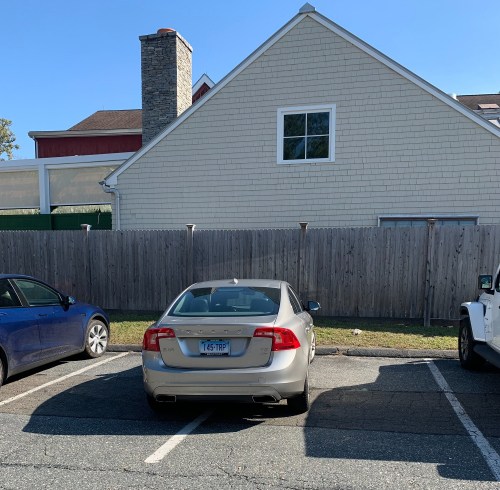
(Photos/David Meth)
“Driving in this town is out of control, supplanted by entitlement, arrogance, rudeness, and unrelenting stupidity,” David observes.
======================================================
Then again, we should have some sympathy for drivers.
As this passenger shows, the wait for a light in Saugatuck can be really, really long.

(Photo/Werner Liepolt)
================================================
Elsewhere in Saugatuck, Renato’s Pizza has opened in the space previously occupied by Parker Pizza.
Click here for the menu, and more information.

(Photo/Werner Liepolt)
==============================================
Where do you go if your dad writes a new will right before he dies, leaving a sizeable fortune to the dog walker he met 3 months ago?
Where do you go if you want a schizophrenic family member committed to a hospital for treatment, or put under conservatorship to protect him from himself?
The answer to both questions is “Probate Court.” At this week’s lunch meeting, the Westport Rotary Club heard Lisa Wexler, Probate Court judge for Westport and Weston, discuss how she deals with issues like those every day.
Wexler called Probate Court “Family Court without the divorce.” She decides over 3,300 matters a year, many involving family members at each other’s throats. She noted that if her life was made into a TV show, it would be “’Parks and Recreation’ meets ‘Blue Bloods.’”

Probate Court Judge Lisa Wexler, at the Westport Rotary Club. (Photo/Dave Matlow)
=================================================
More than 6 million Americans live with Alzheimer’s. Next Friday (October 27 11:30 a.m. to 12:30 p.m.), the Westport Weston Family YMCA hosts a discussion by the Alzheimer’s Association’s Connecticut chapter.
The presentation will speak cover the Association’s resources, ways to get involved. healthy behaviors, Alzheimer’s impact on the workplace, its effects on caregivers, and more.
Everyone is welcome to attend. Questions? Email jsamuels@westporty.org.

==================================================
Say She She closed out the 2023 Levitt Pavilion concert season last night.
That’s a wrap: About 60 nights of free entertainment, under the stars.
The stars — well, the air — was a bit chilly last night. But it’s only a few months until the air will be warm again, and music will be back on the banks of the Saugatuck.

Say She She, at the Levitt Pavilion. (Photo/Dinkin Fotografix)
==================================================
It’s almost the weekend, so … rain.
But the weather this week was pretty good. Tracy Porosoff was in her garden, photographing beautiful sights like this for our “Westport … Naturally” daily feature.

(Photo/Tracy Porosoff)
==================================================
And finally … as the colors change, and the foliage blazes (though perhaps not this week), it’s time to remember Simon & Garfunkel’s classic tune:
Today, as always, “06880”‘s Roundup delivers a broad array of Westport-specific news and notes. If you rely on this coverage, please support our work. Click here — and thank you!)
Posted in Entertainment, Environment, Local politics, Police, Restaurants, Saugatuck
Tagged Entitled parking, Long Lots School Building Committee, Probate Court Judge Lisa Wexler, Renato's PIzza, Saugatuck train station, Staples High School boys golf team, Westport Community Gardens, Westport Rotary Club, WestportMoms
Much has already been written about the proposal for a new Long Lots Elementary School.
Discussion has centered largely on the decision to place a new school on the current baseball field, and build a new diamond on the site of the Westport Community Gardens and Long Lots Preserve.
Less attention has been paid to another factor: the proposed size of the school, based on enrollment and possible redistricting.
Edie and Sam Anderson have live on Hyde Lane, next to Long Lots, since 1983. They sent this letter to 1st Selectwoman Jen Tooker:
As you consider the proposal made by the Long Lots School Building Committee, please keep in mind the many stakeholders in this decision including the students, neighboring property owners, homes affected by Muddy Brook flooding, Parks &Recreation programs, and the Community Garden.
This is a $100,000,000 generational decision that deserves more careful study, or at least fine tuning.
The LLSBC performed yeoman’s service, carefully studying a wide range of options for the location of the new vs renovated school, resulting in the proposed “Option C.”
The Long Lots School Building Committee recommended “Option C” for a new structure.
This was based upon consideration of many stakeholders and an effort to meet the criteria laid out in the Educational Specs it was given by the Board of Education. Given this direction, the LLSBC did a good job.
However, the ed specs which are the foundation of the planning has troubling flaws. Now that the preliminary study is complete, it is time to get the details correct.
The Board of Ed acknowledges the need to redistrict and utilize excess capacity in other schools, yet this was not reflected in the Ed Specs, which call for a 33% increase in enrollment far in excess of other Westport elementary schools and comparable surrounding towns.
At the Board of Ed meeting on January 23, 2023 (prior to the issuance of the ed specs), the imbalance between elementary and middle school populations was noted, and the need to redistrict was discussed.
The board indicated that 100+ students could be moved from Long Lots to other elementary schools, which have excess capacity. At this meeting the superintendent indicated that an elementary school should not exceed 600. Despite this, the ed specs call for 687 elementary students and 98 pre-school students.
The current LL enrollment is 588. All the other Westport elementary schools range from 430 to 479 students. In addition, post-COVID, Westport’s elementary school population has declined by 50 students. Total enrollment for all Westport schools and the entire state is also down.
This is relevant because reducing the base population of LL by 100+ via redistricting would result in enrollment of 488 (similar to other Westport elementary schools).
This would reduce the size and the cost of the new building, and would improve the quality of the environment for young children to be consistent with other Westport schools.
A quick survey of surrounding school districts shows enrollment around 450 students. Building a “right” sized elementary school would significantly reduce the traffic and improve the quality of life for all stakeholder—students and neighbors.
The current Long Lots Elementary School. (Drone photo/Brandon Malin)
Adding Stepping Stones to an already very large elementary school simply exacerbates the situation.
The Long Lots ed specs call for 687 elementary students, plus 96 Stepping Stones pre-school children, totaling an enrollment of 783. This is a 33% increase in students (not including the increase in teachers and support staff.) The question here is: How big is too big?
This plan is inconsistent with the enrollment of all other Westport elementary schools, as well as elementary schools in neighboring towns.
This significant increase in enrollment would interfere with the residential nature of the neighborhood, and result in more traffic and noise in an already very busy location.
The Long Lots campus is within a residential area, AA zoned. A 33% increase in traffic and noise will be significant, and disrupt the peaceful enjoyment of our neighborhood. I should also note that the Long Lots neighborhood hosts thousands of children each year, who use the fields as well as 100+ Community Gardeners.
The most favorable option for all stakeholders is concept B. It meets the ed specs, maintains the current buffers from neighbors and Muddy Brook, and preserves the fields, parking and Community Gardens.
The selection of Concept C for a new school is the recommendation made by the LLSBC to minimize the damage to as many stakeholders as possible. However, the committee acknowledged that current building is ideally located in the center of the campus. This location provides the best possible buffer from the neighbors, while hosting 2 soccer fields, a multi-purpose field and the community garden. Further, the Long Lots campus is in an environmentally sensitive area with wetlands on and near the campus as well as nearby Muddy Brook.

Muddy Brook, after a recent rain. (Photo/Peter Swift)
Concept B vs concept C. Renovating requires managing the project and student population while the school is in session. Westport has done this successfully many times before.
It appears that the biggest objection to the renovation options is the inconvenience/difficultly of working around an operating school. This is not in-surmountable. It has been accomplished successfully many times in Westport, Coleytown Middle School and Staples High being the most recent examples.
Earlier renovations (1990s) to Long Lots and Kings Highway were also managed successfully. (Our daughter graduated from Staples in 2006, and experienced all of the above renovations).
Cost and time vs. long-term benefit of a school that remains in the center of the campus is clear. Concept B would maintain the character of the neighborhood, and provide students with a new “neighborhood” elementary school which they deserve.
The prospect of 29 months vs. 18 months for this project is daunting for the Long Lots’ neighborhood. However, the 50-year benefits of a well-sited school that respects the quality of the neighborhood by maintaining the status quo seems like a good trade for a few extra months of construction disruption.
Redistricting and keeping the school at the center of the campus maintains the status quo for all stakeholders, while providing the Long Lots school community with a beautiful new facility which they will enjoy for 50+ years. Surely it is worth the time to take a harder look at creating the best school for all the stakeholders in the long term. Ultimately, this must be our goal.
Next steps:
At this point, we ask that the ed specs be revised, and serious consideration be given to “right” sizing this school to be optimal for the students and surrounding neighborhood.
It’s time to think outside the box and get the best plan on the table. For example, Weston, Darien and Greenwich have incorporated their pre-school classes within several elementary schools.
Certainly, utilizing excess capacity in existing schools and balancing the student population via redistricting could be accomplished.
We hope that we have outlined some of the many questions that should be directly and openly addressed before proceeding with design plans. Again, this is a $100 million generational decision that we need to get right.

Click here to help support “06880” via credit card or PayPal. Any amount is welcome, appreciated — and tax-deductible! Reader contributions keep this blog going. (Alternate methods: Please send a check to “06880”: PO Box 744, Westport, CT 06881. Or use Venmo: @blog06880. Or Zelle: danwoog@gmail.com. Thanks!)