Tag Archives: Seth Braunstein

Affordable Housing Trust Fund: Innovative Solution Fills Important Need

Affordable housing is crucial.

It’s a way for town employees — police officers, firefighters, teachers — to live in the town where they work.

It’s how longtime older residents can remain here, and striving young people can come.

But it’s not cheap to buy the land for affordable housing, then build it.

In other words: How can Westport afford affordable housing?

Earlier this month, we took a big step forward.

The Planning & Zoning Commission established an “Inclusionary Zoning Fee,” and recommended a fee: 0.5% of construction costs of all projects for which zoning permit applications are filed. That’s $5 for every $1,000.

The fee will be paid by anyone filing for a zoning permit — for instance, builders of new construction, and homeowners making major renovations.

The Representative Town meeting then unanimously passed the motion to create the fund, and voted 30-1 to ratify the fee. The ordinance becomes effective February 23.

What does it all mean?

Here’s one example. The 1 Glendinning Place project — a plan to build 10 homes near the office complex off Weston Road, 2 of them reserved for people with special needs — has an estimated construction cost of $10 million.

That would generate $50,000 for the new Affordable Housing Trust Fund. More would be added from other related zoning permit transactions.

The Glendinning Place proposal could add over $50,000 to Westport’s new Affordable Housing Trust Fund.

The Fund would be used to purchase land, and for the subsequent construction, of affordable housing.

Though the ordinance is not yet effective, the Affordable Housing Trust Fund is already at $10,000. It was jump-started by an anonymous donation, from a resident who believes in its mission.

Besides the 0.5% zoning permit fee and donations, the fund will include investment income, as well as possible state and federal grants.

Planning began almost 2 years, with discussions by then-P&Z chair Danielle Dobin about Westport’s Affordable Housing Plan.

RTM members Matthew Mandell and Seth Braunstein helped shepherd it through many legislative steps. It had strong support from town officials (including 1st Selectwoman Jen Tooker), town attorneys, and RTM members.

The fund will be administered by an oversight committee. They’ll advise the Boards of Selectwomen and Finance, and the RTM, on how and where to spend the funds. Those bodies must then approve the recommendations.

Tooker will appoint the 5 members of the committee.

“This is a high priority for me,” Tooker tells “06880.”

She has already explored opportunities on town-owned land. The Linxweiler property on the Post Road (between Fresh Market and McDonald’s) could be used for cluster housing, for example.
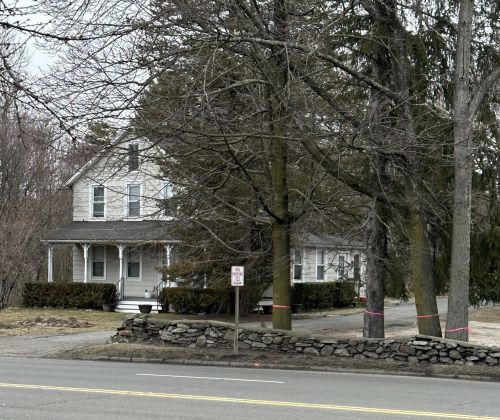
The Linxweiler property, on Post Road East.

The 5 existing structures on Baron’s South could also be renovated and repurposed, through the Affordable Housing Trust Fund.

The committee will add “a whole other perspective, and another strategic viewpoint and layer of focus” to the work Tooker has already done, she says.

“It’s incredibly important to have diverse housing in Westport,” the 1st Selectwoman adds.

“It’s an issue we take very seriously. The committee and fund will be a big help as we proceed strategically.”

Westport is not the first Fairfield County community to embrace the idea of an affordable housing fund. Fairfield, New Canaan, Darien, Stamford and Greenwich have similar ordinances.

Fairfield — which has the same 0.5% construction cost fee as Westport — has raised $2.25 million since 2018. They’ve allocated nearly $1.5 million so far, mainly to acquire property.

New Canaan collects 1% of construction costs for new construction and additions. They have raised $1.1 million since 2020.

Mandell hopes Westport’s Affordable Housing Trust Fund will receive $750,000 to $1 million a year. The first results could be seen in 2026.

(“06880” covers local politics, real estate, and much more. Please click here to support our work. Thank you!)

[OPINION] Issue Is Not “Gardens Or School”; It’s “Gardens AND School”

Yesterday, Representative Town Meeting member Seth Braunstein told “06880” that after careful examination, he now supports the Long Lots School Building Committee’s decision to adopt “Option C,” for a new structure.

Westport Community Gardens chair Lou Weinberg responds:

A new Long Lots Elementary School can and should be built while preserving, in their current location, the Westport Community Gardens and the Long Lots Preserve. Nobody is trying to delay or stop a new school from being built. This is not a Gardens or school issue. This is a Gardens and school issue.

We understand that you’ve been given a lot of information by the Long Lots School Building Committee. They have expertise in architecture and engineering, and were appointed by our First Selectwoman. They have volunteered a lot of their own time, and that is to be commended.

To those who believe that the main focus of the Long Lots project should be the kids: You’re right.

The LLSBC was tasked with getting a new school built. They are not a land-use planning committee. The decision to place a ballfield over the Gardens and part of the Long Lots Preserve came from them. It was not part of the Board of Education specifications that were given to them. The proposed ballfield will not serve the educational or physical needs of the Long Lots students.

The decision to put a ballfield over the Gardens has been in the works for many months. We know that the LLSBC has been involved in this decision through communications with the Parks & Recreation Department and other athletic groups in town.

The Long Lots School Building Committee’s recommendation for a new school.

While we don’t know the full extent of what discussions took place, we know that the Westport Soccer Association has been significantly involved to the point of offering money to Parks & Rec to ensure that synthetic turf get added to the project to increase their field usage.

We know that our Parks Department, under Jennifer Fava, has been working to get a ballfield located at Long Lots, at the expense of the 20 year old WCG and parts of the LL Preserve. It is hurtful, and we believe it is wrong.

If the First Selectwoman believes it’s possible to create a bigger/better community garden at Baron’s South, she can certainly locate the ballfield there. It’s centrally located and more convenient for everyone in town.

The artificial turf proposed for the ballfield would not exacerbate the flooding experienced by the neighbors adjacent to the Gardens. Those neighbors would also be unaffected by the lights and the noise.

Additionally the traffic, which will undoubtedly get worse in the Long Lots neighborhood, would be somewhat mitigated. Instead of having a new garden created on questionable soil, the questionable soil can be covered with artificial turf, without disturbing it, and satisfying a need for a new ballfield in town. That is a solution where everyone wins.

The Long Lots Building Committee recommended this site at Baron’s South for the relocated Westport Community Gardens. (Photo/Morley Boyd)

The decree that the Gardens are going to be destroyed anyway, because they are part of a construction site and probable staging area, was made by the LLSBC at the 11th hour.

What would this committee do if there were 4 homes located where the Gardens are? They would find a way to get a school built. They would find staging areas elsewhere, like Baron’s South or the Sherwood Island connector, or they would maximize efficiencies on site.

There has been no peer review of the options generated by the LLSBC for this $100 million dollar project, and now we are shoving this option through the town governing bodies at a rapid clip.

Covering the Gardens with a ballfield, especially an artificial turf field, would be environmentally devastating. It goes against everything we are trying to teach our kids about being good stewards of the environment.

The Westport Community Gardens and LL Preserve are nationally awarded, first-in-class properties. They are models of sustainability and environmental stewardship. They are unique ecological gems in Westport. The biodiversity in these 4 acres is the result of 20 years of carefully tending to the land. We have cleared the land, removed the garbage, eradicated invasive plants that were devastating the property, and planted hundreds of native trees, shrubs and wildflowers. The Garden is an organic acre of native trees, shrubs, and thousands of perennials. It is home to literally thousands of native bees and other important pollinators, insects and birds.

The WCG membership (120 families representing approximately 300 residents) has a significant portion of older residents. The Gardens provide them with one of the best passive recreational activities known.

The offer to create a new community garden at Baron’s South to make it more convenient for our seniors rings hollow. A new garden there would still not be within walking distance of the Senior Center. Many of our older members will not be willing to put in the incredible amount of work it will take to build a new garden. We don’t need any new amenities. A Port-a-Potty has served us just fine for the last 20 years.

Westport Community Gardens.

The WCG is a community that has developed over 20 years. It is vibrant, active, and does not just serve the garden members themselves. We donate food through Grow a Row, support the Westport Garden Club and work together with Eagle Scouts. We have partnered with the Boy Scouts, Girl Scouts, SLOBS, and over 20 businesses and nonprofit agencies to create this magical place.

Hundreds of individuals have donated $40,000 and labored to create the Long Lots Preserve. We provide a phenomenal opportunity for Westport Public Schools to partner with us in a number of different areas, including their environmental education curriculum as dictated by state standards.

Imagine that there were 20 community gardens in town and one ballfield, built by hand and maintained for 20 years by the sports community. If one of the gardens was going to be displaced, would we all agree that the ballfield should be destroyed so we don’t lose a garden? No. We wouldn’t do that. It wouldn’t be right.

We believe any other town in America would celebrate and protect what Westporters have created here.

Thank you.

[OPINION] RTM Member: Feasibility Study Made Me Favor Long Lots Plan

Seth Braunstein is a Representative Town Meeting member from District 6, and chair of the RTM Finance Committee.

After 2 visits to the Long Lots Elementary School property, his views on the future of the Westport Community Gardens have changed. He now supports the Long Lots School Building Committee’s recommendation to relocate the gardens.

Seth writes:  

Sometimes beauty is in the eye of the beholder. You might like one thing, yet I may favor another. Opportunities for interpretation or differing appreciation exist and can be celebrated. However, we can all agree that the Community Gardens and Preserve are beautiful and valuable town assets.

Feasibility generally isn’t something that is open to the same subjective interpretation.

Last Sunday morning I joined roughly 25 other concerned Westport citizens for a formal tour of the Long Lots School property hosted by a majority of the Long Lots School Building Committee.

The LLSBC began the tour by leading the assembled group from the south end of the property where the beautiful Community Gardens and Preserve are located to the north end of the property across various athletic fields (soccer and baseball) spread across 2 distinct property tiers, then to the west side of the property where wilderness (thankfully no poison ivy was encountered) and catch basins and a stream exist amidst a steeply declining grade as the property terminates back behind Harvest Commons.

Part of the Long Lots Elementary School campus. The Community Gardens (not shown) are south of the school. (Drone photo/Brandon Malin)

I am convinced that all parties involved in the hotly debated issues surrounding the question of build new vs. renovate come to this difficult decision with only the best of intentions. I am certain that the Board of Education, the LLSBC and first selectwoman are earnest in their desire to come up with the best solution possible for our community. None of these dedicated public servants have any “nefarious intent” and none of them want to have an outcome here that results in something that would fall short of the high standards our town demands. None of these people deserve the ad hominem attacks they have been subjected to.

I am also certain that supporters of the Community Gardens have sound arguments for why their 2 decades of investment in this property leave them hopeful that their interests and the reality of a new school can effectively coexist with the Garden remaining in its existing footprint. In fact, as a concerned member of the community (and an elected RTM member) I was convinced that this mutually beneficial outcome would be highly likely.

Having now had the benefit of a well detailed explanation for the reasoning behind the LLSBC support of the option they are recommending, along with a firsthand view of the property’s limitations, my view of what is feasible has changed. I had visited the Gardens a couple of months ago at the invitation of a member and at the time struggled to see why the two could not co-exist.

Now I understand why. This is a relatively small piece of property that is already crowded. The LLSBC has worked for months and hosted numerous meetings focused on what can be done to fit all of the existing puzzle pieces together so that all of the various constituencies represented on this property can walk away happy. This has been a huge task (did I mention they are all volunteers?).

The LLSBC has had to consider not just how to build a new school on this cramped property but also, most importantly, how to make sure the children in the existing school can continue to receive the best education possible while in the middle of a construction zone for the roughly two years the project will take to complete.

The committee has considered everything from how buses will enter the property, how parents who prefer to drop their students off will approach the building, where teachers and others working in the school will park, how all of the athletic and outdoor leisure time activities can continue and how to do all of this while minimizing the inevitable disruption that a project of this scale will pose to the neighborhood.

They have also been clear in their desire to consider Westport’s intent to increase sustainability which would require a series of geothermal wells to also occupy the site in the future to increase the energy efficiency of the new building.

Parking and bus loops are considerations in designing a new school. 

Under the best of circumstances (and this property does not meet that standard due space limitations, as well as grade and drainage concerns) a project of this magnitude requires significant staging areas. Take a moment to think about things like building materials (steel, brick, windows, etc.), heavy equipment (tractors, backhoes, forklifts), workspaces (construction trailers, bathrooms), large quantities of soil and other materials (to help correct grades and support foundations), not to mention parking for the sizable construction crew. When considering the requisite staging areas, the difficult job of putting this complicated puzzle together becomes untenable.

No one wants to displace the Community Gardens. No one has made a decision to sacrifice this wonderful town resource, but when considering where the flexibility in planning this project falls it is obvious that the school (a $100 million+ investment that will further help burnish our well-regarded school district) must take the highest priority.

Some have chosen to frame this unfortunate circumstance as the Gardens vs. the school or the Gardens vs. town leadership or the BOE. That simply does not reflect the reality of the situation. This really becomes a question of what is actually feasible on this property.

I choose to look at this as an optimization opportunity. Rather than trying to overcome the inherent limits associated with this crowded property, a better solution exists. In fact, it is a solution that has already been brought forth by the LLSBC itself. The Community Gardens could be moved to a portion of the Baron’s South property. While this will undoubtedly upset the supporters of the Community Gardens (and they have earned the right to be upset given the two decades of work they have invested in the current location) it might actually offer a better outcome long term for the Gardens and for the Town.

I have been a long-term supporter of preserving the rare open space left in Westport (check the voting record – I was adamantly opposed to a deal to develop Baron’s South for housing or for active uses), but placing the Community Gardens on a portion of the property could accomplish a number of desirable outcomes.

First, it would provide an environmentally positive usage of the land that would be consistent with the passive usage spirit of the current zoning (while drawing many more people to this vastly underutilized town jewel).

Second, it would actually provide the Gardens with a bigger space than is currently being utilized. I’d also add that the supporters of the Gardens have cited the number of seniors that have enjoyed the Gardens and moving the location to a spot in Baron’s South that would place them just a few steps from the Senior Center seems like a beneficial outcome. It is difficult for me to see how this wouldn’t be a classic win/win scenario.

The proposed site of the Community Gardens, at the Senior Center. (Photo/Morley Boyd)

Ultimately, the RTM will be presented with an appropriation request for this building project and the full range of issues associated with this property will be debated. From where I stand, legitimate questions exist around the status of the baseball field. The mandate for the LLSBC was to retain all existing school features and a baseball field is one of those features so it should be included in the new plans. However, any discussion of turf or lights or a vast increase in the scale and scope of a new field should be scrutinized.

I’d also add in closing that as an RTM member and chair of the RTM’s Finance Committee I would vote to have the town provide funding for the transition of the Gardens’ location (there may be a chance to maintain the Preserve in its current location). The Gardens are unquestionably one of Westport’s jewels and moving them to a spot where they can continue to grow and blossom, rather than exist in some sort of limbo amidst at least two years of construction, seems like a smart way forward.