
Holiday message on Saugatuck Shores (Photo/Rindy Higgins)
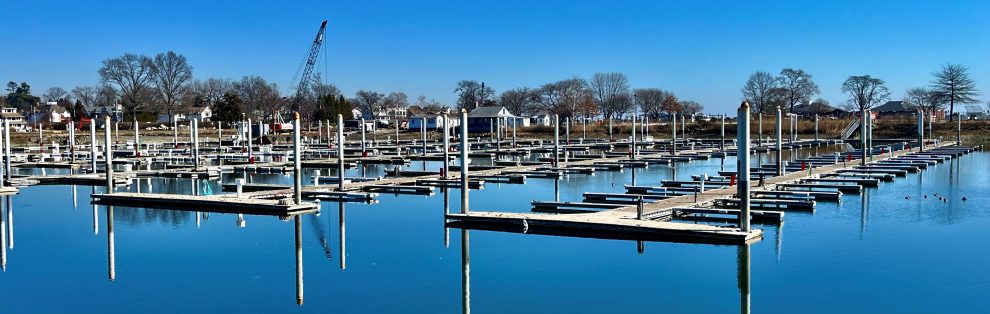
Holiday message on Saugatuck Shores (Photo/Rindy Higgins)
The Staples High School Music Department celebrated the holiday season last night with its 82nd annual Candlelight Concert.
It was stunning.
The choral symphonic and jazz ensembles awed the full auditorium with their voices and musicianship. The program — from the traditional, lovely “Sing We Noel” through the stunning “Nutcracker Suite,” rousing “Jubilate Deo” and clever production number, to the powerful “Home Alone Suite” and rousing “Hallelujah Chorus” finale — was both proof that our town’s young artists are very alive, quite well (and superbly well-trained), and that even in times of uncertainty and division, all can be right in Westport.
Thanks to all who produced and participated in last night’s Candlelight. Two more (sold-out) concerts continue today.

The “Sing We Noel” processional. (Photo/Lynn Untermeyer Miller)
=======================================================
It’s still hard to believe Sue Pfister is retiring.
The beloved Senior Center director has spent 36 years serving Westport with plenty of kindness, tons of care and tremendous competence.
The town gets a chance to say goodbye and share memories on Wednesday, December 28. An open house (1:30 to 4:30 p.m.) is set for her beloved Senior Center.
Can’t make it? Drop in virtually. Just click here; the passcode is “retirement.”
And once again: Thank you, Sue!

Sue Pfister
====================================================
Did you know that black plastic can’t be recycled?*
So what can you do?
Bring your washed, clean, black plastic takeout food containers (and matching lids) to the Westport Farmers’ Market the next 2 Thursdays (December 22 and 29, 10 a.m. to 2 p.m., Gilbertie’s Herbs & Garden Center, 7 Sylvan Lane).
Food containers will be used by Fridgeport Outdoor Food Pantry to repackage large trays of donated prepared foods into smaller portions for people facing food insecurity. Many recipients reuse the containers many times over.
The event is co-sponsored by Sustainable Westport and Food Rescue CT
*Why can’t black plastic be recycled? Optical sorting systems used to sort recycling cannot identify it as “plastic.” When black plastic is placed incorrectly with other items it contaminates the overall recycling stream reducing its value. In addition, black plastic has a hazardous level of toxins that increase in the recycling center. So whenever you can: Refuse or reuse black plastic!

=======================================================
¡Felicidades! to José “Feliz Navidad” Feliciano and his wife Susan.
The longtime Weston residents are the proud grandparents of twin grandsons. Their daughter Melissa and her husband Charles announce the birth of Theodore “Theo” Jose and Beau William Erickson.
They arrived 5 weeks early, weighing 3.13 and 6.02 pounds respectively.
They’re home and thriving, with Theo coming home on his mother’s birthday.
José and Susan say: “The Feliciano and Erickson families are blessed, and thrilled beyond words. So many prayers offered by so many good and loving people … we are incredibly grateful.”

Proud grandparents Jose and Susan Feliciano.
====================================================
The bar for our Entitled Parkers feature is extremely high. Usually, someone hogging 2 spaces won’t make the cut. “06880” readers demand something even more egregious: 3 spaces perhaps, or a vehicle completely covering a sidewalk.
But this Very Important Person takes today’s (Trader Joe’s) cake.

He — and you know it’s a guy —
========================================================
Speaking of driving: We’re not sure how this car managed to get where it is — the grass near Cabin 1 at Longshore.
But it doesn’t hurt to remind everyone: Be careful out there.

(Photo/Andrew Colabella)
Andrew Colabella — who was driving (carefully) by — reports that the driver was okay.
=====================================================
Westport Sunrise Rotary’s guest speaker yesterday was Lexi Shereshewsky.
Founder and Executive Director of the Azraq Education and Community Fund (formerly The Syria Fund) — a non-profit providing education programs and hands-on humanitarian aid to Syrian refugees and other vulnerable families living in Jordan — she’s no stranger to the group. Sunrise Rotary is a longtime supporter.

Lexi Shereshewsky and Rick Jaffe, past president of Westport Sunrise Rotary.
======================================================
Thursday was wet and windy.
But on Friday — yesterday morning — our Public Works crew was out early, cleaning Compo Beach.
It’s the kind of thing most people don’t notice, on a December weekday.
But Sunil Hirani did. Here’s his photo:

(Photo/Sunil HIrani)
Thanks to all the often-unseen workers, who make this town what it is.
=====================================================
Today’s “Westport … Naturally” photo shows Friday’s nasty weather, as seen at Compo Beach.
The weekend forecast is nicer: partly cloudy skies today, sunny tomorrow. Temperatures will be in the high 30s and low 40s.
It’s a great time to get your shopping done. Or head to the beach.

(Photo/Sunil Hirani)
======================================================
And finally … we don’t have video of last night’s “Candlelight Concert” (copyright issues prevent its recording and posting).
But here’s a wonderful version of one of its centerpieces, performed by a community choral ensemble in South Carolina:
Christmas, Hanukkah — and tiles — are part of this week’s online art gallery.
No, not those “River of Names” Westport Library tiles.
These are much less controversial. They’re part of the holiday season too.
Remember: This is your feature. All readers are invited to contribute. Age, level of experience, subject matter — there are no restrictions.
All genres are encouraged. Watercolors, oils, charcoal, pen-and-ink, acrylics, lithographs, collages, macramé, jewelry, sculpture, decoupage and (yes) needlepoint — whatever you’ve got, email it to 06880blog@gmail.com. Share your work with the world!
Ho ho ho!

“Happy Chanukah” (Amy Schneider)

Untitled. Artist Anne Bernier writes: :Getting crafty at Christmas with some watercolor gnome bookmarks..”

“Abstract Tiles” (Patricia McMahon)

“Friendship Sloop ‘Jolly Buccaneer” — India ink on a clear negative, printed in reverse. This Christmas card was created by artist Peter Barlow, a while ago.

Untitled (Kathleen Burke)

“Kiss Me” — Galapagos Islands. Photographer Mike Hibbard explains: “There are so many people who are not loved, not hugged, and not kissed. It is so painful to be lonely and not ‘kissed.’ This brings tears to my eyes and my heart. I am blessed to be loved, and hugged, and kissed. Let’s please give our love, hugs, and kisses to those in need.”

Untitled (Tom Doran)

“Where Have All the Flowers Gone? The Girls Have Picked Them Everyone!” (Steve Stein)

“It’s a Stretch” (Lawrence Weisman)

Untitled — Rocky Ridge Road (Linda Franco Doyle)
Posted in Arts
Tagged Amy Schneider, Lawrence Weisman, Mike Hibbard, Patricia McMahon, Peter Barlow, Steve Stein
When the Westport Library asked the Westport History for Museum & Culture for advice on the “River of Names” mural, the Museum cited a number of what they called “historical inaccuracies, inaccurate representations, and perhaps most importantly glaring omissions of fact based on idealized Euro-centric views of the past.”
Dorothy Curran disagrees.
She wrote and helped publish an art historical catalogue that accompanied the tile mural, and upon which the Museum based much of its criticism. Offering a fascinating (though of course incomplete) tour of local history, Dorothy writes:
In October 2021, the Westport Library, seeking not to return the “River of Names” historical bas-relief ceramic donor tile mural to the Library interior, asked Ramin Ganeshram, executive director of the Westport Museum for History & Culture, for a Diversity, Equity and Inclusion opinion on the mural’s content.
Ramin, along with WMHC colleague Cheryl Bliss, focused not on the mural itself, but on “River of Names: An Historical Tile Mural at the Westport Public Library” — my accompanying art historical catalogue. As a then RTM-appointed Library trustee, I donated my time writing it and raising another $25,000 to pay for photography, graphic design, printing, binding and shipping of 5,000 copies.
The aim was for a portable “art docent tour” of the mural, and a long-term book sale revenue stream for the Library. (If you need last-minute holiday gifts, the beautifully printed and bound volumes still sell, for $5 or less, at the Westport Book Shop. All proceeds benefit the Westport Library.)

Here are my reactions to the DEI report:
Tile #1, 1637 Puritans & Pequots end Swamp War; Puritans plan settlement

The Westport Museum of History & Culture says that
The Pequot War of 1636-1638 began as a colonial Puritan response to the alleged murders of English colonists by Pequots. Rival tribes joined the Puritan initiative, but were horrified by English tactics. Puritans attacked and burned the Pequot village in Mystic, massacring most of the tribe’s women, children and elderly. Surviving Pequots sought to migrate west, but the English followed. The final battle — the Fairfield Swamp Fight in 1637, near what today is I-95 Exit 19 — was devastating. But thanks to intervention by Thomas Stanton, who spoke Algonquian, a massacre was avoided. For a very brief overview of a very complex series of events, here is a link with footnotes and bibliography for deeper study: https://en.wikipedia.org/wiki/Pequot_War
Why was this event included in the River of Names? Because following the Pequots across Connecticut was how Roger Ludlowe discovered Fairfield’s lovely salt meadows and decided to move his settlers from Windsor’s flood-prone Connecticut River banks to Fairfield. Westport later formed from parts of Fairfield and Norwalk. Neither the caption nor the catalogue’s summary provide the full story, but together they certainly inspire curiosity.
Tile #2, 1648 Pequannock Tribe agrees to sell “Machamux” to the five “Bankside” farmers

Yes, the concept of “selling” land to the English colonists was alien to migratory Native American tribes, but colonial records do document acceptance of the English purchase offer and remuneration. As for the Native Americans’ skin color, it is darker than the English, but not as deep as exhibit model photographs provided by the Mashantucket Pequot Museum. When I first saw this tile, I remarked to artist Marion Grebow; “They look like ghosts.” She smiled, knowingly. Very aware of how local Native Americans were ravaged by European diseases and warfare, she was making an artistic statement.
Tile #7, 1705 John Cable builds tidal mill, produces corn flour for emerging West Indies trade and Tile # 10, 1775 E. (Ebenezer) Coley builds saltbox home, shop and wharf; Tile #13, 1790 E. (Ebenezer) Jesup Builds Wharf on Saugatuck’s east Bank

Under British colonial rule, trade by its American colonies was restricted to England, and exports, to raw materials like lumber, in exchange for English finished goods. But thanks to lax enforcement, many locals became maritime commerce entrepreneurs (aka black-market bootleggers), trading products like corn meal for Caribbean molasses and rum. After 1763, increased enforcement helped precipitate the American Revolution. Yes, there were slaves in Puritan Connecticut, including enslaved Pequot survivors, but what now is Westport never was a hub for the larger transatlantic “triangular trade,” involving larger ships, sailing to Africa.
Tile #11, 1756, 1775, 1780, 1789 George Washington’s diaries record four trips through town, including an overnight stay at Marvin’s Tavern

You complain that in 1789, when Washington stayed overnight at Marvin’s Tavern: “The wall features other details of historical inaccuracy such as… Washington’s visit to Marvin Tavern in 1789… As a point of fact, Washington only rode white horses, however he would have been travelling by carriage during this presidential tour. Further, in 1789 he was President and made a point of wearing civilian clothing—not his Continental Army uniform as portrayed on the tile.”
In my catalogue discussion of Tile #11, I wrote: “By November, 1789, in reality, Washington was the first President of the 13 United States, a national icon, weary of war and no longer in military attire. Literal reality, however, is not Grebow’s primary concern. Instead, by returning Trumbull’s image of Washington, the Yorktown victor, the archetypal American Revolutionary War hero, to Marvin’s Inn in 1789, Grebow expresses completion of a cycle. Among the people who welcomed him back in 1789 were some who first greeted him in 1775, before the war began, some who suffered loss of life and property in 1777 when the war arrived here, and some who witnessed his 1780 meeting here with the French to end the war. While few if any were present at Yorktown when the fulfillment of this vision was realized, his victory there validated the personal and political dreams and values he epitomized and they shared. Grebow’s Washington, by extending a greeting with the same hand he refused to a British general, offers both a politically powerful and profoundly human statement. Grebow’s Washington, like the one we all revere, transcends the limits of space and time.”
P.S. Washington notes in his diary that he was less than pleased with his stay at Marvin’s Inn, which makes his gesture even more gracious.
Tile #17, 1810 Catherine Burr Sherwood, farm wife & mother of ten, including triplet sea captains
Commemorating the birth of the Sherwood triplets during a heavy snowstorm, this tile illuminates the vital, often overlooked impact of women in local colonial history, including building and maintaining families with very little medical assistance. In fact, at about the same time that Catherine Burr Sherwood gave birth to her eighth, ninth and tenth children (the triplets), her sister-in-law died in childbirth, so the family then had 11 to raise. The later maritime careers of the 3 triplets are a topic for separate study.
Tile #19, 1832 Saugatuck Congregational Church and Saugatuck Fire Co. established

Well into the 19th century, Puritan governance practices persisted in Connecticut. For example, new towns first needed a new seat of government: a Congregational church, with selectmen presiding. Only after the Saugatuck Church’s 1832 completion could Westport petition the state for a town charter. Likewise, forming the Saugatuck Fire Co. ended emergency dependence on Norwalk and Fairfield. The scope, limits and flaws of the 1818 Connecticut Constitution are topics for separate study.
Tile #18, 1814 Saugatuck Manufacturing Co. makes cotton yarn at Richmondville Ave. site and Tile #20, 1835 R.H. Haight’s tannery, later Kemper Tannery, makes leather hat bands
British rule forbade American colonial manufacturing, forcing Americans to buy British finished goods, at Britain’s prices. After American manufacturing began, the British War of 1812 coastal shipping blockade caused such severe economic hardship that Connecticut briefly considered secession from the new union. Happily, the war ended.
That era’s Connecticut manufacturers (and families, for supplemental income) relied on labor by children, immigrants, apprentices and indentured servants for success. Most children, like their parents, attained only an elementary education, but received training in other skills needed for farm and household management.
Neither tile can begin to probe the era’s labor practices, but each can inspire curiosity to learn more.
Tile #24, 1852 First Bank
You are correct that: “Descriptions of the building of the Westport Bank by Horace Staples and later refurbishment of the property at large (National Hall) on tile #24 (Curran) fails to indicate that the National Hall portion of the building referred to the 2nd floor where a theater was located. Minstrel shows, caricaturizing African Americans, were a popular attraction at this theater.”
That’s asking a lot of an already crowded 6″x4″ tile.
Tile #25, 1840’s, 1850’s & 1860’s Emerging diversity of religious worship

Though this tile depicts a “diversity of religions,” groups assessing the River of Names say that it presents a very Christian-centric view of Westport’s history. There are no tiles for other religions.
In mid-19th century Westport, where the 1832 Saugatuck Congregational Church was the seat of government, one way to observe emerging diversity was construction of churches by other denominations: Episcopalian, Methodist and Catholic. Yes, other religious congregations existed then, but were not in construction mode. A 6″x8″tile can only prompt curiosity to learn more.
Tile #35, 1899 First autos on Post Road
Your complaint: “The tile #35 (Curran) referring to the first automobiles in the town misses the opportunity to talk about the Toquet Motor Company here in Westport which produce a motor car earlier than Ford.”
As my catalogue states, #35 depicts an eyewitness account by local historian Edward Coley Birge, astonished at being passed on the Post Road by a “self-propelled open buggy,” likely a Stanley Steamer. Discussing Toquet Motor Company was not a fit for this tile. That does not make it historically inaccurate, Euro-centric or exclusive.
Tile #49, 1947 Lucille Lortel founds the White Barn Theatre
Yes, Lucille (not “Louise”) Lortel protected, nurtured and paid talented actors, writers, composers and designers. Agreed that not much can be said on a 6″x8″ tile about the “the opportunity she gave to the Black performers in the era of segregation.” Likewise, not much could be said here about her equally important role in continuing to employ “unemployable” McCarthy-era black-listed writers and actors. But naming her and the White Barn on a tile is a start.
Tile #68, 1980 Westport Historical Society, established 1889, acquires its home, Wheeler House, built 1795

Your complaint: “The information about Westport Museum (Westport Historical Society) on tiles #68 (Curran) is inaccurate. The original building on this site was a 2nd period colonial style, like the building currently across the street. The ocular windows in the current structure are not unique as stated—two other Italianate houses on Main Street feature them.”
In fact, the 12″x12″ River of Names tile #79 makes no such statement. My catalogue does refer to the original structure (still inside the Bradley-Wheeler house) as probably a saltbox. Agreed that ocular windows per se are not a unique feature of Italianate architecture.
P.S. What does this discussion of architectural detail have to do with diversity, equity and inclusion?
Tile #79, 1996 Bradley-Wheeler Museum restored
You complain that: “The tile referring to the Bradley Wheeler barn refers to the statues on our property as sculptures—they are, in fact, miniature golf statues, made for use on a private miniature golf course. They are not sculptures.”
Tile #79 makes no such statement. My catalogue does call them sculptures, mostly because they are free-standing folk art created by famous, fun-loving Westport artists, whose major commissions included work at Disney World. The Einsel valentines to each other were remarkable.
Re: your comment that “The description refers to the towns “diverse cultural heritage” although there is virtually no representation of non-Europeans on the picture tiles of the River of Names Wall.”
The mural’s 84 picture tiles, ranging in size from 6″x4″ to 12″x12,” and covering over 350 years, offer only a glimpse of our history. My catalogue merely enriches that glimpse. In no way does that mean that this peek at our history is, in your language, “whitewashed.”
Diverse cultural heritage means many things. New England’s Puritan colonists were British subjects. Many River of Names tiles depict no people at all; instead, they show architecture and boats extending British tradition. Collectively, that makes our depiction of New England colonial history not so much “Euro-centric” as Anglo-centric. Over time, our town, state and country have grown and evolved. Today, looking back at the long, imperfect arc of our dynamic cumulative history, warts and all, I think most Westporters simply would call it “American.”
Done for the season at Compo …

Kayaks …

… and boats …

,,, at Ned Dimes Marina. (Photos/Dinkin Fotografix)
Comments Off on Pics Of The Day #2069
Posted in Beach, Pic of the Day
Tagged Compo Beach kayaks, Ned Dimes Marina
The year was 1803. Thomas Jefferson was in the White House. The Louisiana Purchase doubled the size of the United States.
And — nearly 180 years ago — Westport did not even have a legitimate Main Street.
The other day, Morley Boyd and Wendy Crowther were in the Westport Library, researching our town’s stone bridges. They stumbled on a remarkable map — one that even they, despite their years as diligent historians, had never seen.

They note that while Elm Street and Avery Place are connected close to the river, Main Street is still just a “proposed road” (outlined with dashes, left side of the map).
Myrtle Avenue was part of the “King’s Highway.” There were just a scattering of houses throughout the area.
The forerunner of what later became the Westport Hotel — at the corner of State Street (Post Road) and Main Street — was called the Nichols Hotel.
That makes sense. The village on the map was still “Saugatuck.” It would not become “Westport” until 1835.
That’s another 32 years, 4 presidents, and 7 states admitted to the union later.
(“06880” has been around far fewer years than Westport. But since our founding in 2009, we’ve never missed a day of posting. Please click here to help us continue our work. Thank you!)
Posted in Downtown, Friday Flashback
Tagged Avery Place, Elm Street, Morley Boyd, Myrtle Avenue, Wendy Crowther, Westport map
Opening today (with just 9 shopping days left before Christmas): OKA.
The British furniture and home accessories retailer moves into the former Banana Republic (and before that, Klein’s) space on Main Street.
They call this their “US flagship.” There are 14 OKAs in the UK, plus 2 in Texas (Dallas and Houston).
A press release hails the store’s “signature mix of classic, eclectic and contemporary furniture and homeware (for) shoppers and designers looking to add character to their homes.”
OKA’s Westport location includes a “series of fully decorated rooms and vignettes featuring a treasure trove of unusual finds and statement pieces. (There are) samples of our custom handmade seating service, Tailored by OKA, an English garden’s worth of faux flowers and plants, and a dedicated team of Home Stylists on hand to give advice and help realize your dream interiors. ”
O-kay!

=======================================================
Meanwhile, opening yesterday: A new 30,000-square foot specialty care center opened, at 191 Post Road West (just west of Nash’s Plaza).
Connecticut Children’s Specialty Care Center features murals of the ocean, forests, sky and stars (with 12 LED constellations). There are self check-in kiosks, exam and procedure rooms, an outpatient infusion center, imaging services, plus speech, occupational and physical therapy, EEG and echocardiogram, and casting rooms.
This is the largest of Connecticut Children’s 6 specialty care centers. More than 20 specialties are represented.
Yesterday’s grand opening included a paper ribbon chain made by area kids, and Santa (and the Grinch) handing out toys.

Santa arrives at the Connecticut Children’s Specialty Center.
=======================================================
Didn’t score a ticket for this weekend’s Candlelight Concerts? Or just a holiday music junkie who wants to hear more from the fabulous Orphenians?
The highly acclaimed Staples High School a cappella group present their traditional December program for the Y’s Men of Westport and Weston — and everyone is invited.
The event is Monday (December 19, 5 p.m.) at the Westport Library Trefz Forum.

Staples’ Orphenians are in high demand this month. In addition to this weekend’s Candlelight Concert, they sang recently at the town holiday tree lighting, for the Rotary Club and at Assumption Church — among many other gigs.
=======================================================
Looking for a nice holiday meal?
La Plage — the popular and scenic Longshore Inn restaurant — offers 3-course dinners on Christmas Eve (4 to 10 p.m.) and Christmas day (noon to 7 p.m.), plus an early New Year’s Eve dinner (5 to 7 p.m., with a la carte specials); a gala New Year’s Eve dinner (8:30 to 10:30 p.m.; 5-course menu, Champagne toast, and live music by Tangled Vine),
Click here for menus and reservations.

=======================================================
With approval ratings above 75%, Charlie Baker is the most popular governor in the nation.
The Massachusetts Republican chose not to run again. When his term ends next month, he’s got a new gig: President. (Of the NCAA, that is.)
The tangential connection to “06880” is that Governor Baker’s wife — Lauren Schadt — grew up in Westport. Back then, she was “Laurie.”
She’s no slouch herself. With an MBA from Northwestern’s Kellogg School, she is a marketing communications consultant. She is active in many volunteer efforts, focusing on education. As First Lady of Massachusetts, she worked closely with the Department of Children and Families.
Governor Baker is familiar with his new role. Two of his and Lauren’s 3 children are former college athletes.

Governor Charlie Baker and Lauren Schadt Baker.
======================================================
Our “Westport … Naturally” feature usually celebrates the animals, flowers, trees and other scenes of beauty that make our town beautiful.
Today’s image is from Terrain. Sure, it’s a business. But there are enough elements of nature here — and it’s so beautifully photographed by Patricia McMahon — that it fits right in.

(Photo/Patricia McMahon)
=======================================================
And finally … happy 76th birthday to Trevor Pinnock. The English harpsichordist and conductor — heard often on WSHU’s “Sunday Baroque” — is 76.
Comments Off on Roundup: OKA, Orphenians, Children’s Care …
Posted in Children, Local business, Politics, Restaurants, Sports, Staples HS, Teenagers
Tagged Charlie Baker, Connecticut Children's Specialty Care Center, La Plage, Lauren Schadt Baker, Oka, Staples High School Orphenians, Y's Men of Westport and Weston
Westport parks get lots of love.
Big ones like Longshore and Winslow bustle with activity. Smaller ones like Grace Salmon on Imperial Avenue are visited often too, by ardent fans.
For decades though, Riverside Park was an afterthought.
Tucked away near the busy Riverside Avenue/Saugatuck Avenue fork, it was easy to overlook. Trees and brush covered the entrance. Parking was limited. Hardly anyone knew that — past the overgrowth and weeds — lay a magnificent view of the Saugatuck River.

Riverside Park, before improvements.
Now they do.
A Parks & Recreation Department project removed invasive species and a few trees. A new design created truly open space, plus a wooded area with rocks.
It’s inviting. It’s handicap accessible.
And — even driving by — it’s easy to see the beautiful river.
For a small spot, Riverside Park has a long history. In the 1950s, it was where contractors dumped rocks as I-95 was built nearby.
In the 1970s, the town bought the land. At some point, officials thought, the Saugatuck fire station would be relocated there.
That never happened. It became a little used, barely maintained, often overlooked ugly stepchild.
No longer.

One view of the “new” Riverside Park …
Parks & Rec director Jen Fava is proud of the transformation. In addition to the removal of invasives and improved vistas, it includes new plantings, a pollinator garden and rain garden.
The I-95-era rocks have been been moved, to create a more natural look and feel. Some have been repurposed for seating.
The project also adds picnic tables; a permeable surface stable enough for people with wheelchairs and walkers; a new parking lot, and an extended sidewalk on Riverside Avenue.
The cost of the new park was $436,000. The parking lot and sidewalk were another $74,000, funded through the Department of Public Works.

… and another …
As with any municipal project, it did not happen overnight. The department worked with its Parks Advisory Committee and SLR Consulting on the design. It was approved by the Parks & Recreation Commission and Board of Finance.
“It’s important get people right down to the water,” Fava says. “And if we’re doing the work, we should make it as accessible for as many people as possible.”
Work began this summer. It’s almost complete.
Fava says that many Westporters are already enjoying the “new” Riverside Park.
And, she promises, “it will look especially great this spring.”
(Every day, “06880” brings you news from every part of Westport. Please click here to support your hyper-local blog. Thank you!)

… and a third. This one looks north.

Compo Beach: A clear view from Soundview (Photo/Sunil Hirani)
Comments Off on Pic Of The Day #2068
Posted in Beach, Pic of the Day
Tagged Compo Beach, Soundview Avenue
The Westport Library board of trustees has issued a statement regarding the River of Names mural. They say:
In recent days, we have listened to, heard, and read the comments from some members of the community regarding the decision of The Westport Library Board of Trustees to not reinstall the River of Names tile wall at The Westport Library.
To address the concerns raised and to avoid any misunderstandings, below is a timeline of the River of Names project:

The River of Names was hung in the lower level of the Westport Library.

(From left): Former 2nd Selectwoman Betty Lou Cummings, tile artist Marion Grebow and historian Dorothy Curran. All were involved in the River of Names project.

The Westport Library (Photo/Lynn Untermeyer Miller)
The decision not to reinstall the tile wall was one made by the Library’s Board of Trustees and the Board alone. We appreciate that not everyone agrees with the board’s conclusion, and we understood that it might not be universally popular, but it was made in good faith based on the mission and values of the Library.
We love Westport for many reasons, and one of the things we cherish most is that Westporters are passionate and engaged. We believe that reasonable people can disagree, at times strongly, on an issue, and we support that conversation. In fact, it aligns with the Library’s stated commitment to empower the individual and strengthen the community through dynamic interaction and the lively exchange of ideas.

The Board advocates for civil conversations that are respectful and topical, not derogatory, or personal. We ask that varying points of view be shared respectfully and for the ongoing discussion to be one of learning, sharing, decency, courtesy, and growth.
We are grateful for our continued partnerships with the Town’s Art Advisory Council, TEAM Westport, and the Westport Museum for History and Culture. The Westport Library looks forward to continuing to work on our shared interests with the goals of enriching the lives of the residents of Westport and beyond. It is unfortunate that through this recent discourse, these organizations are being attacked for a decision the Library’s Board of Trustees made regarding the tile wall.
The motto of the Library is “open to all” — and we truly see it that way. That is not only those who agree with this decision or those who will disagree with a future decision. The Library is for everyone, a gathering space and a community resource. We are thankful to all who have reached out to share their thoughts constructively. Please know we have listened and regarded every opinion. And we look forward to sharing this community space — in the days, weeks, and years to come.
Sincerely,
Westport Library Board of Trustees

Click here to help support “06880” via credit card or PayPal. Any amount is welcome, appreciated — and tax-deductible! Reader contributions keep this blog going. (Alternate methods: Please send a check to “06880”: PO Box 744, Westport, CT 06881. Or use Venmo: @blog06880. Or Zelle: dwoog@optonline.net. Thanks!)