Category Archives: Looking back

Friday Flashback #27

As Bedford Square nears completion — and an Elm Street/Baldwin parking lot land swap is back in the news — it’s a great time for a bird’s-eye view of downtown Westport, 1965-style.

Click on or hover over to enlarge.

Click on or hover over to enlarge.

It’s tough to see the old Y (new Bedford Square), or any part of Elm Street, thanks to the trees. But this photo — by R.P. Lentini, courtesy of alert “06880” reader Matt Murray — intrigues me for several reasons. Among them:

  • The old Victorian house still stood on Gorham Island
  • The Wright Street building was a decade in the future
  • The building between Christ & Holy Trinity Church, and what is now Seabury Center.

What stands out for you? Click “Comments” below.

Zelda!

F. Scott and Zelda Fitzgerald spent just a few months in Westport — way back in 1920.

But it made a lasting impact on their lives.

Now Netflix and Amazon Prime viewers can relive that crazy time through a new series called “Z: The Beginning of Everything.”

Christina Ricci plays Zelda, “the brilliant, beautiful Southern Belle who became the original flapper and icon of the wild, flamboyant Jazz Age.”

In episode 9, “Scott and Zelda work through rising marital tensions at their Westport house.”

Sounds interesting.

Even if it was filmed on Long Island.

Zelda today...

Zelda today…

F. Scott and Zelda Fitzgerald, in front of what appears to be their Westport home.

and yesterday, with F. Scott Fitzgerald in front of their Westport home.

(Hat tips: Erica Peale and Jeff Mitchell)

Happy 216th Birthday, Horace Staples!

From the opening of Staples High School in 1884, to a few years after he died 13 years later at age 96, students and faculty celebrated January 31 — Horace Staples’ birthday — as “Founder’s Day.”

That tradition — dormant for over a century — gained new life today. The Staples chapter of Rho Kappa — the national high school honor society — brought Founder’s Day back..

Exhibits outside the auditorium, created by nearly every academic department, portrayed life in the late 19th century. The culinary classes dedicated one to onions. After all, when Staples’ High School (as it was punctuated then) was dedicated, the Westporter newspaper proclaimed, “A good high school will increase the value of property, and raise the price of onions.”

1880’s music played between classes.

And “Horace Staples” — the founder who was a businessman, merchant, factory owner, bank president and farmer — roamed the halls again today. He wandered into classrooms, discussing the differences between his school in 1884 and the 2017 one that sits, a few miles from his original Riverside Avenue building, on North Avenue.

"Horace Staples" posed with students in Barbara Robbins' English class this morning.

“Horace Staples” (center) posed with students in Barbara Robbins’ English class this morning.

Students asked questions. Mr. Staples answered everything from what Westport was like back then (“there were not as many very large houses”) to what he thought of the school today (“you have so many wonderful teachers; be sure to listen to them, read, think, and make your mark on the world”).

And who was “Horace Staples”?

Why, the guy who wrote the book — Staples High School: 120 Years of A+ Education — about his own alma mater.

"Horace Staples," with his portrait near the front entrance to Staples High School. He hasn't aged a bit.

“Horace Staples,” with his portrait near the front entrance to Staples High School. He hasn’t aged a bit.

Friday Flashback #24

“06880” readers like our Friday Flashbacks. This one they’ll love.

Actually, it’s a two-fer. Back in the day, Westport was home to not 1, but 2, sanitariums. (Sanitaria? Whatever. If you’ve forgotten your medical history, a sanitarium was a hospital for the treatment of chronic diseases, often tuberculosis or mental disorders.)

The best known and most visible was originally the former mansion of Henry Richard and Mary Fitch Winslow. Built in 1853 and named Compo House, the palatial home was surrounded by guest houses, servants’ and gardeners’ quarters, and gorgeous gardens. Former president Millard Fillmore was a visitor, and extravagant fireworks were shot off there every July 4th.

By 1907, it had become the Westport Sanitarium. Here’s how it looked then:

westport-sanitarium-1907-now-winslow-park

The building was torn down in the 1970s. It had long earlier fallen into disuse, becoming an attractive nuisance to teenagers, drug users and other random folks.

No wonder. It was just a few steps away from downtown, on land bordered by the Post Road and North Compo.

Today, it’s the site of a dog park. Its name is Winslow, in honor of the original owners. The sanitarium is the reason for all those asphalt paths, in places you’d never expect them.

Our 2nd sanitarium — named for its owner, Dr. McFarland — was on Long Lots Road. In later years it became a full-fledged psychiatric hospital, called Hall-Brooke. A building visible from Long Lots was renamed McFarland Hall.

This is what Dr. McFarland’s Sanitarium looked like in the early 1900s:

dr-mcfarlands-sanitarium-hall-brooke

The photo above is of the main building. The other building was visible for many years from Long Lots.

If you’ve got memories of either sanitarium, click “Comments” below.

(Photos courtesy of Seth Schachter)

MLK

This story has become a Martin Luther King Day tradition on “06880.”

Today is Martin Luther King Day. Westporters will celebrate with a day off from school or work.  Some will sleep in; others will ski, or take part in a Staples basketball clinic for younger players. Few will give any thought to Martin Luther King.

Twice, though, his life intersected this town in important ways.

Martin Luther KingThe first was Friday night, May 22, 1964. According to Woody Klein’s book Westport, Connecticut, King had been invited to speak at Temple Israel by synagogue member Jerry Kaiser.

King arrived in the afternoon. Kaiser and his wife Roslyn sat on their porch that afternoon, and talked with King and 2 of his aides. She was impressed with his “sincerity, warmth, intelligence and genuine concern for those about him — our children, for instance. He seemed very young to bear such a burden of leadership.”

King’s sermon — to a packed audience — was titled “Remaining Awake Through a Great Revolution.” He analogized his America to the time of Rip Van Winkle — who also “slept through a revolution. The greatest liability of history is that people fail to see a revolution taking place in our world today.  We must support the social movement of the Negro.”

Westport artist Roe Halper presented King with 3 woodcarvings, representing the civil rights struggle. He hung them proudly in the front hallway of his Atlanta home.

Artist Roe Harper (left) presents Coretta Scott King with civil rights-themed wood carvings.

Within a month Temple Israel’s rabbi, Byron Rubenstein, traveled south to take place in a nonviolent march. He was arrested — along with Rev. Dr. Martin Luther King.

In jail, the rabbi said, “I came to know the greatness of Dr. King. I never heard a word of hate or bitterness from that man, only worship of faith, joy and determination.”

King touched Westport again less than 4 years later. On April 5, 1968 — the day after the civil rights leader’s assassination in Memphis — 600 Staples students gathered for a lunchtime vigil in the courtyard. Nearby, the flag flew at half-staff.

A small portion of the large crowd listens intently to Fermino Spencer, in the Staples courtyard.

A small portion of the large crowd listens intently to Fermino Spencer, in the Staples courtyard.

Vice principal Fermino Spencer addressed the crowd. Movingly, he spoke about  his own experience as an African American. Hearing the words “my people” made a deep impression on the almost all-white audience. For many, it was the 1st time they had heard a black perspective on white America.

No one knew what lay ahead for their country. But student Jim Sadler spoke for many when he said: “I’m really frightened. Something is going to happen.”

Something did — and it was good. A few hundred students soon met in the cafeteria. Urged by a minister and several anti-poverty workers to help bridge the chasm between Westport and nearby cities, Staples teachers and students vowed to create a camp.

Within 2 months, it was a reality. That summer 120 elementary and junior high youngsters from Westport, Weston, Norwalk and Bridgeport participated in the Intercommunity Camp. Led by over 100 Staples students and many teachers, they enjoyed swimming, gymnastics, dance, sports, field trips, overnight camping, creative writing, filmmaking, photography, art and reading.

It wasn’t easy — some in Westport opposed bringing underprivileged children to their town — but for over a decade the Intercommunity Camp flourished.

Eventually, enthusiasm for and interest in the camp waned. Fewer Staples students and staff members wanted to devote their summer to such a project.  The number of Westporters willing to donate their pools dwindled. Today the Intercommunity Camp is a long-forgotten memory.

Sort of like the Rev. Dr. Martin Luther King. Even on his birthday.

MLK speech

Compo Marina: Then And Now

In the wake of my recent “06880” post about the upcoming Compo Beach marina dredging project — specifically, who should pay for it — plenty of folks weighed in (on both sides of the issue).

The 50-plus comments included several from long-time and once-upon-a-time slip owners. Some recalled an era before permanent docks, when you did not have to wait several years for a mooring permit.

Now, alert reader Matt Murray sends along this fascinating aerial photo:

compo-marina-aerial-1965-rp-lentini

Click on or hover over to enlarge.

The shot — taken by R.P. Lentini in 1965 – shows a much less crowded basin, for sure. And yes, owners had to toot horns to be ferried from their boat to the dock.

But there are some other interesting items too, which you can see clearly if you hover over the photo or click on to enlarge.

Chubby Lane’s concession stand sits where the volleyball courts are today.

To the south of Chubby’s and the pavilion are the old (and very scary) wooden bathhouses.

But what are those two rectangular things in the bottom of the photo, near the west end of the circular drive?

And — most importantly — why was there no one at the beach?

It’s mid-summer; the trees are full. But there are just a couple of cars, and no one on the sand.

It’s hard to tell from the photo. Perhaps it was taken just after a thunderstorm.

Or maybe no one went to Compo in the summer of ’65?

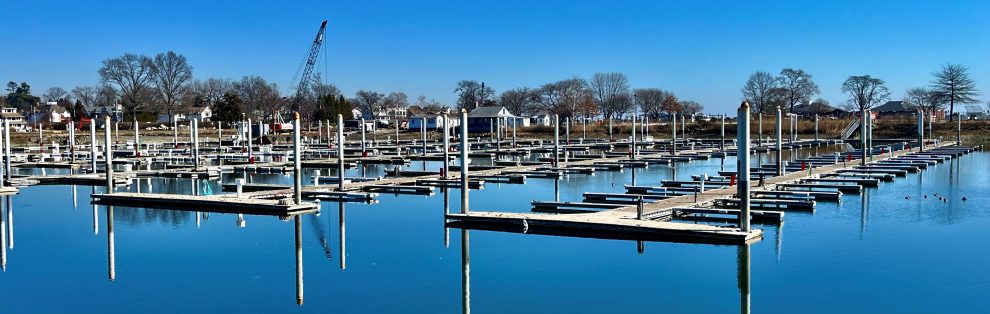
A much more recent shot of the Compo Beach Ned Dimes Marina.

A much more recent shot of the Compo Beach Ned Dimes Marina.

Friday Flashback #22

In the early 1950s, Peter Barlow took this photo:

westnor-diner-1950s-peter-barlow

Here’s the back story. The car-carrying  truck was parked outside the Westnor Diner one evening. The Westnor was on the corner of Post Road West and Sylvan Road North — where J. Pocker and Belmondo are now. The diner’s name comes from its Westport location, near Norwalk — get it?

In those days — before I-95 — all trucks traveled on the Post Road. It was a mess. As much as we loathe the highway, it’s taken tons of traffic off our streets.

Peter — who took this photo with an amateur camera (using a flashbulb) — figures that with all the snow on the truck, the driver was inside “having a leisurely meal.”

This is a serene scene. But directly across the street, a few years earlier — on May 2, 1946 — a truck blew a tire, smashing into a drum filled with vulcanizing cement.

The resulting explosion set off a spectacular blaze. Fire chief Frank Dennert, former fire chief Francis Dunnigan, and 2 other firefighters were killed. Eight people were injured. It was one of the worst disasters in Westport history.

Restaurant Rights Abandoned; Big Changes Ahead For Old Mill Beach

The on-again, off-again, on-again saga of a restaurant near Old Mill Beach is off again.

This time, forever.

When Positano — the latest in a string of restaurants on Hillspoint Road — closed almost exactly 2 years ago, there was speculation the new owners wanted to tear it down, and build a big house right there on the sand.

There was also talk that some neighbors — fearing the loss of their shoreline view, and enjoying the funkiness of a restaurant in the midst of a residential area — were doing what they could to make sure a new restaurant took Positano’s place.

The "Positano property," at Old Mill Beach diagonally across from Elvira's.

The “Positano property,” at Old Mill Beach diagonally across from Elvira’s.

That was somewhat ironic. When Positano applied for patio dining in 2012, neighborhood opposition scuttled the plan. Lack of outdoor seating was one factor leading to Positano’s closing, and its subsequent move to a new location next to the Westport Country Playhouse.

Though a number of residents worked for months to get another restaurant on the site, one neighbor continued to object. She sued.

Now comes news that the owner of the property — an LLC with an office in Nashville, Tennessee — has filed an affidavit with Westport’s Planning and Zoning Department. The owner acknowledges and affirms that “any and all commercial uses of the premises at 233 Hillspoint Road have been irrevocably abandoned and discontinued.”

In other words, any chances for a new restaurant — grandfathered in as a pre-existing condition — has been killed. Now, and in perpetuity.

Before it was Positano, 233 Hillspoint Road was several other restaurants (including, most notably, Cafe de la Plage). But before THAT it was a grocery store. Among its names: Beach Food Mart, and Joe's.

Before it was Positano, 233 Hillspoint Road was several other restaurants (including, most notably, Cafe de la Plage). But before THAT it was a grocery store. Among its names: Beach Food Mart (above), and Joe’s.

So what happens next?

The property is back on the market. It’s listed as “A Generational Waterfront Opportunity.”

Potential buyers have a chance to “build and live directly on Compo Cove Beach’s [sic] most unique [sic] lot with spectacular Long Island Sound views.” The land “is now available for a luxury private home to be built.”

Buyers can enjoy “the most beautiful expansive water views, spectacular sunrises and sunsets” (those sunsets might be tough, since the listing notes it is an “east facing property”, and Compo Hill is a substantial obstruction to the west).

This photo from the real estate listing shows the current footprint of the former restaurant (center). The yellow line shows the property boundaries.

This photo from the real estate listing shows the current footprint of the former restaurant (center). The yellow line shows the property boundaries. Click on or hover over to enlarge.

The listing continues:

Enjoy the ever-changing tides and light, the shore birds, and the tranquility that exists with living right on the beach. With no neighbor to your right,  it’s like having your own front row seat to the best Long Island Sound offers — sunbathing, swimming, fishing boating…

Seize this opportunity to create your own magnificent custom home for the first time ever on this site.

The cost?

A mere $4,500,000.

But wait! There’s more!

Elvira’s — diagonally across Hillspoint from #233 — continues to be on the market too. There’s been no sale yet, but word on the soon-to-drastically-change street is that it may not remain a grocery store/ community center.

All of which is food for thought.

A good place to think about it is at the Sherwood Mill Pond Preserve.

You know — where for nearly a century, Allen’s Clam House used to be.

4 Stony Brook, 5 Golden Rings

It was always a tense moment.

We gathered in the cozy living room of the Bacharachs’ house on Stony Brook Road. We’d caught up on each other’s lives, had a bit of food, sung a few warm-up Christmas carols.

Now it was time for “The 12 Days of Christmas.” Slips of paper would be passed out. Which “day” would you get?

There were a few dozen of us — old and young, relatives and friends, from near and far — but 12 days is a lot. Each of us would have only 3 or 4 other singers to help out.

All ages gathered at the Bacharachs' house for the annual carol sing. This photo is from the early 1970s.

All ages gathered at the Bacharachs’ house for the annual carol sing. This photo is from the 1970s.

If you were a good singer — and many of the Bacharachs and their guests were — you were happy to get the 1st day: “a partridge in a pear tree.” Another prize was “5 golden rings.” You could draw that one out like Enrico Caruso.

I love music. Unfortunately, my voice does not. I always hoped for “12 drummers drumming.” Inevitably, I got “2 turtle doves.”

I thought of all that recently, when a group of former Bacharach carol singers got together. I was with some storied Westport names — Anne Leonard Hardy, Suzanne Sherman Propp — and the more we chatted, the more we realized those holiday gatherings were more than just a fond memory.

They were transformative moments in our lives.

The Bacharachs' library, where generations gathered to sing. (Photo/Robert Colameco)

The Bacharachs’ library, where generations gathered to sing. (Photo/Robert Colameco)

It wasn’t just the warmth of the Bacharachs’ home — a 1796 farmhouse with a 3-sided fireplace in one of the oldest sections of town, that could have come right out of colonial New England central casting.

It wasn’t the warmth of the annual holiday party either, with its cherished traditions: the smiling patriarch Jim Bacharach leading everyone in song; his wife, the equally delightful DoDo, carving up ham and ladling out egg nog; the tree in the same spot every year, unchanging amid the turbulence of the world around.

And it wasn’t the guest list: the Bacharachs’ friends and neighbors; their 5 kids’ friends; girlfriends, boyfriends, college friends — the more the merrier. Jim and DoDo embraced them all.

DoDo Bacharach

DoDo Bacharach

All those memories came flooding back, as Anne and Suzanne and a few others talked. But it was something else that made those particular carol sings such a powerful piece of our past.

Among the folks always in the Bacharachs’ home were adults we knew from Staples High School: teachers we admired and respected. Phil Woodruff, the next door neighbor. Dick Leonard. Dave and Marianne Harrison. All were there, year after year.

At first we were a little intimidated by them. Singing “The 12 Days of Christmas” with the same people who handed out homework and gave us grades was — different. But socializing with those adults in that way made us feel a bit like adults too.

As we grew up, we grew in other ways. We graduated from Staples, and entered college. Returning to the Bacharachs’ for the carol sing, we had new things to talk about. We told them what we were studying. We offered our opinions. We were probably a bit pretentious, but our former teachers listened.

Relating with them on that level validated us. Those adult-type conversations — respectful, honest, about real issues — were some of the first times I felt like an adult myself.

At the same time, as I looked around at the many “kids” there, I saw younger versions of myself. I realized I had once been like them. For the first time I understood what it meant to grow up. I recognized with clarity that at that point, my life was poised between my past and my future.

As we moved on into the “real world” — with real jobs — we kept returning to that carol sing. Now we were the adults. The Bacharachs, Leonards, Shermans and others got married, and started families. And every year, they brought their own children to the annual Christmas party.

The Bacharachs' next door neighbor John Woodruff, with his young daughter Emily.

The Bacharachs’ next door neighbor John Woodruff, with his young daughter Emily at the carol sing.

The Bacharach carol sing is no more. Sadly, the house was torn down, replaced by something far less warm and much less meaningful.

But the memories remain, as strong as ever. It was a joy to share those memories the other day, with good friends who remember those great days.

Something else is strong too: My sense of self, nurtured so lovingly by those adults years ago, when I was a teenager trying to figure the world out.

Over ham, over egg nog — and yes, over the dreaded “12 Days of Christmas” — I tasted Westport at its best.
Friday Flashback #19

This is one of our most intriguing Friday Flashbacks ever. It’s a great 1920s-era photo. It shows a place I’ve never heard of — and one I sure can’t identify.

(Photo courtesy of Seth Schachter)

Click on or hover over to enlarge. (Photo courtesy of Seth Schachter)

The caption says “Flambeau Tea Room.” There’s another word after “Flambeau,” but I can’t make it out. It might be “Salon,” or it might be another name. Click on or hover over the photo in case your eyes are better than mine.

At first glance, the building on the left resembles the Westport Country Playhouse. The one on the right looks like what’s now Positano restaurant.

But in the ’20s, the current Playhouse was a tannery that had fallen into disuse. And if you look closely, you’ll see a tall white structure behind the building on the right.

So who was Flambeau? What was his or her tea room? And where was it? If you know, click “Comments” below.

Meanwhile: It sure looks like an interesting place!