Tag Archives: Tyler Hicks

Tyler Hicks And The Somali Pirates

Where in the world is Tyler Hicks?

The Staples grad — now an internationally known New York Times photographer, who last year spent 6 days in Libyan captivity — is back in action. This time he’s in the Gulf of Oman.

Tyler’s photos of a Somali pirate being taken into American custody compellingly illustrate today’s fascinating Page 1 story about a hijacked Iranian fishing crew that outwitted terrorists armed with knives, a pistol and assault weapons.

One of the Somali pirates who seized an Iranian fishing vessel in the Gulf of Oman was taken into American custody. The Iranian hostages were able to let the Americans know their plight by speaking in Urdu, which their captors did not understand. (Photo/Tyler Hicks for the New York Times)

Tyler’s website describes his work around the world: Kenya, Haiti, Albania, Kosovo, Afghanistan, Pakistan, Chechnya, Congo, Ethiopia, Sudan, Iraq.

“He now lives in Istanbul,” it concludes. “But he’s seldom home.”

Westport proudly shares this talented, intrepid photographer with the world he documents so brilliantly.

(Click here for more Tyler Hicks photos from the American rescue effort.)

Tyler Hicks: Behind The Story

Last August, the New York Times published a striking Page 1 photo by staff photographer — and Westport native — Tyler Hicks.

The shot showed a starving Somali child, tucked in a fetal position.  Its graphic nature stirred an internet controversy.

In today’s “The Story Behind the Story” — an email feature “exclusively for Times subscribers” — Tyler explains how he took the photo, and why he felt its publication was important.

The worst cases of starvation, Tyler wrote, occurred at a crowded hospital.

That’s where I found the hardest hit, mostly children, some unable to walk or even sit up, others vomiting and all suffering from dysentery.  In the hallway every available surface was used for another sick child.  I’ve seen bad conditions in hospitals, but this was one of the worst.

Swarms of flies infested the mouths and eyes of children too weak to move.  Their parents spent the day swatting the flies away from them and doing whatever else they could to keep them alive.   I photographed a father carrying his lifeless daughter, wrapped in cloth, out of the hospital for burial.

He had to work quickly.  He did.  His shot, he knew, “would give proof of how desperate the situation had become.”

Tyler added:

I enthusiastically support the image chosen for Page 1.  The public reaction was overwhelmingly positive, and a reminder of the impact The Times can generate – not only among our readers, but also among other news media organizations and humanitarian aid groups.

This is an example of the raw, unfiltered definition of news photography.  It doesn’t happen every day, and it might not come your way in the course of a year.

But sometimes you land on a story, a cause, something that has meaning to you, and the resulting photographs have an impact. They are seen and spur reaction.

In a digital age, that’s when you’re reminded of the impact that a still, motionless photograph can have.

Tyler Hicks’ Somalia Photo Stirs Reactions

Four months ago, Westport native Tyler Hicks and 3 New York Times correspondents — including fellow Staples grad Lynsey Addario — were captured in Libya.

Last month Tyler was back in Africa, chronicling South Sudan‘s independence.

Now he’s in Somalia.  Yesterday the Times ran his harrowing photo of a starving child on Page 1.

According to the Huffington Post, the photo touched many hearts.

It outraged others.

Huffington Post reports:  “While jarring, Times executive editor Bill Keller told (us) that the decision to publish was ‘kind of a no-brainer.'”  The photo was “pretty much the consensus” of the top editors at the paper’s 4 p.m. meeting.

Keller added:

… We realize, of course, that the story du jour is the debt vote — to which we devoted the lead story and upwards of four pages this morning — but there’s no reason that has to eclipse a human catastrophe in Africa.  Readers can follow more than one important story at a time.  Jeffrey (Gettleman, the reporter) and Tyler went to great trouble and some risk to get as close as they could to the calamity in Somalia.  They sent us a harrowing story and vivid, arresting photographs.  We put them before the attention of our readers.  That’s our job.

Over 500 Huffington Post readers commented.  Many praised the Times’ decision — and Tyler’s photo.

One wrote:  “Guess it’s hard for some in their air conditioned rooms eating 3 good meals a day with a nice home to go to to see this reality huh?  Shame on us.”

Another said:  “How horrifically sad to be offended by the sight of a starving child.  Perhaps it is the conscience of those offended that pricks them so hard they cannot stand it.”

The Times’ website includes 15 heart-rending photos by Tyler, including this one:

(Photo/Tyler Hicks for the New York Times)

Click here for a full  — and haunting — slideshow.

Last night, Tyler was interviewed on the CBS Evening News, by anchor Scott Pelley.  Tyler described the dismal situation:

Everywhere in the city there are people streaming in.  Particularly the thing that jumped out at me were the amount of children and how incredibly frail they were.   There are women – every single one is carrying what looks like skin and bones and I honestly — there were moments that I didn’t notice that the child they were carrying was alive until they shifted and you could see that the child was moving.

Click here for the full CBS Evening News video.


Tyler Hicks Returns

Just 4 months after his abduction in Libya made international headlines, Tyler Hicks is back in Africa.

The Pulitzer Prize-winning New York Times photographer spent some time in his hometown of Westport after his release in March.  He was among 4 journalists captured, including fellow Westport native Lynsey Addario.

Returning to work, his 1st assignment was Mexico.

Now he’s back overseas.  Today’s Times carries 4 compelling photos — the 1st ever from the newly created nation of South Sudan.

All carry Tyler Hicks’ photo credit.

Jubilation reigns in the capital of Juba, as South Sudan gains independence. (Photo by Tyler Hicks/New York Times)

As the sun shone through the trees, independence came to South Sudan. (Photo by Tyler Hicks/New York Times)

South Sudan president Salva Kiir's trademark is a black cowboy hat, a gift from former President George W. Bush. (Photo by Tyler Hicks/New York Times)

The new nation of South Sudan is led by former guerilla fighters and commanders. (Photo by Tyler Hicks/New York Times)

Tyler Hicks Tells It Like It Is

There are many ways to be invited to give a graduation speech.

You can be president of a country.  You can donate a building.

Or you can be a graduate of the school who spent a harrowing week being captured and nearly killed in a far-off, war-torn land.

Tyler Hicks arrived at Boston University’s College of Communication convocation via that last route.

The Staples High School graduate and Pulitzer Prize-winning New York Times photographer paused recently from his hectic life.  He donned academic robes and delivered a powerful address, advising 511 newly minted communications grads to head into a dangerous world, and try to make a difference.

Like most good commencement speakers, Tyler has already done just that.

“I doubt I’m the first person to ask you why you studied communications,” the 41-year-old veteran of Kosovo, Congo, Sudan, Afghanistan and Iraq began.

He noted that newspapers are shutting down, and the number of foreign correspondents is 3/4 less than a decade ago.

At the same time, he said, the young graduates have grown up “with more war than at any time in American history.”  Most are untouched by it — without a draft, our wars are fought by other people — but the need to “witness and communicate” what’s going on overseas has never been greater.

Today, Tyler said, “a new world is being born, politically and technologically.  This is your time to embrace it.”

Tyler described his own career path:  working at a small Midwestern paper; quitting a contract job with the Times to pay his own way to Afghanistan; carving his own way of communicating through photographs.

He told the graduates to “find a place where something is going on, and move there.”  They’ll be hungry and lonely, he noted — but the rewards of persistence, and belief in themselves, will be worth it.

His family and friends don’t always understand the risks he’s taking, Tyler said.  In fact, he’s questioned his own choices.

The risks became clear as he described his recent captivity and near-death in Libya — in his words, “a week-long road trip of violence and intimidation.”

So why continue to do it?  Why “do anything counter to what we’re expected to do?”

He does it because he wants readers to react to his photos, then form their own opinions of the world.  He feels, Tyler said, “a duty to share.”

And now — after understanding in Libya how quickly life can end — he appreciates it in a way he did not before.

Tyler Hicks (Photo/Winslow Martin)

“Your lives will change soon,” Tyler told the BU graduates, who majored in film and television, journalism and mass communications.  Each will have thousands of different, unique experiences.

He urged them to put aside their apprehensions about money or security.  The key to a successful life, he said, is to be so passionate about something that they accept risks as a by-product of what they do.

The tools the graduates use in this new world are up to them, Tyler concluded.  But all of them should “be brave.  And take chances.”

Tyler Hicks certainly has taken chances.  The result is a successful, challenging, productive life.

And countless images that challenge us, make us think, and help change the world.

(For Boston University’s coverage of the event — and a slideshow of Tyler Hicks’ photos — click here.)

Bill Keller Focuses On Lynsey Addario

The sexual pawing of New York Times photographer (and Staples graduate) Lynsey Addario in Libya earlier this year focused a lens on the role of photographers — particularly females — in war zones.

Lynsey Addario

From the national airwaves to the comments section of “06880,” Americans debated the perils — and positives — of putting people in harm’s way, just to get a picture.  (Or — put another way — in the service of history and humanity).

Now Times executive editor Bill Keller has weighed in.

Writing in last Sunday’s Magazine, Keller discussed in broad strokes the imperatives and moral burdens of wartime photography.

Toward the end, he addressed Addario and other female photographers’ specific situation:

(Some) critics demanded to know how we could justify sending women into places where the threat of bombs and bullets is compounded by the threat of sexual violence.   On that question, I defer to some of the intrepid Times women who have distinguished themselves in a field that is mostly populated by men — war journalists like Carlotta Gall, Alissa Rubin, Sabrina Tavernise or Lynsey herself, who says that compared with the beatings her male colleagues suffered during six days in Libyan captivity, “I felt like I got off easy.”  The women who do this work will tell you that the question is patronizing, that they are capable of making their own choices and that, importantly, they have access to stories that men do not.

Lynsey recalls covering sexual assault as a weapon of war in Congo and in Darfur.  The victims were more comfortable entrusting their stories and showing their wounds to a woman.  In Muslim societies, Lynsey points out, female reporters and photographers have access to homes, to women and girls, that would be off-limits to any man who was not part of the family.

Keller concluded with a strong endorsement of female photographers:

For a sample of what you’d be missing if Lynsey Addario worked only in safe places, visit her 2010 portfolio of women in Afghanistan, who, in despair over brutal marriages or ostracism, set themselves on fire.

Lynsey Addario — and other photographers, like fellow Timesman and Westporter Tyler Hicks — travel to the danger zones of the world.  Their courageous work enhances our understanding of the world, even as it raises new questions about it.

As Lynsey’s boss notes, it is a mission they — and he — take with their eyes wide open.

And, thankfully, their cameras too.

Lynsey Addario, Tyler Hicks On Anderson Cooper, NPR

One of the most extensive interviews with Lynsey Addario and Tyler Hicks took place last night on Anderson Cooper’s “360” show. The CNN journalist interviewed the Westport natives — both New York Times photographersand their 2 reporter colleagues.  All were held in captivity for a week in Libya.

Lynsey and Tyler described the initial chaos of a “no-win” situation, and their certainty that they would be killed by pro-Gaddafi forces.  “Once we got on our stomachs, we thought it was all over,” Tyler said.

Lynsey described being constantly groped — the first time that happened to her in 11 years covering the Muslim world.

A soldier caressed her hair and face in a “sick, tender way,” she said.  All the while he was proclaiming in Arabic, “You will die tonight.”

The Anderson Cooper interviewed lasted nearly an hour.  Only 10 minutes were shown last night.  More will be shown tonight (10 p.m., CNN) and next week.  Other material is available on his website.

Lynsey was also heard this morning on NPR’s “Morning Edition.”  It was an extensive interview.  She spoke of the effects of captivity on her family:

I think the hardest part of this job is what you do to the people who love you.  When something like this happens to me, I can get through it. But it’s traumatic for my parents, for my husband, for my sisters.

As for the future, Lynsey said:

I believe very strongly that the world needs to see what’s happening.  I will try as best as I know how to be cautious, and to not let this happen again.  But am I going to stop being a photojournalist? No.

Click here to listen, and here to read about the interview on NPR.org.

Watch “Today Show” Clip: Lynsey Addario And Tyler Hicks

Westport photographers Lynsey Addario and Tyler Hicks, and 2 fellow New York Times journalists, appeared on the “Today Show” this morning.

Looking subdued, they discussed the intense gunfight and split-second decisions that ended in captivity earlier this month in Libya.

Tyler Hicks (3rd from left), Lynsey Addario (4th from left)

Tyler described a “hail of gunfire.”  They were fired upon by both sides — the opposition, and Gaddafi loyalists.

Lynsey said her greatest fear was being taken away from her colleagues, because she was a woman.

All 4 spent much of their time blindfolded.  Every time the quartet changed hands, Lynsey was groped.

Those assaults — and the rifle-beating of the men — were ways their captors “showed their power over us,” Lynsey said.

The scariest part of captivity, she added, was “the clanking of the cell opening.”  Every time that happened, “we didn’t know what they were going to do.”

(To watch the 5-minute interview, click here.)

Lynsey Addario Talks To The Times

Nine days after being freed from captivity in Libya, Lynsey Addario spoke about the experience she shared with fellow Westporter photographer Tyler Hicks, and 2 fellow New York Times reporters.

She addressed an issue that also arose in “06880” stories about her ordeal:

I was reading the feedback to the account that Anthony, Tyler, Steve and I wrote.  (“Four Times Journalists Held Captive in Libya Faced Days of Brutality.”)  Some comments said:  “How dare a woman go to a war zone?” and “How could The New York Times LET a woman go to the war zone?”

To me, that’s grossly offensive.  This is my life, and I make my own decisions.

If a woman wants to be a war photographer, she should.  It’s important. Women offer a different perspective.  We have access to women on a different level than men have, just as male photographers have a different relationship with the men they’re covering.

In the Muslim world, most of my male colleagues can’t enter private homes.  They can’t hang out with very conservative Muslim families.  I have always been able to.  It’s not easy to get the right to photograph in a house, but at least I have one foot in the door.  I’ve always found it a great advantage, being a woman.

DESCRIPTION
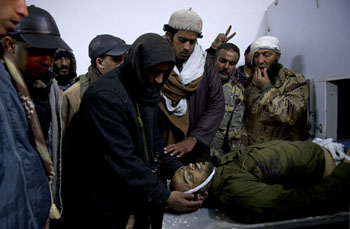
Rebels with the body of a fighter at the morgue in Brega.  (Photo:  Lynsey Addario/New York Times)

That said, I generally have a man accompany me everywhere.  When I’m on assignment, I hire either a local translator or a driver who speaks English.  And I make sure they’re always with me.  I do find that a woman who is alone is more prone to being mistreated than a woman who is with a man.

People think photography is about photographing.  To me, it’s about relationships.  And it’s about doing your homework and making people comfortable enough where they open their lives to you.  People underestimate me because I’m always laughing and joking.  That helps.  They let their guard down.

I try to do women’s stories when I can, but I don’t want to be pigeonholed as just a women’s photographer, because my interest is in covering the whole story — and human rights abuses and humanitarian issues.  Ironically, I don’t think I saw more than a handful of women the entire time I was in Libya.

DESCRIPTION
Relatives of Emad al Giryani at his funeral in Ras Lanuf.  (Photo:  Lynsey Addario/The New York Times)

After the attack on Lara Logan in Egypt, a lot of people started asking, “Why are women covering the Muslim world?”  Several people wondered why Western women covered countries where women are mistreated so badly.

To me, that’s not the case.  I have always been offered the utmost hospitality and protection and shelter in the Muslim world.  I have been fed.  I have been offered a place to sleep.  My translators and drivers have put their lives before mine.  It’s very important for people to recognize that these qualities do exist.

Yes, what happened to Lara was horrible, by all accounts.  There’s no question.  And when I was in Libya, I was groped by a dozen men.  But why is that more horrible than what happened to Tyler or Steve or Anthony — being smashed on the back of the head with a rifle butt?  Why isn’t anyone saying men shouldn’t cover war?  Women and men should do what they believe they need to do.

I don’t think it’s more dangerous for a woman to do conflict photography.  Both men and women face the same dangers.

DESCRIPTION
Bodies of rebels killed around Ajdabiya.  (Photo:  Lynsey  Addario/New York Times)

Lynsey discussed the physical and logistical demands of her work:

I have to make sure I’m always in shape.  I run every day.  I’m always at the gym.  Because if you do a lot of military embeds, people are not going to wait for you. I’m 5-feet-1.  There are times in Afghanistan when, if I have to jump a canal that’s 3 feet wide, I’m going to have a problem.  And I’m not as strong as my male colleagues.  But in most of the assignments I do, I don’t find it makes a difference.

Libya was a hard conflict to cover, finding that boundary when it was not safe anymore.  There was one road that led to the front line.  That road was being shelled.  There was tank fire.  There was artillery.  There were airstrikes.  And there were helicopters coming in.  So as soon as you got close enough to cover the conflict, you were also close enough to get fired upon.  It was hard to navigate.

You learn the fighting patterns.  You try and use that experience to judge how to move forward.  But every conflict is different and every conflict has different boundaries.  In Libya, it just so happened, the landscape didn’t provide any cover.  That was a basic fact about trying to cover the conflict: it was flat, open desert.

DESCRIPTION
Rebel soldiers wept at the hospital in Ras Lanuf.  (Photo:  Lynsey Addario/New York  Times)

It was so dangerous, we traveled in full cars.  It was hard to find a driver.  If one person found a driver we’d all pile into that car.  We generally were in two cars, with seven or eight photographers.

And the personal demands:

In the last few years, people have treated me more as part of the gang.  But I think that it is a chauvinistic profession.  In every conflict I’ve covered, there’s always been sort of a boys’ club.  And there aren’t that many women covering conflict right now.  I mean, it’s amazing in this day and age.  There are probably a dozen female photographers — at most — whom I see actively in the field, covering conflict.

There are many reasons.  It takes a great toll on your personal life.  It’s lonely.  It’s physically demanding.  You have to carry a lot of equipment.  It’s emotionally taxing.  You see and document things that take a lot to process, both mentally and physically.  Most women, at some point, decide they want to put their personal lives first.

Most of my life, I had no personal life.  I tried having relationships.  But they were never successful because I was never home.  That’s my fault.  That was my decision.  I would leave for an assignment and come back 4 months later.  You can’t ask someone to be in a relationship with you if you’re not home.  I think it’s a very good reason that a lot of women decide that they don’t want to do this.

DESCRIPTION
Lynsey Addario hugged Michele McNally, the director of photography.  (Photo:  James Estrin/New York Times)

Her experience in Libya has not deterred her:

I will cover another war.  I’m sure I will.  It’s what I do.  It’s important to show people what’s happening.  We have a unique access to what unfolds on the ground that helps our policymakers decide how to treat certain issues.

The hardest part about what happened to us in Libya, our having been detained, is what we put our loved ones through — more than what happened to us.  The whole time we were detained, I think our main concern was that our families didn’t know we were alive.  And we knew we would be hurting them.  At times, it’s a very selfish profession.  And it’s hard to put people through what we put them through.

Lynsey And Tyler’s Incredible Tale

What do you do if you’ve just spent 6 days in terror-filled captivity in Libya?

If you’re journalists and photographers for the New York Times, you collaborate on a story about it.

Westport photographers Lynsey  Addario and Tyler Hicks joined Beirut bureau chief Anthony Shadid and Stephen Farrell in writing a 5,000-word story that the Times just posted on its website.  It will undoubtedly run in tomorrow’s print edition.

Among the most remarkable passages:

No one really knows the script for days like these, and neither did we….

As they neared a dangerous government checkpoint:

“Keep driving!” Tyler shouted at Mohammed, the driver. “Don’t stop! Don’t stop!”Mohammed had no choice, and a soldier flung open his door.   “Journalists!” he yelled at the other soldiers, their faces contorted in fear and rage.  It was too late.

Tyler was in the front, and a soldier pulled him out of the car.  Steve was hauled out by his camera bags.  Anthony crawled out the same door, and Lynsey followed.

Even before the soldiers had time to speak, rebels attacked the checkpoint with what sounded like rifles and medium machine guns.  Bullets flew around us, and the soft dirt popped. Tyler broke free and started running.  Anthony fell on a sand berm, then got to his feet and followed Tyler, who, for a moment, considered making a run for it.

Lynsey instinctively clenched her cameras as a soldier pulled at them.  She let them go and ran behind us.   Soldiers tried to get Steve on the ground next to the car, and he pointed at the gunfire.  They made him drop his camera, then he ran, too.

We made it behind a simple one-room house, where a woman clutched her infant child.   Both cried uncontrollably and a soldier tried to console them. When we got there, soldiers trained their guns on us, beat us, stripped us of everything in our pockets and forced us on our knees.

Tyler’s hands were bound by a strip of a scarf. A soldier took off Lynsey’s gray Nike shoes, then bound her with the shoelaces. “God, I just don’t want to be raped,” she whispered to Steve.

The journalists were no strangers to danger:

All of us had had close calls over the years.  Lynsey was kidnapped in Falluja, Iraq, in 2004, Steve in Afghanistan last year.  Tyler had more scrapes than he could count, from Chechnya to Sudan, and Anthony was shot in the back in 2002 by a man he believed to be an Israeli soldier.  At that moment, though, none of us thought we were going to live.  Steve tried to keep eye contact until they pulled the trigger.  The rest of us felt the powerlessness of resignation. You feel empty when you know that it’s almost over.

“Shoot them,” a tall soldier said calmly in Arabic.

A colleague next to him shook his head.  “You can’t,” he insisted.  “They’re Americans.”

They bound our hands and legs instead — with wire, fabric or cable.   Lynsey was carried to a Toyota pickup, where she was punched in the face.  Steve and Tyler were hit, and Anthony was headbutted.

Even that Tuesday, a pattern had begun to emerge.  The beating was always fiercest in the first few minutes, an aggressiveness that Colonel Qaddafi’s bizarre and twisted four decades of rule inculcated in a society that feels disfigured.  It didn’t matter that we were bound, or that Lynsey was a woman.

But moments of kindness inevitably emerged, drawing on a culture’s far deeper instinct for hospitality and generosity.   A soldier brought Tyler and Anthony, sitting in a pickup, dates and an orange drink. Lynsey had to talk to a soldier’s wife who, in English, called her a donkey and a dog.  Then they unbound Lynsey and, sitting in another truck, gave Steve and her something to drink.

From the pickup, Lynsey saw a body outstretched next to our car, one arm outstretched.  We still don’t know whether that was Mohammed.  We fear it was, though his body has yet to be found.

If he died, we will have to bear the burden for the rest of our lives that an innocent man died because of us, because of wrong choices that we made, for an article that was never worth dying for.

No article is, but we were too blind to admit that.

We probably shouldn’t have lived through the night.

Even before the sun set, another gun battle broke out, almost as fierce as the first one.  We were trapped in trucks in the open.  Tyler stretched the binding of his handcuffs, allowing him to open the door.   Anthony yelled for help, trying to open the door with his teeth.

A soldier finally let Tyler crawl around the pickup to let Anthony out. For a moment, our captors were in the same plight as us. As the hours passed, they offered us food, drink and cigarettes.

“These are the morals of Islam,” one said to Anthony.  “These are the morals of Qaddafi. We treat prisoners humanely.”  For a few hours they did.  They offered blankets and mattresses, then put us in a car.  As rebels attacked every so often, we all barreled out of the car and dove to the ground, until the firing subsided. They put us back in, and we dove to the ground again.

They eventually let us lie behind a pickup.

Lynsey asked for her shoes. She got a bullet-riddled pair of Tyler’s, taken from his bag.

Clockwise from top left: Lynsey Addario, Stephen Farrell, Anthony Shadid, Tyler Hicks

On Wednesday:

A new group seized us, and they were rougher.  They blindfolded us, tied our arms and legs and beat us.  They then stuffed us into an armored car, where Lynsey was groped.  She never screamed but instead pleaded.  A soldier covered her mouth, tracing his hands over her body.  “Don’t speak,” he warned.  Another soldier tried to shove a bayonet into Steve’s rear, laughing as he did it.

A half-hour later, we arrived on what we thought were the outskirts of the other side of Ajdabiya.  A man whom soldiers called the sheik questioned us, then began taunting Tyler.

“You have a beautiful head,” he told Tyler in a mix of English and Arabic.  “I’m going to remove it and put it on mine.  I’m going to cut it off.”  Tyler, feeling queasy, asked to sit down.

We were finally put in a pickup where a soldier taunted Lynsey.

“You might die tonight,” he told her, as he ran his hand over her face.  “Maybe, maybe not.”

At 8:30 a.m. Wednesday, they were thrown blindfolded and bound in the back of a pickup truck and driven along the Mediterranean coast toward Colonel Qaddafi’s hometown of Surt, a six-hour drive.

We felt like trophies of war, and at a dozen checkpoints, we could hear militiamen running to the car to administer another beating.“Dirty dogs,” men shouted out at each stop.Over the years, all of us had seen men detained, blindfolded and handcuffed at places like Abu Ghraib, or corralled after some operation in Iraq or Afghanistan.  Now we were the faceless we had covered perhaps too dispassionately.  For the first time, we felt what it was like to be disoriented by a blindfold, to have plastic cuffs dig into your wrists, for hands to go numb.

The act is probably less terrifying than the unknown.  You don’t know when it’s going to end or what comes next.  By late afternoon, we were taken to a jail in Surt. Our captors led us to a basement cell with a few ratty mattresses, a bottle to urinate in, a jug of water and a bag of dates.  As night fell, we wondered whether anyone knew — or could know — where we were.

The foursome realized that no one outside of their captors knew where they were.
The next afternoon, on Thursday, was perhaps the worst beating.  As we stood on the tarmac in Surt, waiting for a military plane to Tripoli, Tyler was slapped and punched, and Anthony was hit with the butt of a gun to the head.  We were blindfolded and bound another time with plastic handcuffs, and Lynsey was groped again….

Nothing ever felt more generous to Anthony than a handcuffed Tyler managing to reach into the pocket of Anthony’s jacket, pull out a cigarette and light it before handing it back to him.

Tyler Hicks near the frontline during a pause in the fighting on March 11 in Ras Lanuf, Libya. Four days later, he and three other Times journalists were taken captive by government soldiers. (Photo: John Moore/Getty Images)

After a plane trip and bus ride:
We were moved to another vehicle but not before a soldier, perhaps from the losing side, drove the barrel of his rifle into the back of Tyler’s head.

Within a half-hour, we were in a military compound, in the hands of military intelligence. We collapsed on the floor, accepting milk and mango juice. We saw our bags unloaded, though we would never get them back.

A gruff man struck a sympathetic tone. You won’t be beaten or bound again, he told us.   You will be kept safe and, although you will be blindfolded if you are moved anywhere else in the compound, no one will mistreat you.

From that moment, no one did.

We were taken to a detention center that looked more like a double-wide trailer.  On the shelves were a two-volume German-Arabic dictionary and five of Shakespeare’s plays. (Colonel Qaddafi once famously quipped that Shakespeare, or Sheik Zubeir, was actually an Arab migrant.)

The men were given track suits. Lynsey was brought a shirt that read, “Magic Girl,” emblazoned with two teddy bears.  Her new underwear read, “Shake it up.”

At the late hours of night, we were blindfolded to receive visitors.

“You are now in the protection of the state,” a Foreign Ministry official told us….

Officials asked Lynsey whether she had been raped.

Over the next 4 days:

We fought boredom more than anything else.  Tyler finished Julius Caesar.  Lynsey started Othello.  If it went on much longer, Tyler jokingly suggested we perform the plays.  As the hours passed, we replayed each moment of the preceding days in detail, trying to piece together what had happened to Mohammed.

We wondered whether we would be delivered into more sinister hands.  After the no-fly zone was imposed and we heard volleys of antiaircraft fire, we thought that a desperate government could make us human shields.  Weighing over all of us was guilt for what we had put our families and friends through.

In the end, it was the trappings of diplomacy that delayed our departure.

Foreign Ministry officials, clinging to a prestige they may have never had, insisted that our transfer be formal, between two sovereign states.   At one point, they insisted an American or British diplomat had to travel to Tripoli in wartime.  In the end, Turkish diplomats served as intermediaries and delivered us to the border.

As we left, we saw the billboards of a crumbling government.  “Forty-one years of permanent joy,” read one slogan superimposed over a sunburst.  But the words that lingered with us as we left were quoted to Steve by an urbane Foreign Ministry official speaking idiomatic British English.

As we sat in an office, he murmured two lines of Yeats.

“Those that I fight I do not hate,

Those that I guard I do not love.”