As president of the Greens Farms Association, Art Schoeller has a special fondness for Burying Hill Beach.
Over the years, he’s watched the jetty deteriorate. He has an idea on how to keep it safe — without spending one local tax dollar. He says:
An old aphorism suggests it’s better to invest early. Waiting costs more in the long run.
This sign went up at Burying Hill Beach years ago, after lobbying by the Greens Farms Association and concerned neighbors.
“Dangerous” indicates the dire condition of the jetty. While its main purpose is not for pedestrian traffic, it still describes the poor condition of the structure, whose main purpose is to protect the beach.
Up to 40% of the structure has eroded or decayed away, due to normal aging. It was built in 1958. Some research indicates the useful life of a jetty is 30 to 50 years.
Losing the jetty means losing the beach.
The first selectman’s office has already directed Public Works to obtain estimates and permits. This is a “shovel ready” project, estimated to cost $900,000. Not acting now would allow these permits to expire, therefore wasting that investment.
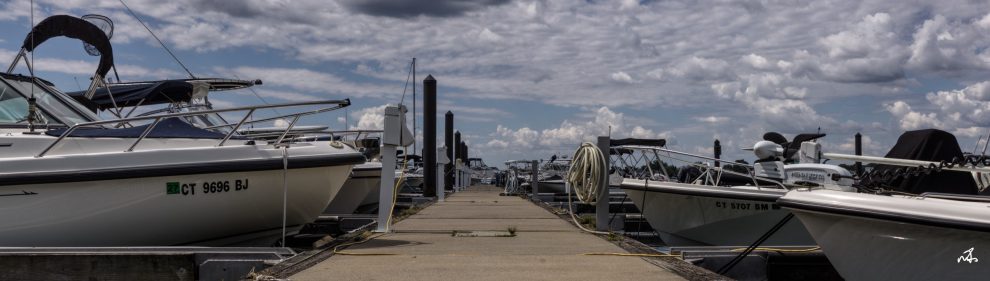
One view of the Burying Hill Beach jetty ,,, Photo/Amy Schneider)
Now we have a chance to finally push this project through — at no cost to the town.
The town of Westport is due to receive $8.4 million in CARES (Coronavirus Aid, Relief, and Economic Security) Act funding from the federal government. On January 5, the Board of Finance will decide whether or not to apply a portion of those funds to this sorely needed project.
As noted in numerous “06880” postings over the years, a thriving community of users beyond Greens Farms residents enjoy the informal, relaxed and quiet nature of Burying Hill Beach.
The Board of Finance will consider CARES funding soon, If you think this is a project worth considering, please contact board members by email: BOFcomments@westportct.gov.
Alert — and astute — “06880” reader Paul Rossi writes:
Reading a recent article in the Wall Street Journal titled “An Antidote to Inflation? ‘Buy Nothing’ Groups Gain Popularity” reminded me why this works so well in Westport — and why I offered to help administer our local Buy Nothing Project group years ago, with co-admins Meg Lepsisto and Danielle Alexander.
As we enter this season of giving, I want to share a resource that may not be well known.
As many can relate, our family of 5 had amassed a great deal of “stuff” since moving here to Westport in 1996. Most is no longer needed or wanted. Kids grow up, trends come and go, new products offer preferred conveniences, the nest begins to empty … you know.
Paul Rossi (far left) and his family at this year’s Memorial Day ceremony. Paul’s father Nick was the grand marshal. (Photo/Dan Woog)
Like most Westporters, we are genuinely concerned with protecting the environment and not dumping on our future generations. If you have ever been to our transfer station, you have seen the shocking amount of perfectly usable items deposited there that will end up in a landfill or incinerator.
On the other side, what really hooked me on Buy Nothing Westport was an experience a few years ago. I needed an extra propane tank for a BBQ grill. I posted a “wish” on the Buy Nothing Facebook Group Page.
Sure enough, 3 people offered to give me one. I considered how it might look asking for a freebie, but I swallowed my pride and proceeded.
I picked up the tank and had a lovely encounter with the giver, who was happy to pass along a perfectly good item she no longer needed.
That’s the reason why, since its founding in 2013, the Buy Nothing Project is expected to grow to over 5 million members worldwide next year.
You can give on the Buy Nothing Facebook page …
The formula works: A hyperlocal Facebook group (you must legitimately live in Westport) fueled by people’s desire to reduce waste and connect with neighbors.
As COVID hit, we saw a spike in membership. Being cooped up made us all more aware of how much “stuff “we no longer needed. The urge to purge kicked in.
Over the last few weeks, I was curious about another surge in Westporters wanting to join our Buy Nothing group. Reading the WSJ article suggests that “with inflation hitting a 31-year high and supply-chain issues making it difficult for people to get the goods they want on time, some have found an answer in online groups where members give things away free.”
… or get. People are encouraged to do both.
Re-enter the Buy Nothing Project. It is not a trash-to-treasure online thrift store. Most of the “gives” offer new or gently used items, surpluses, vintage finds, etc. The “wishes” run the gamut from lamps for college dorms, children’s books, tools needed tomorrow for one-time use, wheelchairs and supplies for elderly homecare, to surplus herbs and veggies for cooking and the like.
Our family loves meeting the people we give to and receive from. The community-building aspect differentiates this movement from others. It is very much a “feel good” experience all around. And in the process, we do our part to remain good stewards of the planet.
Click here to learn more about the Buy Nothing Project. Click here to join the Westport Facebook Group. You can also download the BuyNothing app.
Dr. Gerry Kuroghlian and Tod Kalif taught Matt Yemma to write.
Nearly 2 decades after his 2002 graduation from Staples High School, he remembers the educators’ criticisms, encouragement and impact.
A few years after Yemma graduated from the University of Redlands — where he majored in English — Kuroghlian reached out on Facebook, with more words of support. Once a teacher, always a teacher.
Yemma had planned to go into public relations. His parents worked in PR and journalism, and — as a news junkie — he cherished the media’s role in society.
But before graduation, the 2006 midterm elections loomed. “I thought the world was like the TV show ‘West Wing,'” he recalls. “So before I jumped into the corporate world, I wanted to try politics.”
As an intern for the Nevada Democratic National Committee, he worked on campaigns from city council to Harry Reid’s re-election bid. Then came stints as press assistant for the Nevada State Assembly speaker and, 2 years later, Nevada deputy press secretary for Obama for America.
But corporate America called. Yemma headed to New York, where he worked in financial services PR just as the financial crisis deepened. It was trial by fire.
Matt Yemma
After a few years — including stints when Detroit went into bankruptcy, and lobbying on behalf of Obamacare — Yemma headed back to school. While earning a master’s in public affairs, he freelanced.
He started his own business, and in 2017 merged with another. Yemma has built up that business — Peaks Strategies — ever since. It’s a successful boutique firm, with many clients. They include asset managers, private equity firms, technology, ESG and impact investing, biotech and healthcare, and a company advocating for carbon capture and a common sense approach to the NetZero challenge.
And, now, cryptocurrency and blockchain companies too. Yemma works with major players in the NFt, digital security and crypto spaces.
“A lot of PR is being on the forefront of frontier markets,” Yemma says. Though crypto and blockchain have been around for a while, suddenly the public is paying attention.
“Some countries don’t have real banking systems,” Yemma explains. “Digital is the way to go, everywhere in the world.”
His PR work extends from mainstream publications like the Wall Street Journal and Bloomberg, to trade publications. In his work, he meets many Westporters also involved in these “frontier markets.”
Working with a client who is big into SPACs.
But as exciting as all that is, Yemma may not always work in the fintech field. Next month, he and Weston High School graduate Elodie Kremer will marry. She’s an equestrian; he loves dog training.
Some day, they hope to buy a farm.
Perhaps with cryptocurrency. As he and his clients often say: It’s the next frontier.
We hear it all the time: The labor shortage is killing the economy.
News reports, social media, casual conversations — all repeat the same refrain. From the supply chain to the stockroom, the cook to the cash register, the only thing holding America back is that no one wants to work.
Breno Donatti begs to differ.
The owner of Winfield Street Coffee locations in Westport (Post Road West), Wilton, Stamford, Trumbull, Croton (NY) and Naples (FL) has 27 in-house employees.
Another dozen work as independent contractors (web and brand design, architect, bookkeeper, accountant, electrician, plumber, handyman, garden care, carpenter, PR).
Breno Donatti
The average wage of his 5 full-time office staff is $32 an hour. In Westport, where 6 people works as store and assistant manager, part-time chefs and part-time baristas, the average is $17.20 an hour.
The pay in his other locations generally ranges from $14 to $16.25 an hour. Some employees earn as much as $22 an hour.
Most employees earn between $1 and $4 an hour in tips. All employees are eligible for paid sick and personal days, and vacation time. Managers and assistant managers can qualify for monthly and quarterly bonuses.
Because of a shortage of qualified restaurant staff, Donatti says, employees can pick where they like to work. Wage in “not top of mind,” he says, though imporant.
“Employees are lookin for an uplifting workplace with good colleagues, good culture and flexibility.” At Winfield, he says, that means frequent meetings to discuss problems, scheduling staff events and parties, and allowing managers the flexibility to provide staff what they need to do their jobs.
Staff are also involved in meal donations and community events, giving them “a sense of purpose.”
Winfield Street’s Post Road West location.
“We have not had major problems with worker shortages, because we believe that prospecting candidates and training staff is an ongoing process,” says Donatti.
They usually hire by word of mouth. Those who come that way usually stay longer than those found via Craigslist or resumes.
Donatti says he is “blessed” with an “honest, hard-working and motivated” staff, who care about the company and their colleagues. He has begun exploring ways to make it employee-owned.
Meanwhile — undeterred by staff shortages — Winfield Street continues to grow. A new coffee shop kiosk will open at 86th Street and 2nd Avenue in New York; 2 other kiosks will follow in the city by February. A large store similar to the Stamford flagship is planned for Rye by spring. Those 4 outlets will require 18 more employees.
“Our staff is the most important part of our company,” Donatti says. “Obviously, customers bring us the revenue to hire everyone. But by having the right personnel, we ensure that every customer is fully cared for — and that improves the chance they’ll return.
“My job, as CEO, is to make sure that my staff is cared for.”
Helen McAlinden is excited about yesterday’s housing rally on Jesup Green.
The event — co-sponsored by Homes with Hope, the Westport Housing Authority and Westport Department of Human Services — drew dozens of housing supporters, and a number of politicians.
McAlinden — executive director of Homes with Hopes — says:
“Their attendance and support shows us we have friends and advocates at the State Capitol. It was brilliant to see that!
“With Connecticut’s $300 million of American Rescue Plan Act funds unallocated at this time, our collective voices were heard. But this needs to continue, so that these funds are invested in affordable housing and support services to protect our most vulnerable residents.
Young attendees carried signs at yesterday’s rally. (Photo/Lauren Braver Schiller)
“We would like to thank First Selectman Jim Marpe, Elaine Daignault (Human Services director) and Carol Martin (Housing Authority director) for their partnership and leadership in hosting such a wonderful shindig in Westport. They did a brilliant job highlighting the Fairfield County housing crisis.
“But our efforts are not over. Please continue your advocacy. Now, with this event fresh in people’s minds, is the time to continue to spread the word and consider doing a similar event in other communities.
“One woman’s story — which mirrored many others — brought the event into a real-life scenario which was appreciated by everyone. The town of Westport and Westport Housing Authority will be happy to lend their support to help produce a similar event in every community highlighting, how small, affluent towns can be part of the answer.”
The Connecticut Department of Public Health, Connecticut Interscholastic Athletic Conference and many youth sports organizations are urging all athletes 12 years and older to get vaccinated against COVID.
It’s the best way, officials say, to ensure a healthy, safe and uninterrupted fall season. The organizations suggest that sports groups host and sponsor mobile or other vaccine clinics, to reach students.
They note one major reason to get a shot: people who have been vaccinated do not need to quarantine if exposed to a COVID case, if they are asymptomatic.
La Plage — the great new restaurant at the Inn at Longshore — opens today. But — as noted in a recent 06880″ story — it’s dinner only for now, Wednesdays through Sundays.
The reason: staffing. Finding help — cooks, servers, dishwashers, bussers, front-of-the-house, you name it — is tough.
It’s a town-wide (and nationwide) problem. Basso is one of Westport’s most popular restaurants. This sign hangs near the outdoor tables, on Jesup Road:
(Photo/Dan Woog)
There’s no such thing as a free lunch. But there may be no lunch at any restaurants, if they can’t find enough help.
The popular 1,800-acre Weston preserve — The Nature Conservancy’s largest in Connecticut — closed in the spring of 2020, in the early days of the pandemic. It was overwhelmed with visitors, many of whom parked illegally, brought dogs or stayed past dark.
As of last Sunday, the woodlands, wetlands and rock ledges are open from sunrise to 5 p.m. Click here for more information. (Hat tip: Weston Today)
Speaking still of nature: ButtARfly is inelegantly named.
But it’s a great program, bringing butterflies from the Smithsonian’s Open Access collections to life on a computer screen. Users can learn about butterfly species, add them to a virtual shadow box, and release them into an augmented reality experience for desktop and mobile. There are even different sounds for each specimen.
The Department of Media Arts & Technology at New Mexico Highlands University helped develop the initiative — with the help of 1984 Staples High School graduate Lauren Addario, as audio advisor and content developer.
The Y’s Men (and their wise spouses) meet every Tuesday during the summer at South Beach, for food, camaraderie and sunsets. Jon Fox organized the event several years ago.
Yesterday they added a bit of fundraising, for the Hole in the Wall Gang Camp. Peter Nathan solicited donations — and brought in over $1,300.
That’s one more feather in one of Westport’s premier volunteer organization’s cap!
Y’s Men (from left): Mike Guthman, Roy McKay, David Kalman (hot dog supplier), Peter Nathan, Jon Fox, Baxter Urist and Larry Lich. (Photo/Dorothy Fox)
And finally … our musical interlude usually celebrates birthdays, anniversaries and upbeat events from years gone by. After all, there aren’t too many downer songs about bad things in history. (Okay — “Eve of Destruction.”)
But today is the 47th anniversary of the day 3 civil rights workers — Michael Schwerner, Andrew Goodman and James Chaney — were found dead in Mississippi. They had disappeared 43 days earlier.
So — at the risk of alienating all my friends from that state — I present Phil Ochs:
There were snickers in 2019, when the town announced it was buying a Tesla Model 3 for the Police Department.
You can stop laughing.
The vehicle — put in service in February 2020 — is being celebrated for “exceeding performance, cost savings and environmental benefits estimates.”
That’s not just hopeful hype. It’s the verdict of a study by the EV Club of CT.
The Westport Police Department’s Tesla 3.
The report says the Model 3 police cruiser recoups the purchase price premium, and saves money — even in the first year.
It adds:
• After 4 years the Tesla will have saved enough money to buy another one.
• Each EV avoids emission of over 23 tons of CO2 per year, and saves $8763 in
environmental and health costs.
• There is a $12,582 savings in fuel alone after 4 years, from using electricity to
power the vehicle.
• Reduced maintenance comes from regenerative braking (the engine slows the
car and recaptures some of the kinetic energy, replenishing the battery and
reducing wear on the friction brakes), as well as no spark plugs, transmission,
alternator, water pump, or catalytic converter. The Tesla does not require oil changes.
• Even during the winter months, the Tesla ran 2 patrol shifts without needing to be recharged. There were no issues related to charging and battery use.
The EV Club reports that there was a $15,300 differential in the purchase price of the Tesla versus a Ford Explorer, previously the the “workhorse of the fleet.” That was recouped in the first year due to reduced customization and lower operating costs.
Though Police Department would not receive the discounts applied to the initial vehicle, a second Tesla is still projected to recoup the price premium in one year due to lower customization, maintenance, and fuel costs.
According to the EV Club’s report, there are non-financial benefits too.
“The car’s catlike alacrity enables an officer to quickly overtake a moving suspect’s vehicle, which reduces the risk to the driver (and) officer, as well as other vehicles and pedestrians.”
Police Chief Foti Koskinas says:
What initially attracted us to the Tesla was how it compared to our traditional fleet vehicles in terms of performance, 5-star crash ratings, and collision avoidance technology.
While the Police Department has been using plug-in hybrids for parking enforcement for several years, this was the first fully electric car to be used in active duty. We needed to confirm our estimates on things like mileage per charge and how the vehicle would stand up overall in the challenging environment of police work.
And of course, we were tracking expenses. The purchase price of the Tesla was higher than the Ford Explorer, but we hypothesized that we’d recoup that expense in lower fueling and maintenance costs for the Tesla.”
Charles Sampson of the WPD managed this project. He adds, “Feedback from the public has been overwhelmingly positive. We’ve have been contacted by at least 50 other police departments – from all over the world – with questions about our experience. I know many of them have gone on to purchase Teslas for their fleets.”
They’re not the Trump Organization, the mammoth real estate company. They’re not Empire State Realty, which own the Empire State Building — and commercial real estate on Westport’s Main Street.
But Admiral Real Estate Services is no slouch. The commercial real estate company focuses on retail sites in the tri-state area. You’ve seen their signs on vacant storefronts around town.
If they have their way, you’ll see fewer in the future. Admiral is bullish on Westport.
The last couple of years have not been easy, notes president and CEO Jonathan Gordon.
Norwalk’s new SoNo Collection mall — “the newest and shiniest project out there,” Gordon admits — “sucked a lot of the energy out of downtown.”
COVID brutalized merchants and landlords. Downtown Westport — and similar markets like Darien, Greenwich, Rye and Scarsdale — saw shoppers flee to online.
But as the nation emerges from the pandemic, Gordon says, “retailers are returning our calls.”
Part of the reason, he believes, is “internet fatigue. Millennials want a more experiential shopping experience. Retailers see a need to be downtown.”
One empty storefront is among the most visible in all of downtwn.
“Downtown” draws more than Westporters, Gordon says. It’s a destination for many area residents. Within a 15-minute drive, Admiral’s website says, “the population jumps to over 150,000 with an average income exceeding $170,000, resulting in total buying power for in-store retail goods (excluding food and drink) of $4 billion+.”
One thing that Westport has over some other affluent suburbs is that while residents leave in the summer for vacations (and vacation homes), they’re replaced by equally affluent summer residents. That’s attractive to Admiral — and the properties they represent.
Despite an upturn in commercial real estate activity, there are still a number of empty storefronts. For Admiral, that includes 2 properties at the Post Road/ Main Street intersection, and 4 others on the river side of Main Street (one is the long-vacant 2-story restaurant most recently occupied by Boca and Acqua).
Boca restaurant closed in 2018. The Main Street property has been empty ever since.
Admiral also represents 2 properties on Post Road East, near Balducci’s.
For retailers looking for a new location, Gordon says, Westport’s competition is “really Greenwich.” It’s a “formidable” location, with a “nice, long retail strip, close to New York City.”
So, he says diplomatically, he tries to sell both locations.
In terms of Westport, Gordon says, “we view Main Street as one entity. Our goal is to find retailers that help other retailers be successful.” La Fenice gelateria — an Admiral tenant — is one such place.
“People who get a gelato will go next door to shop,” Gordon notes. “If they come at night, they’ll go window shopping.”
The new Barnes & Noble — not an Admiral property — is another example of “exactly what downtown needs.”
27 Main Street is another Admiral property.
So how tough a sell is Westport?
“Everything is tough these days,” Gordon says. “We may drag people there by the scruffs of their neck. But we show them the free parking lots. We give them marketing materials, with specific breakdowns of population, income and consumer purchases. We help them assess the viability of a site. Seeing downtown is more powerful for them than anything.”
In the past, he notes, potential retailers have been “surprised at the disconnect between the number of vacant stores, and the potential.”
Coming out of COVID, he hopes, those numbers — and that disconnect — will diminish. In their place will be a new mix of retailers, and eager shoppers from far and wide.
Do you lead a startup? Run an established business? Need a satellite office for your larger organization?
Westport wants you!
Town officials, commercial developers and real estate agents have partnered to launch ChooseWestport.com. The “economic opportunity website” focuses on the benefits of opening a business here.
The site targets small businesses, entrepreneurs and other professionals in the tri-state region. It highlights the benefits of locating (or relocating) in Westport.
ChooseWestport includes sections on “Economic Vitality” (education, credit rating, taxes, transportation, income and wages, real estate); “What’s Possible” (lifestyle, commerce, quality of life, values and education), along with sections for retail, small businesses and “finance businesses” (Kitt Shapiro of the store WEST, Field Trip Snacks co-founders Matt Levey and Tom Donigan, and Saugatuck Financial’s Justin and Christy Charise all provide videos).
Screenshot from Choose Westport
The “Concierge” section promises that the “Westport Economic Opportunity Division” will provide assistance in opening a business, and “navigating the operations of town government.”
The Visual Brand — based in Westport — created the website, and will run a digital marketing campaign, including videos.
For more information on ChooseWestport — including joining the partnership — email town operations director Sara Harris: sharris@westportct.gov.
Posted onMay 25, 2021|Comments Off on Helping Neighbors: Camp, Grad Celebration Donations Needed
For years, Westport’s Human Services Department has run 2 important spring collections. Community donations provide critical support to families needing financial assistance for summer camp programs, and the end-of-school-year celebrations that so many others take for granted.
For parents of kids, the pandemic has made the need even more urgent. Lost social and educational time — combined with fewer affordable structure activities, and adult stress — has driven financially insecure families into greater distress.
Childcare and summer enrichment programs — registered for without a second thought by a number of Westporters — are crucial for children in those circumstances.
After a rough year, summer activities are important.
Camps are in a bind too. After not opening last year, they’ve been unable to offer the same number of discounted tuitions as in the past.
Just as important — for 8th and 12th graders’ social well-being — is having appropriate clothing for graduation ceremonies. Cash and gift card donations help parents with those purchases. They may also hep families share a special meal, to recognize their children’s achievements.
Human Services director Elaine Daignault invites residents to contribute to the department’s Family to Family programs: “DHS Campership Fund” and/or “DHS Ceremonies and Celebrations Fund.”
No one wants to feel left out at graduation.
Every dollar counts. An average week of day camp in the area is $300.
Click here; under “Seasonal Program Name,” click the fund(s) you wish to contribute to. Checks can be sent to Human Services Department, 110 Myrtle Avenue, Westport, CT 06880 (indicate which fund on the memo line).
Questions? Email adaugelli@westportct.gov, or call Annette D’Augelli at 203-341-1050.
Comments Off on Helping Neighbors: Camp, Grad Celebration Donations Needed
Click here to help support “06880” via credit card or PayPal. Any amount is welcome, appreciated — and tax-deductible! Reader contributions keep this blog going. (Alternate methods: Please send a check to “06880”: PO Box 744, Westport, CT 06881. Or use Venmo: @blog06880. Or Zelle: dwoog@optonline.net. Thanks!)
GET THE “06880” APP
The “06880” app (search for it on the Apple or Android store) is the easiest way to get “06880.” Choose notifications: whenever a new post is published, or once or twice a day. Click here for details.


 The EV Club reports that there was a $15,300 differential in the purchase price of the Tesla versus a Ford Explorer, previously the the “workhorse of the fleet.” That was recouped in the first year due to reduced customization and lower operating costs.
 If they have their way, you’ll see fewer in the future. Admiral is bullish on Westport.


