Author Archives: Dan Woog

Last Cuppa For Davids Tea

Downtown shoppers: You’ve got 2 weeks to get your specialty teas and accessories.

Davids Tea — or, as they oddly prefer, DAVIDs TEA — will close its Main Street store on April 29.

According to alert “06880” reader Pat Pontoriero, they’re doing well here. However — surprise! — they’re not renewing the lease because of high rent.

Davids plans to diversify around Connecticut. Right now, their only other location in the state is at West Hartford’s Westfarms Mall.

The Westport store — between Brooks Brothers women’s store and Jack Wills — was only the 3rd US outlet for the Canadian-based chain. The first 2 were on Bleecker Street in New York, and Polk Street in San Francisco.

Now there are a few dozen.

But — in 2 weeks — one fewer.

A sign announcing the closing. (Photo/Pat Pontoriero)

Scott Pruitt Will Love This Photo

Alert — and disgusted — “0688o” reader Robert Jacobs was behind this bus the other day, on Old Hill Road:

(Photo/Robert Jacobs)

Schools were off last week, for spring break.

I guess the driver wanted to make sure no one enjoyed the weather.

Dredge We Must!

Visitors to Compo Beach — and there have been many these recent, beautiful days — have wondered about all the heavy equipment near South Beach.

(Photo/Bruce McFadden)

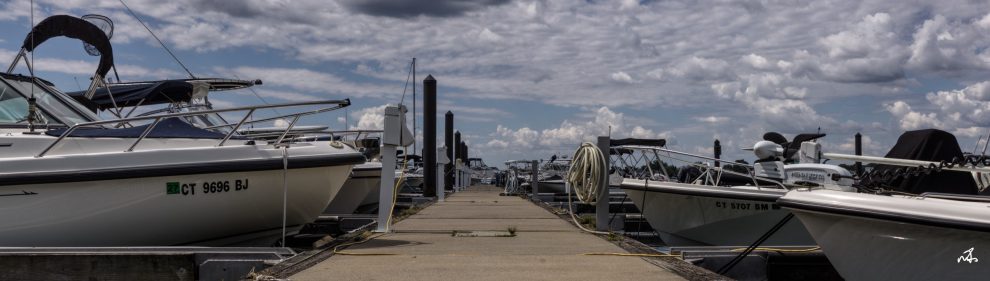
They’re there to dredge the Ned Dimes Marina and adjacent channel.

It’s the first time since 1993. Since then, Hurricanes Irene and Sandy — along with the natural movement of tides — have created dangerous conditions for boaters.

The project involves over 20,000 cubic yards of sand.

And in 2040 or so, we’ll do it all over again.

Jim Hammond, F. Scott Fitzgerald, Famous Writers And The Westport History Rabbit Hole

Jim Hammond grew up in Westport. He graduated from Staples High School in 1979, but has not been back for a long time.

Jim Hammond

A few weeks ago, he heard about the controversy surrounding TEAM Westport’s “white privilege” essay contest.

That led him down the “06880” rabbit hole — and a story on fellow Staples alum Deej Webb’s documentary about F. Scott Fitzgerald’s time in town.

That spurred him to write and post an essay on his philosophy-and-literature website — 2 of his passions, since he was a teenager.

And THAT led him to send these thoughts to “06880”:

Fitzgerald lived on South Compo Road, near what is now Longshore, in the summer of 1920. J. D. Salinger also lived on South Compo, from about 1950 to 1952.

I read a Salinger short story, and asked my mother, Nancy Hammond, about old Westport. She lived there from 1957 to 1997, and was involved in local politics.

When she arrived, Westport was home to the Famous Artists School, which purported to turn people into artists. Prominent artists like Norman Rockwell lent their names to the scam.

Norman Rockwell (center, bow tie), with some of the Famous Artists School’s faculty.

You would send in a sample of your work. They would write back, saying you had great potential, and should enroll in their school. Salesmen combed the country, recruiting gullible students. Ads filled the newspapers, Money rolled in.

It was so profitable that a Famous Writers School was also established in Westport, using the same template. Bennett Cerf of Random House was a founder. Prominent writers like Clifton Fadiman, Bruce Catton and Mignon Eberhart lent their names. By 1969 the stock price had risen from $5 to $40.

The next year, Jessica Mitford published an exposé, called “Let Us Now Appraise Famous Writers,” in the Atlantic Monthly. An investigation was launched, the stock price fell, and in 1972 the Famous Writers School went bankrupt.

JD Salinger

When J.D. Salinger moved to Westport, Famous Artists School had been going for 2 years. It’s likely that he heard about the school. In 1952 he published a short story about an art correspondence school, called “De Daumier-Smith’s Blue Period.”

When I was growing up in Westport, the phrase “Famous Artists” rang in my ears. The school rented space from Eddie Nash on Riverside Avenue. Since money was rolling in, they decided to build a new headquarters.

They chose my neighborhood as the site. Specifically, they selected an area we called the Gravel Pit. Now known as Partrick Wetlands, it’s between Partrick Road, Wilton Road, the Merritt Parkway and Newtown Turnpike.

According to rumor — spread by my mother, in countless phone conversations — Famous Artists School planned to build a large office, with a parking lot for 1,000 cars.

My mother banded together with other neighbors, and formed a group called Families for a Residential Westport.

A pond near the Partrick Wetlands. (Photo/Scott Smith)

They referred to their opponents as the Boyd Group (or The Boyds). John Boyd was a prominent Westport lawyer, who favored business and development. One of his allies, Lu Villalon, ran the local newspaper, the Town Crier.

My parents were Republicans. So were the Boyds. The battle over Famous Artists wasn’t a Republican-Democratic battle, or a conservative-liberal one. It was a development battle, similar to those fought in thousands of American towns.

My mother’s group won the battle. Famous Artists never moved to my neighborhood. They built their new headquarters on Wilton Road, along the river.

Cockenoe Island, off Compo Beach. In 1967, it almost became the site of a nuclear power plant.

The next development battle in Westport was over Cockenoe Island, where Northeast Utilities proposed building a power plant. Anti-development forces used the fledgling newspaper, the Westport News, to help rally support. The anti-development forces won, and the paper became the dominant one in town.

A third battle was fought over a dairy farm, Nyala, where Stauffer Chemical proposed building their headquarters. They won that fight.

Fortunately, F. Scott Fitzgerald’s house is still standing. I plan to take a look on my next visit to Westport.

And maybe I’ll visit Partrick Wetlands too.

Robots Invade Westport

For 5 years, a robot has served as the mascot for Westport’s Mini Maker Faire.

The event grew so big, it shed the “mini” moniker.

So this year the robot mascot invited his friends.

Boy, does he have plenty.

The other day, they gathered outside the Westport Library — which is part of where next week’s Maker Faire will be held (Saturday, April 22, 10 a.m. to 4 p.m.).

It will also sprawl over to Jesup Green and the Taylor parking lot, and on to Church Lane and Bedford Square.

Look for them soon all over town.

Then see real robots — and lots more — next Saturday, at the Maker Faire.

(For more information, click here.)

Friday Flashback #35

A few Friday Flashbacks ago I posted a postcard from the block across from the 1908 library, on the Post Road.

A 2nd photo showed the Club Grill, a popular 1940s-’50s restaurant at the corner of Taylor Place and the Post Road. Owners included the Gault and Papageorge families (the latter of Oscar’s fame).

At some point the Club Grill became Muriel’s Trolley Diner. It looked like one of the trolley cars that stopped right outside its front door.

(Photo courtesy of Paul Ehrismann)

In the photo above you see the library building in the background, across the Post Road, and the Klaff’s store that (with Muriel’s) burned in November of 1974.

But here’s something I never noticed: “Trolley” is misspelled as “Trolly” on the side of the diner.

Elvira’s Opens Monday!

It’s the news Westport has waited for: Elvira’s is back.

The popular Old Mill deli/grocery store/community center was closed all winter. It’s the first well-deserved rest the Yiovanakos family owners have taken in 20 years.

But at 7 a.m. on Monday, they’ll again greet their regulars: commuters, kids waiting for the school bus, construction workers, delivery people, joggers, bikers, and everyone else who lives, works in or passes through the neighborhood.

Nicky and Stacey at their familiar spot. The counter displays photos of some of Elvira’s many young customers.

“We missed everyone!” co-owner Stacey says.

“We’re ready to rock and roll for the season,” Nicky adds.

It’s all back: coffee, salads, sandwiches, pizza, and Elvira’s beloved bacon-egg-and-cheese.

And all is once again right with the world.

Uncovering 300 Years Of Church History

In 2011, Green’s Farms Congregational Church celebrated its 300th anniversary.

The other day, operations director Claire England sent me a copy of a souvenir brochure, produced for that occasion.

I’m amazed I didn’t see it earlier. It’s filled with astonishing stories, intriguing sidelights, and tons of fun facts.

I’m sorry it’s taken me 6 years to get around to reporting on this. But after 3 centuries, that’s not so bad.

Here are a few things I learned:

† In colonial days, communities were led by their churches. The term “1st selectman” — for our town’s leader — dates back to the days when the secular leader of the church was “selected first.” Even after Westport was incorporated in 1835, Green’s Farms Congregational members served as 1st selectmen. In 1997, Diane Goss Farrell — a Green’s Farms congregant — was elected 1st Selectwoman.

Before services were announced by a drum or bell, early settlers were called to worship by the beating of 2 thin strips of board, from a high hill.

So, the brochure asked, was Clapboard Hill named for the excellent quality of building wood that was harvested there, or for its great location that allowed worshipers to hear the clapping of the boards?

An early map of Green’s Farms. Turkey Hill and Clapboard Hill are in the center. The 1st church site (now marked by Machamux boulder) is just below that. The 2nd site is marked “Colonial Church” (center left). “Third and Fourth” Churches are also noted at the top. Green’s Farms’ founding Bankside Farmers properties can be seen along Long Island Sound. Click on or hover over to enlarge.

 In 1742, Reverend Daniel Chapman — who had served as minister since the church’s founding 31 years earlier — was dismissed. The reason: He “hath led for several years an Eregular [sic] life …in being sundry times overtaken in drinking to excess.”

150 years later, then-Reverend Benjamin Relyea noted: “In those times, when it was an act of discourtesy in making pastoral calls to refuse to partake of something from the array of decanters which always stood upon the sideboard, the only wonder is that any minister ever went home sober.”

After the British burned the 2nd Green’s Farms Church (located near the current commuter parking lot, at the corner of what’s now the Sherwood Island Connector and Greens Farms Road), services were held in private homes for 10 years.

Meanwhile, the new American government compensated our local church for its losses during the war with land in the Ohio wilderness, known as the “Western Reserve.” The church later sold its Ohio lands, to raise money for the new meeting house (on Hillandale Road, site of the current building).

Lucy Rowe’s headstone.

The original Bankside Farmers — founders of Green’s Farms parish — owned slaves. A century later, many freed slaves lived in Green’s Farms as respected residents. When slavery was finally abolished in Connecticut in 1848, the “last of the slaves” — Charles Rowe — was church sexton. He lived on Hyde Lane, near where Long Lots School is now. He and his wife Lucy are buried in the Green’s Farms Upper Cemetery (adjacent to the current church.)

The church’s original burial ground still stands, on the corner of Green’s Farms Road and the Sherwood Island Connector. The oldest gravestone belongs to Andros Couch, who died in 1730 at 57. Also buried there are the church’s 1st 3 ministers, who served for a total of 110 years; several sea captains, including Franklin Sherwood, and Dr. Ebenezer Jesup — a surgeon in George Washington’s army — along with his 3 wives.

In 1911, the church celebrated its 200th anniversary by commissioning a bas-relief plaque honoring past ministers. The artist was Gutzon Borglum — the same man who carved Mt. Rushmore. He seldom did small commissions — but friends in the congregation asked him for this one.

On November 25, 1950, the 100-year-old steeple crashed down during a hurricane. The weight of the bell carried it through the roof of the meeting house, into the Sunday School.

At the time, declining membership had already created doubts about the church’s future. Services attracted as few as 27 people, with the collection seldom reaching $5.

Insurance covered part of the steeple damage, and a subscription campaign raised the rest. Many non-members — calling the steeple a “landmark” and a “beacon” for sailors — contributed. That drive helped save the church. By 1957, membership had grown so large that 2 Sunday services were needed.

Part of the 1951 fundraising appeal.

There is much more of interest in the Green’s Farms Church’s 300-year historical brochure.

Here’s to its next 294 years!

The 2nd Osprey Family

The ospreys at Terrain/Fresh Market are Westport’s favorite raptors. Their nest is visible to everyone shopping or driving on that busy Post Road stretch.

The pair at Longshore is less visible — but just as majestic.

Alert (and patient) “06880” reader Alan Beasley snapped this shot near Gray’s Creek.

He says the male is hovering over the nest, while the female observes.

Fore!

(Photo/Alan Beasley)

Golfers Give Back

While many Westport students are on spring break, Staples High School athletes remain in town. They’re practicing and playing.

The Wrecker girls and boys golf team made the most of their week — and gorgeous weather — yesterday. They hosted young golfers from Bridgeport’s Sheehan and McGivney Centers.

The Stapleites introduced their guests at Longshore to the game of golf, with a fun clinic. They also gave them equipment, which had been donated through Golf to Give.

The organization is the brainchild of Sophie Carozza, a Staples junior on coach Patty Kondub’s team.

There were smiles all around yesterday, as Staples’ girls and boys golf teams hosted Bridgeport youngsters at Longshore.

Golf to Give plans more events — and they’re still collecting donations of clubs, balls, shoes, etc. They’ll even pick up at your house! Click here, or email sophiecarozza@gmail.com for more information.

Sophie Carozza, with some of her first donations.