Monthly Archives: November 2010

Lynsey Addario’s Afghan Women

Lynsey Addario

Proud Westporters know Lynsey Addario as a Pulitzer Prize-winning New York Times photographer.  Her haunting images from the world’s hot spots bring disaster, disease and deprivation into our comfortable homes.

Now she’s featured in National Geographic.

Elizabeth Rubin’s story in the December issue — “Veiled Rebellion” — is lavishly illustrated by the Staples grad.

The subhead reads:  “Afghan women suffer under the constraints of tribalism, poverty, and war.  Now they are starting to fight for a just life.”

Lynsey’s photos are intimate looks into seldom-seen sights:  two women on the side of a mountain, unaccompanied by a man.

Two women on an Afghan mountain. (Photo by Lynsey Addario for National Geographic)

A strong woman driving a car — her face, hair and arms in full view.

A young woman who set herself on fire, for reasons no one knows.

Last year, Lynsey won a $500,000 MacArthur “genius grant.”

Now National Geographic readers around the world know why.

(Lynsey’s next project:  a story from Iraq, also for National Geographic.)

Arnie’s Place

Once upon a time — way back in the 20th century — kids did not play video games in their basements or bedrooms.

There were no Wiis, no Kinects, no big screens or joysticks. In the early 1980s, FIFA 2011 was 2 decades in the future.

But Westport had Arnie Kaye. And no history of video games would be complete without him.

Arnie Kaye was larger than life — literally. A hulk of a man — 350 pounds is charitable — he wanted to build a video arcade on the Post Road. The site was the current location of Balducci’s.

In October 1981, the Planning & Zoning Commission rejected his initial proposal. They cited insufficient tree plantings and buffer space, and lack of parking.

A battle royale ensued between the town (and Green’s Farms Association), and Arnie Kaye. It reached the state Supreme Court — but not before Arnie Kaye chained himself to Town Hall. (He was unchained and arrested 10 minutes later.)

Arnie’s Place opened on June 14, 1982. Three weeks later, a Superior Court judge ordered it closed. But within a month it reopened, with a zoning permit allowing up to 50 video games.

Arnie Kaye installed 80. The fight continued.

This was Arnie's Place -- Vegas and teenage nirvana, Westport style. Note the baby in the stroller, hopefully unharmed by early exposure to video games. This photo ran in the November 1984 edition of Electronic Games Magazine, and is now on ArniesPlaceArcade.com.

For the next 10 years, Arnie’s Place was — depending on who you talked to — either the greatest place in town, or the symbol of everything wrong with teenagers, Westport and America. It was glitzy. It was gaudy. It was — gasp! — a video game arcade.

There was more, of course — pool tables, foosball and air hockey — but the video games were the centerpiece. Each standing alone in a wood and copper cabinet, they’ve been described as “seven rows of teenaged nirvana.”

Young kids flocked to Arnie’s — some with their parents’ blessing, some without. An adjacent ice cream parlor — Georgie Porgie’s — attracted plenty of families. Others boycotted the place.

Arnie Kaye outfitted kids in town with t-shirts during his legal battles. Many parents were no doubt horrified at what their children wore.

Arnie loved the controversy — and fanned its flames. Thumbing his nose at the town that had done the same to him, he threatened at times to turn Arnie’s Place over to Hell’s Angels — and to make it a porn theater.

Finally, on September 18, 1994 — done in by changing tastes as well as a decade of litigation — Arnie’s Place closed.

I know all this not because I was an Arnie’s Place fan — I never set foot in the place — but because Peter Caylor has created an online tribute to the video game emporium of his youth.

Welcome to Arnie’s Place” is a website whose appeal is narrow but deep. The relatively small number of kids growing up in Westport in the 1980s who hung out there will enjoy it. Video game history savants will probably appreciate it. If you’re interested in the history of Westport, you might glance at it.

Yet what visitors find is intriguing.

There’s a brief history, which I have stolen liberally from (above).

There’s a comprehensive list of games. Apparently, Arnie’s was “about the only place in Connecticut (for) unusual titles like Krull or Journey.” There was also “plenty of room for sit down or cockpit games like Turbo.”

The list of games “verified” by more than 1 person, or a photo, runs alphabetically from APB to Wizard fo Wor. The “need to verify” list starts with 720, and ends with Vs. Super Mario Bros.

Brett, Aiden, Chris and Jesse play Gauntlet during Brett's birthday party in 1988. Arnie's was a favorite place for SOME birthday parties.

The goal is to create a 3-D model of Arnie’s Place — complete with playable games. It’s a work in progress.

Wandering through the site, it’s hard to imagine how something as innocuous as a video game arcade could have so consumed the town’s time, energy — and legal resources — for over a decade.

It did not turn Westport’s tweens and teens into derelicts, or juvenile delinquents. Kids who hung out at Arnie’s stayed in school, graduated, and had real lives for themselves. One even created a clever website about the place.

Kind of puts today’s debates about teenage texting, Facebook use and — yes — video game playing in context. Right?

“American Idol,” Westport Style

One of the many cool things about Westport is the number of intriguing, creative and joyful events happening here.

Some get great publicity:  Playhouse shows, library talks, the BBQ and Blues Festival.

Others fly below the radar.  Be truthful:  How many of you knew that this weekend 16 of the world’s most promising concert vocalists will travel here, to compete for major cash prizes?

I sure didn’t.  And the event — the Heida Hermanns International Vocal Competition — has been going on for 37 years.

Heida Hermanns and John Corigliano (father of today's composer).

The singers really do come from around the world.  Westport music lovers will host them — and ferry them to and from  Town Hall, where the competition is held.

Next Saturday (Dec. 4), from 10 a.m. to 5 p.m., the 16 vocalists — selected from dozens of entrants — will perform before a panel of professional judges.  The challenging auditions are scheduled for 20-minute intervals, and the public is invited to come any time.

On Sunday at 3 p.m., the 6 finalists compete.  The audience is then invited to a reception, while the judges decide who will win $10,000.  It’s not “American Idol” cash, unfortunately — especially because our performers are so much better.

(The competition is named for longtime Westport resident Heida Hermanns, a concert pianist, music lover and promoter.  A child prodigy and Jewish refugee, she fled Nazi Germany with her 2 great loves: her husband Artur Holde, and the music in her heart.

Tickets for the finals — $20; those 18 years and under are admitted free — are available at the door, or by calling 203-319-8271.)

The White Stripes, Part 2

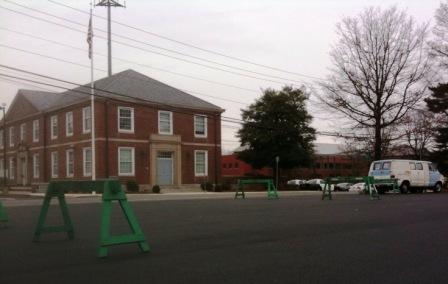
The other day, “they” paved the parking lot in front of the police station — the one near the Gillespie Center and Bank of America.

It may or may not have needed it, but whatever.

Now comes the important part.

When it’s painted for parking spaces, can “they” please — please — think about what they’re doing?

For years, this was one of the worst lots in towns.  The lanes were too narrow; the rows were random.  It was bad.

I always thought our cops could have made their monthly ticket quota just by walking out the front door, then watching drivers try to navigate the whole confusing mess.

Thanks For The Memories

The other day, alert “06880” reader Wendy Crowther stumbled on a website called PittsburghDiary.com.  (Don’t ask — I sure didn’t.)

Part of the site contained compelling stories about growing up in Westport during the 1940s and ’50s.  They were lovingly written by someone named T. Comden.

“They say you can’t go home again,” she began.

But I have always been able to call up the images of the hometown of my childhood by merely closing my eyes.  I’d go home in my mind.

I lived there from 1940 to 1962 and once I was old enough, and pedaled safe enough, was allowed free range through my neighborhood, and then Saugatuck and finally downtown and beyond.  My bike was a clumsy street bike, and I stood on the pedals and panted my way up the “steep steep hills” as I remembered them!

The original Staples High School, on Riverside Avenue — a photo from T. Comden’s website.

My husband and I moved away from town as he followed his educational opportunities and then his career.  We returned for visits to my family and his…and we watched the changes and photographed them with each visit.

T. Comden recalls the YMCA as “our crown jewel.”  She was not a member — she was, after all, a girl — but she did attend Miss Comer’s dance class in the 2nd floor ballroom.

Aah, Miss Comers.  She was elegant, in velvet gown, and her sister, Miss Elsie, played the piano on the stage.  We were her students, in prom finery, and we learned to foxtrot and waltz, to samba and tango, to jitterbug.

Miss Comer polished Westport’s young elite.  We learned the etiquette of formal dances with dance cards, bows and curtsies. Unfortunately, none of it stuck.

(My husband) Larry remembers going across the street to the Tally Ho for Cokes while waiting for his parents to pick him up; I remember dinner parties there preceding our dance lessons.  I remember the excitement of climbing the Y steps in the early evening, in my long gown and white gloves, and feeling so grown-up and sophisticated!

Next to the Y was the firehouse.  (Vestiges remain.  A fireman’s pole in what is now the Weeks Pavilion leads from the upstairs cardio center to the downstairs weight machines.)

T. Comden says:

Besides the small corps of firemen, there were also volunteers.  In the days before emergency radio communications, the location of fires was blown on a whistle at the fire station in a 3-numeral code, which could be heard all over town.

We knew the numbers for our immediate neighborhood by heart and had a complete list tacked to the cellar door so that we could look them up as we heard them.  If a neighborhood number was called, we’d be off chasing the fire on our bikes. I remember several grass fires — oh! the excitement.

One fire we did not see happened at night: a truck burning on the Post Road.  It was carrying a load of rubber cement.  When the firemen opened the back of the truck it exploded, killing several firemen.

It was well discussed around our dinner table.  My father knew the firemen.  After that, fires did not seem as exciting or attractive.

The fire whistle was put to another use.  It blew every afternoon at 5 p.m., signaling to the town’s children that it was time to go home.

She writes about the Fine Arts Theatre, Main Street — and Willowbrook Cemetery.

Larry grew up on Maplewood Avenue, which is just beyond the cemetery.  The cemetery was his playground.  The area where our plot is today was his ballfield back then.

Larry and his friends often took their dates up to the cemetery, and always, one would “hang” from one of the trees or leap out from behind a tombstone, scaring the girl into her date’s arms.  It was better (and cheaper) than a scary movie!

One large tombstone, “Julia,”was horizontal and soaked up the sun all day.  In the evening it reflected the warmth, and was a favorite rendezvous point in the cemetery.

A photo — from T. Comden’s website — of the house that once stood at the top of Burying Hill Beach.

T.  Comden also describes the Saugatuck River (“an open sewer and all the awful offal flowed down to the Sound with each outgoing tide”), Staples High School (on Riverside Avenue), the railroad station, Saugatuck, the Gault gravel pit (now the Gault neighborhood off Imperial Avenue), the beaches and Longshore (back in the day, a private country club).

Wendy Crowther spent a lot of time wandering around T. Comden’s site.  A Westport native herself, she loved the memories.

When she was done, Wendy clicked the “e-mail me” link to say “thanks.”

Quickly, she heard back — from Larry.

He told Wendy that his wife, T. Comden — “Tippi” — died October 10th.

Yet — thanks to Tippi Comden’s wonderful words, and the enormous, random reach of the internet — both she, and the Westport of her long-ago youth, live on.

Mike Perlis Moves Up

What do Playboy, Forbes Magazine and Westport have in common?

Mike Perlis.

Mike Perlis (Photo by Walter Smith)

Next week, the 1971 Staples grad becomes Forbes Media‘s chairman and CEO.  He assumes the duties of CEO Steve Forbes, a member of the business media company’s founding family and 2-time Republican presidential candidate, as well as COO Tim Forbes.  Both will have lesser roles in daily management.

Mike’s present post is general partner at SoftBank Capital, a venture capital firm.  Before that he was CEO at Ziff-Davis Publishing.

Much more impressive — at least to his former Staples classmates, like me — was his stint as president of the Playboy publishing group.

“Mike is the perfect guy to keep pushing us forward and to take us to new heights,” Tim Forbes said.

“This is a guy who’s really well versed in the digital world.  We take his coming as a real affirmation of what we’re doing here and what he thinks the opportunity is going forward.”

Congratulations, Mike, on your new position with Forbes.  The Capitalist Tool.

The True Christmas Spirit

”06880″ reader Adam Stolpen writes:

We are deep in the sprint that runs from the candy glut of Halloween straight through to sobering up on New Year’s Day.  It’s fun — but it’s also a time to do things for other people.

I’ve always thought that since Christmas Eve and Christmas day are so important to our Christian neighbors, that members of the Jewish community — and others who are not Christian — could pull together on that occasion and volunteer to do those jobs which they do the rest of the year.  It could free them up to be with family and friends, and celebrate their important occasion while we pitch in and do what real New England neighbors do.

I’m not talking about handling elective brain surgery, but delivering meals; answering phones for the town, hospitals, the police department, or whatever.

I have absolutely no idea how to move this forward or organize it — but I am sure you do.

Thanks, Adam — and by “you,” I am sure you mean our very wise, compassionate and creative “06880” readers.

Anyone can click the “Comments” link at the top of this story.  As Adam did, suggest a specific task.  Add details on how to offer help:  a phone number, email or website. 

Then — if readers want to help — they can contact those organizations, businesses, hospitals or whatever directly.  Voilà!

Sounds like a great idea — and a fantastic way to build community.

I have just one request:  On December 26, please let us know how it went.

Not a job to volunteer for on Christmas Eve.

Giving Thanks

The “Comments” page of “06880” has been filled with wild stuff the past year.  Drivers, joggers, dogs, education, housing, Obama’s stimulus package — if I’ve written about it, you’ve commented on it.

Today, let’s play nice.

We’ll devote this post’s “Comments” to a simple topic:  whatever we have to be thankful for.

I’ll start it off.  I’m thankful that I live in such a beautiful, creative, compassionate, involved and supportive town.  I’m thankful for the thousands of readers who make “06880” such an interesting labor of love.  And I’m thankful for the 2010 Staples boys soccer team, which brought so much joy and inspiration to so many friends, relatives, teachers, young kids, random Westporters — even their coaches.

Now it’s your turn.  Just click the “Comments” link at the top.

Thank you!

Homeward Bound

Growing up in Westport is one thing.

Coming back here to live is something else entirely.

That was the consensus, a couple of weeks ago, at a Green Village Initiative event attended filled with students from Staples’ Advanced Placement Environmental Science classes.

They were skeptical — if not downright incredulous — that anyone could ever return to Westport without first making incredible amounts of money in the materialistic world.

So GVI organized a meeting with Westporters who had done just that  — that is, came back home without a pit stop on Wall Street.

One of the panelists was Justin Miller.  The 2001 Staples graduate described why he left Westport after college — and why it was important to return.

It’s tough to make a career as a choral music performer, he said.  He got his start as a choral director in California.  And while he knew that teaching music was the way to go, the Golden State was not the place to do it.

He also knew he wanted to eventually raise a family here.  When the Staples choral directing job opened up last spring, he went through the rigorous application process — and got it.

“You should go away,” Justin told the students.  “Get a grasp on the rest of the world.

“I was excited to leave.  As I went, I learned and appreciated what Westport has to offer.”

When GVI leader Dan Levinson opened the floor to questions, the discussion veered to money.  Because the classes had been discussing sustainable local economies, the issue of mom-and-pop shops arose.

Justin pointed out that many small businesses exist — but are often overlooked.

And Mitchells — the high-end clothing store — is actually a grandma-and-grandpa business.

Driving home later, Justin said, he realized that the town is filled with places like Fortuna’s, Angelina’s and Westport Pizzeria.  Even Planet Pizza and Bertucci’s are small chains.

In any other town, he noted, the equivalent of the Post Road would be lined with Olive Gardens and Red Lobsters.

“The world has changed,” he said.  “In some respects, Westport has had slower change — in terms of a close-knit community aspect — than many other places.”

He was impressed with the thoughtfulness of the students’  questions.

One of the harshest young critics of the ability to return to — and sustain — your hometown came from a boy who recited statistics about average incomes and tax structures.  He said he’d love to come back after college, but knows he must go elsewhere first, to acquire wealth.

“We talked about different kinds of finances,” Justin said.  “It can be done.  I’m a music guy.”

Another student declared that he’d go somewhere else, learn about the world — and maybe not want to return.

“When I went away,” Justin replied, “that’s when I realized how special Westport was.

He paused.  “And still is.”

Nick DiBerardino: Rhodes Scholar

Not many people turn down a Marshall Scholarship — the prestigious award giving outstanding American students the chance to earn a graduate degree in the U.K.

Westporter Nick DiBerardino did.

With good reason:  He won a Rhodes Scholarship too.

Today the Rhodes Trust named the 2007 Staples grad as 1 of 32 men and women selected to represent the U.S. at the University of Oxford, for up to 4 years.

Rhodes Scholarships are the oldest, best known — and most prestigious — academic awards available to American college graduates.

They were created in 1902 by the will of Englishman Cecil Rhodes, noted South African diamond merchant and African imperialist.  But enough about his tainted money.  Let’s talk about Nick.

He was selected from an initial pool of over 1,500 applicants.  Final selection is based on high academic achievement, integrity of character, a spirit of unselfishness, respect for others, potential for leadership, and physical vigor.  Rhodes hoped his Scholars would “esteem the performance of public duties as their highest aim.'”

Nick certainly does.  At Staples he was valedictorian, and president of both Student Assembly and the National Honor Society.  He also founded a club that collected and refurbished musical instruments, then delivered them to a Bridgeport elementary school.

Nick — a gifted musician — was so impressed by the students that he traveled to the school a couple of times each week, to teach music.

Nick DiBerardino

Now a senior at Princeton University, Nick is majoring in music composition.  A campus leader in student government and member of Phi Beta Kappa, he has received many awards for his compositions.  He founded the Undergraduate Composer Collective at Princeton.

Nick will earn an M.Phil degree in music at Oxford.

All 16 Rhodes Trust district committees met yesterday, to select 2 winners each.  209 applicants from 88  colleges and universities reached the final stage of the competition.

The Rhodes Trust pays all college and university fees.  It also covers expenses in Oxford and during vacations, and transportation to and from England.  Total value of the scholarship is approximately $50,000 a year.

In an email to Staples principal John Dodig, Nick paid tribute to the role his high school played in preparing him for his new adventure.

And, perhaps, in giving him the analytical skills to help choose between a Marshall Scholarship, and a Rhodes.