Tag Archives: Lynsey Addario

Watch “Today Show” Clip: Lynsey Addario And Tyler Hicks

Westport photographers Lynsey Addario and Tyler Hicks, and 2 fellow New York Times journalists, appeared on the “Today Show” this morning.

Looking subdued, they discussed the intense gunfight and split-second decisions that ended in captivity earlier this month in Libya.

Tyler Hicks (3rd from left), Lynsey Addario (4th from left)

Tyler described a “hail of gunfire.”  They were fired upon by both sides — the opposition, and Gaddafi loyalists.

Lynsey said her greatest fear was being taken away from her colleagues, because she was a woman.

All 4 spent much of their time blindfolded.  Every time the quartet changed hands, Lynsey was groped.

Those assaults — and the rifle-beating of the men — were ways their captors “showed their power over us,” Lynsey said.

The scariest part of captivity, she added, was “the clanking of the cell opening.”  Every time that happened, “we didn’t know what they were going to do.”

(To watch the 5-minute interview, click here.)

Lynsey Addario Talks To The Times

Nine days after being freed from captivity in Libya, Lynsey Addario spoke about the experience she shared with fellow Westporter photographer Tyler Hicks, and 2 fellow New York Times reporters.

She addressed an issue that also arose in “06880” stories about her ordeal:

I was reading the feedback to the account that Anthony, Tyler, Steve and I wrote.  (“Four Times Journalists Held Captive in Libya Faced Days of Brutality.”)  Some comments said:  “How dare a woman go to a war zone?” and “How could The New York Times LET a woman go to the war zone?”

To me, that’s grossly offensive.  This is my life, and I make my own decisions.

If a woman wants to be a war photographer, she should.  It’s important. Women offer a different perspective.  We have access to women on a different level than men have, just as male photographers have a different relationship with the men they’re covering.

In the Muslim world, most of my male colleagues can’t enter private homes.  They can’t hang out with very conservative Muslim families.  I have always been able to.  It’s not easy to get the right to photograph in a house, but at least I have one foot in the door.  I’ve always found it a great advantage, being a woman.

DESCRIPTION
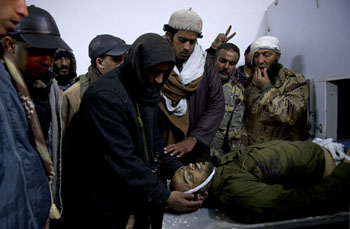
Rebels with the body of a fighter at the morgue in Brega.  (Photo:  Lynsey Addario/New York Times)

That said, I generally have a man accompany me everywhere.  When I’m on assignment, I hire either a local translator or a driver who speaks English.  And I make sure they’re always with me.  I do find that a woman who is alone is more prone to being mistreated than a woman who is with a man.

People think photography is about photographing.  To me, it’s about relationships.  And it’s about doing your homework and making people comfortable enough where they open their lives to you.  People underestimate me because I’m always laughing and joking.  That helps.  They let their guard down.

I try to do women’s stories when I can, but I don’t want to be pigeonholed as just a women’s photographer, because my interest is in covering the whole story — and human rights abuses and humanitarian issues.  Ironically, I don’t think I saw more than a handful of women the entire time I was in Libya.

DESCRIPTION
Relatives of Emad al Giryani at his funeral in Ras Lanuf.  (Photo:  Lynsey Addario/The New York Times)

After the attack on Lara Logan in Egypt, a lot of people started asking, “Why are women covering the Muslim world?”  Several people wondered why Western women covered countries where women are mistreated so badly.

To me, that’s not the case.  I have always been offered the utmost hospitality and protection and shelter in the Muslim world.  I have been fed.  I have been offered a place to sleep.  My translators and drivers have put their lives before mine.  It’s very important for people to recognize that these qualities do exist.

Yes, what happened to Lara was horrible, by all accounts.  There’s no question.  And when I was in Libya, I was groped by a dozen men.  But why is that more horrible than what happened to Tyler or Steve or Anthony — being smashed on the back of the head with a rifle butt?  Why isn’t anyone saying men shouldn’t cover war?  Women and men should do what they believe they need to do.

I don’t think it’s more dangerous for a woman to do conflict photography.  Both men and women face the same dangers.

DESCRIPTION
Bodies of rebels killed around Ajdabiya.  (Photo:  Lynsey  Addario/New York Times)

Lynsey discussed the physical and logistical demands of her work:

I have to make sure I’m always in shape.  I run every day.  I’m always at the gym.  Because if you do a lot of military embeds, people are not going to wait for you. I’m 5-feet-1.  There are times in Afghanistan when, if I have to jump a canal that’s 3 feet wide, I’m going to have a problem.  And I’m not as strong as my male colleagues.  But in most of the assignments I do, I don’t find it makes a difference.

Libya was a hard conflict to cover, finding that boundary when it was not safe anymore.  There was one road that led to the front line.  That road was being shelled.  There was tank fire.  There was artillery.  There were airstrikes.  And there were helicopters coming in.  So as soon as you got close enough to cover the conflict, you were also close enough to get fired upon.  It was hard to navigate.

You learn the fighting patterns.  You try and use that experience to judge how to move forward.  But every conflict is different and every conflict has different boundaries.  In Libya, it just so happened, the landscape didn’t provide any cover.  That was a basic fact about trying to cover the conflict: it was flat, open desert.

DESCRIPTION
Rebel soldiers wept at the hospital in Ras Lanuf.  (Photo:  Lynsey Addario/New York  Times)

It was so dangerous, we traveled in full cars.  It was hard to find a driver.  If one person found a driver we’d all pile into that car.  We generally were in two cars, with seven or eight photographers.

And the personal demands:

In the last few years, people have treated me more as part of the gang.  But I think that it is a chauvinistic profession.  In every conflict I’ve covered, there’s always been sort of a boys’ club.  And there aren’t that many women covering conflict right now.  I mean, it’s amazing in this day and age.  There are probably a dozen female photographers — at most — whom I see actively in the field, covering conflict.

There are many reasons.  It takes a great toll on your personal life.  It’s lonely.  It’s physically demanding.  You have to carry a lot of equipment.  It’s emotionally taxing.  You see and document things that take a lot to process, both mentally and physically.  Most women, at some point, decide they want to put their personal lives first.

Most of my life, I had no personal life.  I tried having relationships.  But they were never successful because I was never home.  That’s my fault.  That was my decision.  I would leave for an assignment and come back 4 months later.  You can’t ask someone to be in a relationship with you if you’re not home.  I think it’s a very good reason that a lot of women decide that they don’t want to do this.

DESCRIPTION
Lynsey Addario hugged Michele McNally, the director of photography.  (Photo:  James Estrin/New York Times)

Her experience in Libya has not deterred her:

I will cover another war.  I’m sure I will.  It’s what I do.  It’s important to show people what’s happening.  We have a unique access to what unfolds on the ground that helps our policymakers decide how to treat certain issues.

The hardest part about what happened to us in Libya, our having been detained, is what we put our loved ones through — more than what happened to us.  The whole time we were detained, I think our main concern was that our families didn’t know we were alive.  And we knew we would be hurting them.  At times, it’s a very selfish profession.  And it’s hard to put people through what we put them through.

Lynsey And Tyler’s Incredible Tale

What do you do if you’ve just spent 6 days in terror-filled captivity in Libya?

If you’re journalists and photographers for the New York Times, you collaborate on a story about it.

Westport photographers Lynsey  Addario and Tyler Hicks joined Beirut bureau chief Anthony Shadid and Stephen Farrell in writing a 5,000-word story that the Times just posted on its website.  It will undoubtedly run in tomorrow’s print edition.

Among the most remarkable passages:

No one really knows the script for days like these, and neither did we….

As they neared a dangerous government checkpoint:

“Keep driving!” Tyler shouted at Mohammed, the driver. “Don’t stop! Don’t stop!”Mohammed had no choice, and a soldier flung open his door.   “Journalists!” he yelled at the other soldiers, their faces contorted in fear and rage.  It was too late.

Tyler was in the front, and a soldier pulled him out of the car.  Steve was hauled out by his camera bags.  Anthony crawled out the same door, and Lynsey followed.

Even before the soldiers had time to speak, rebels attacked the checkpoint with what sounded like rifles and medium machine guns.  Bullets flew around us, and the soft dirt popped. Tyler broke free and started running.  Anthony fell on a sand berm, then got to his feet and followed Tyler, who, for a moment, considered making a run for it.

Lynsey instinctively clenched her cameras as a soldier pulled at them.  She let them go and ran behind us.   Soldiers tried to get Steve on the ground next to the car, and he pointed at the gunfire.  They made him drop his camera, then he ran, too.

We made it behind a simple one-room house, where a woman clutched her infant child.   Both cried uncontrollably and a soldier tried to console them. When we got there, soldiers trained their guns on us, beat us, stripped us of everything in our pockets and forced us on our knees.

Tyler’s hands were bound by a strip of a scarf. A soldier took off Lynsey’s gray Nike shoes, then bound her with the shoelaces. “God, I just don’t want to be raped,” she whispered to Steve.

The journalists were no strangers to danger:

All of us had had close calls over the years.  Lynsey was kidnapped in Falluja, Iraq, in 2004, Steve in Afghanistan last year.  Tyler had more scrapes than he could count, from Chechnya to Sudan, and Anthony was shot in the back in 2002 by a man he believed to be an Israeli soldier.  At that moment, though, none of us thought we were going to live.  Steve tried to keep eye contact until they pulled the trigger.  The rest of us felt the powerlessness of resignation. You feel empty when you know that it’s almost over.

“Shoot them,” a tall soldier said calmly in Arabic.

A colleague next to him shook his head.  “You can’t,” he insisted.  “They’re Americans.”

They bound our hands and legs instead — with wire, fabric or cable.   Lynsey was carried to a Toyota pickup, where she was punched in the face.  Steve and Tyler were hit, and Anthony was headbutted.

Even that Tuesday, a pattern had begun to emerge.  The beating was always fiercest in the first few minutes, an aggressiveness that Colonel Qaddafi’s bizarre and twisted four decades of rule inculcated in a society that feels disfigured.  It didn’t matter that we were bound, or that Lynsey was a woman.

But moments of kindness inevitably emerged, drawing on a culture’s far deeper instinct for hospitality and generosity.   A soldier brought Tyler and Anthony, sitting in a pickup, dates and an orange drink. Lynsey had to talk to a soldier’s wife who, in English, called her a donkey and a dog.  Then they unbound Lynsey and, sitting in another truck, gave Steve and her something to drink.

From the pickup, Lynsey saw a body outstretched next to our car, one arm outstretched.  We still don’t know whether that was Mohammed.  We fear it was, though his body has yet to be found.

If he died, we will have to bear the burden for the rest of our lives that an innocent man died because of us, because of wrong choices that we made, for an article that was never worth dying for.

No article is, but we were too blind to admit that.

We probably shouldn’t have lived through the night.

Even before the sun set, another gun battle broke out, almost as fierce as the first one.  We were trapped in trucks in the open.  Tyler stretched the binding of his handcuffs, allowing him to open the door.   Anthony yelled for help, trying to open the door with his teeth.

A soldier finally let Tyler crawl around the pickup to let Anthony out. For a moment, our captors were in the same plight as us. As the hours passed, they offered us food, drink and cigarettes.

“These are the morals of Islam,” one said to Anthony.  “These are the morals of Qaddafi. We treat prisoners humanely.”  For a few hours they did.  They offered blankets and mattresses, then put us in a car.  As rebels attacked every so often, we all barreled out of the car and dove to the ground, until the firing subsided. They put us back in, and we dove to the ground again.

They eventually let us lie behind a pickup.

Lynsey asked for her shoes. She got a bullet-riddled pair of Tyler’s, taken from his bag.

Clockwise from top left: Lynsey Addario, Stephen Farrell, Anthony Shadid, Tyler Hicks

On Wednesday:

A new group seized us, and they were rougher.  They blindfolded us, tied our arms and legs and beat us.  They then stuffed us into an armored car, where Lynsey was groped.  She never screamed but instead pleaded.  A soldier covered her mouth, tracing his hands over her body.  “Don’t speak,” he warned.  Another soldier tried to shove a bayonet into Steve’s rear, laughing as he did it.

A half-hour later, we arrived on what we thought were the outskirts of the other side of Ajdabiya.  A man whom soldiers called the sheik questioned us, then began taunting Tyler.

“You have a beautiful head,” he told Tyler in a mix of English and Arabic.  “I’m going to remove it and put it on mine.  I’m going to cut it off.”  Tyler, feeling queasy, asked to sit down.

We were finally put in a pickup where a soldier taunted Lynsey.

“You might die tonight,” he told her, as he ran his hand over her face.  “Maybe, maybe not.”

At 8:30 a.m. Wednesday, they were thrown blindfolded and bound in the back of a pickup truck and driven along the Mediterranean coast toward Colonel Qaddafi’s hometown of Surt, a six-hour drive.

We felt like trophies of war, and at a dozen checkpoints, we could hear militiamen running to the car to administer another beating.“Dirty dogs,” men shouted out at each stop.Over the years, all of us had seen men detained, blindfolded and handcuffed at places like Abu Ghraib, or corralled after some operation in Iraq or Afghanistan.  Now we were the faceless we had covered perhaps too dispassionately.  For the first time, we felt what it was like to be disoriented by a blindfold, to have plastic cuffs dig into your wrists, for hands to go numb.

The act is probably less terrifying than the unknown.  You don’t know when it’s going to end or what comes next.  By late afternoon, we were taken to a jail in Surt. Our captors led us to a basement cell with a few ratty mattresses, a bottle to urinate in, a jug of water and a bag of dates.  As night fell, we wondered whether anyone knew — or could know — where we were.

The foursome realized that no one outside of their captors knew where they were.
The next afternoon, on Thursday, was perhaps the worst beating.  As we stood on the tarmac in Surt, waiting for a military plane to Tripoli, Tyler was slapped and punched, and Anthony was hit with the butt of a gun to the head.  We were blindfolded and bound another time with plastic handcuffs, and Lynsey was groped again….

Nothing ever felt more generous to Anthony than a handcuffed Tyler managing to reach into the pocket of Anthony’s jacket, pull out a cigarette and light it before handing it back to him.

Tyler Hicks near the frontline during a pause in the fighting on March 11 in Ras Lanuf, Libya. Four days later, he and three other Times journalists were taken captive by government soldiers. (Photo: John Moore/Getty Images)

After a plane trip and bus ride:
We were moved to another vehicle but not before a soldier, perhaps from the losing side, drove the barrel of his rifle into the back of Tyler’s head.

Within a half-hour, we were in a military compound, in the hands of military intelligence. We collapsed on the floor, accepting milk and mango juice. We saw our bags unloaded, though we would never get them back.

A gruff man struck a sympathetic tone. You won’t be beaten or bound again, he told us.   You will be kept safe and, although you will be blindfolded if you are moved anywhere else in the compound, no one will mistreat you.

From that moment, no one did.

We were taken to a detention center that looked more like a double-wide trailer.  On the shelves were a two-volume German-Arabic dictionary and five of Shakespeare’s plays. (Colonel Qaddafi once famously quipped that Shakespeare, or Sheik Zubeir, was actually an Arab migrant.)

The men were given track suits. Lynsey was brought a shirt that read, “Magic Girl,” emblazoned with two teddy bears.  Her new underwear read, “Shake it up.”

At the late hours of night, we were blindfolded to receive visitors.

“You are now in the protection of the state,” a Foreign Ministry official told us….

Officials asked Lynsey whether she had been raped.

Over the next 4 days:

We fought boredom more than anything else.  Tyler finished Julius Caesar.  Lynsey started Othello.  If it went on much longer, Tyler jokingly suggested we perform the plays.  As the hours passed, we replayed each moment of the preceding days in detail, trying to piece together what had happened to Mohammed.

We wondered whether we would be delivered into more sinister hands.  After the no-fly zone was imposed and we heard volleys of antiaircraft fire, we thought that a desperate government could make us human shields.  Weighing over all of us was guilt for what we had put our families and friends through.

In the end, it was the trappings of diplomacy that delayed our departure.

Foreign Ministry officials, clinging to a prestige they may have never had, insisted that our transfer be formal, between two sovereign states.   At one point, they insisted an American or British diplomat had to travel to Tripoli in wartime.  In the end, Turkish diplomats served as intermediaries and delivered us to the border.

As we left, we saw the billboards of a crumbling government.  “Forty-one years of permanent joy,” read one slogan superimposed over a sunburst.  But the words that lingered with us as we left were quoted to Steve by an urbane Foreign Ministry official speaking idiomatic British English.

As we sat in an office, he murmured two lines of Yeats.

“Those that I fight I do not hate,

Those that I guard I do not love.”

Libya Ordeal: A Frightening First-Hand Account

We’ve all speculated about the conditions of Lynsey Addario and Tyler Hicks’ capture in Libya, and what the Westport photographers and their 2 reporter colleagues from the New York Times went through during 6 days of captivity.

Here is a report from the Times.  They came — literally — seconds from death.  The report is chilling, raw — and very, very important to read.

The four had been covering fighting near Ajdabiya last Tuesday when they decided that the battle had grown too dangerous for them to continue safely.  Their driver, however, inadvertently drove into a checkpoint manned by forces loyal to Colonel Qaddafi.  By the time they knew they were in trouble, it was too late.

“I was yelling to the driver, ‘Keep driving! Don’t stop! Don’t stop!’ ” Mr. Hicks recalled in a telephone interview from the hotel where he and the three others were recuperating. “I knew that the consequences of being stopped would be very bad.”

The driver, Mohamed Shaglouf, is still missing. If he had tried to drive straight through, Mr. Hicks said, the vehicle certainly would have been fired on. In any event, the soldiers flung the doors to their gold four-door sedan wide open so quickly that they had little chance to get away.

As they were being pulled from the car, rebels fired on the checkpoint, sending the four running for their lives.

“You could see the bullets hitting the dirt,” Mr. Shadid said.

All four made it safely behind a small, one-room building, where they tried to take cover.  But the soldiers had other plans.  They told all four to empty their pockets and ordered them on the ground.  And that is when they thought they were seconds from death.

“I heard in Arabic, ‘Shoot them,’ ” Mr. Shadid said.  “And we all thought it was over.”

Then another soldier spoke up. “One of the others said: ‘No, they’re American. We can’t shoot them,’ ” Mr. Hicks said.

The soldiers grabbed whatever they could get their hands on to tie up their prisoners:  wire, an electrical cord from a home appliance, a scarf.  One removed Ms. Addario’s shoes, pulled out the laces and used them to bind her ankles.  Then one punched her in the face and laughed.

“Then I started crying,” she recalled. “And he was laughing more.”  One man grabbed her breasts, the beginning of a pattern of disturbing behavior she would experience from her captors over the next 48 hours.

“There was a lot of groping,” she said. “Every man who came in contact with us basically felt every inch of my body short of what was under my clothes.”

Their captors held them in Ajdabiya until the fighting with the rebels died down.  Soldiers put the four in a vehicle and drove them out of the city around 2 a.m.  One threatened to decapitate Mr. Hicks.  Another stroked Ms. Addario’s head and told her repeatedly she was going to die.

“He was caressing my head in this sick way, this tender way, saying:  ‘You’re going to die tonight.  You’re going to die tonight,’ ” she said.

Their vehicle stopped repeatedly at checkpoints, each time allowing for a new group of soldiers to land a fresh punch or a rifle butt in their backs.  The first night they spent in the back of a vehicle.  The second night they spent in a jail cell with dirty mattresses on the ground, a bottle to urinate in and a jug of water to drink.

On the third day they were on the move again, this time to an airfield.  Mr. Shadid, who speaks Arabic, had overheard one of the soldiers saying something about a plane, and the four assumed they would be flown somewhere.  As they were loaded on the plane they were blindfolded and their hands were bound tightly with plastic handcuffs.

“I could hear Anthony at this point yelling ‘Help me!’ ” Mr. Hicks said, “which I learned later was because he had no feeling in his hands.”  In a rare show of mercy, a soldier loosened the cuffs.

They landed on Thursday in Tripoli, where they were handed over to Libyan defense officials.  They were transferred to a safe house, where they said they were treated well.  They were each allowed a brief phone call.

That was the first time since their capture two and a half days earlier that their whereabouts became known to their families and colleagues at The Times.

Their disappearance had kicked off an intensive search effort.  The Times canvassed hospitals and morgues, beginning a grim process-of-elimination search.  The paper also turned to a variety of people on the ground who might have heard or seen something — local residents, security contractors for Western businesses, workers for nongovernmental organizations.  It also notified American diplomats.

The State Department got word Thursday afternoon that the journalists were safe and unharmed, in a phone call to Jeffrey D. Feltman, the assistant secretary of state for Near Eastern affairs, from an aide to Abdullah al-Senussi, the head of Libyan military intelligence and the brother-in-law of Colonel Qaddafi, Mr. Feltman said.

But the arrival of the four journalists in Tripoli was just the beginning of three days of frustrating, increasingly tense negotiations conducted by a State Department consular officer, Yael Lempert.  Libyan officials kept changing their demands for the conditions of the journalists’ release, and an allied coalition, including the United States, began bombing Tripoli to enforce a no-fly zone.  Several Libyan agencies were involved in the negotiation, which added to the confusion.

First the Libyan government demanded that an American diplomat come to Tripoli to take the journalists, State Department officials said.  The United States, which closed its embassy in Libya last month, refused.  After initially resisting, the Libyans agreed to allow the Turkish Embassy to act as an intermediary.

The release was scheduled for Sunday but was delayed until Monday because of the bombing. The four were turned over to Turkish diplomats Monday afternoon, and were driven to the border with Tunisia.

While Monday was a day for celebration and relief at The Times, other news organizations covering the conflicts in Libya and elsewhere in the Arab world have not been so lucky.  According to the Committee to Protect Journalists, 13 journalists are either missing or in government custody.  The missing include four from Al Jazeera, two from Agence France-Presse and one from Getty Images.  In addition, six Libyan journalists are unaccounted for, the group said.

Others have died. A Libyan broadcaster was killed Saturday while covering a battle near Benghazi. A cameraman for Al Jazeera was killed in the same area on March 12, the first death of a journalist in Libya during the current conflict.

Lleft to right: New York Times journalists Stephen Farrell, Tyler Hicks, Ambassdor Levent Sahinkaya, Lynsey Addario and Anthony Shadid at the Turkish Embassy in Tripoli, Libya.  (AP Photo/Turkish Ministry of Foreign Affairs)
Paywalls And The Price Of Journalism

The New York Times‘ decision to start charging for online access has generated a firestorm of controversy.

The announcement that, starting next Monday, visitors to the Times website will generally be allowed no more than 20 “free” articles a month — there are several major exceptions — has drawn howls of indignation.  Criticism includes the very act of charging; the pricing itself; the several tiers of restrictions, and much more.

On the other side, supporters argue that the Times has created a smart balance, serving both casual readers and voracious news hounds; that the pricing model is both sensible and adaptable, and that news-gathering is not free.

I’m in the latter camp — and not just because I’m a journalist.  David Carr’s column this week expresses far better than I the reasons I believe the New York Times can — and must — charge daily online readers like me for its content.

But it wasn’t until yesterday’s finally-a-glimmer-of-hope news — the release of 4 of their top journalists, including Westporters Lynsey Addario and Tyler Hicks — that I realized how important an institution like the Times is.

People like Lynsey and Tyler serve an amazing role.  Their photographs have shown the world what Al Qaeda terrorists look like.  What the twin scourges of starvation and the oppression of women in Africa look like.  What a devastating earthquake in Haiti looks like.

And now, what Muammar Gaddafi’s war against his own people in Libya looks like.

Lynsey Addario (far left) and Tyler Hicks (far right) in Libya earlier this month.

Lynsey and Tyler — and their Times colleagues, reporters Anthony Shadid and Stephen Farrell — literally put their lives on the line this month, so the world could read about and see what’s going on in a land most of us knew very little about, but that is crucial to understanding the world today.

Lynsey and Tyler have done this — for over a decade, in more hot spots than I can count — because they have a passion for it.  They do it because they love photography, and they’re superb at it.  They do it because they feel compelled to share their talents, their insights, their visions and their work with a world that would have no other way of knowing — really knowing — what war, deprivation, destruction, terror, fear, hatred, and the rest of reality in the 21st century, really are.

They could not do it, of course, without the vast resources of the New York Times behind them.  Very few news organizations like the Times exist today.

Most papers are shells of their former selves.  American television networks have pretty much abandoned foreign coverage.  Al Jazeera, of all things, has been outstanding in its coverage of Egypt, Bahrain, Libya — and now Japan.  (Sure, only 2 or 3 cable companies carry it in the US.  But check it out online — you’ll be very impressed.)

So on Monday, I’ll gladly subscribe to the Times paywall.  I’ll happily pay for access to a very impressive news-gathering organization, with tremendous depth and breadth, and coverage around the world.

And I will dedicate my subscription to Lynsey Addario, Tyler Hicks, and the courageous, compelling work that they and all their New York Times colleagues do.

Freedom!

New York Times photographers Tyler Hicks (far left) and Lynsey Addario (center) stand with (from right) Times reporters Stephen Farrell and Anthony Shadid, and Turkish ambassador Levent Sahinkaya in Tunisia, soon after being freed by Libyan government forces.  (Photo/Turkish Foreign Ministry)

Tyler Hicks And Lynsey Addario Are Safe In Tunisia

New York Times photographers — and Staples graduates — Tyler Hicks and Lynsey Addario are finally safe.

The pair — along with Times reporters Anthony Shadid (Beirut bureau chief) and Stephen Farrell — were released by the Libyan government earlier today.  They had spent 6 days in captivity, while covering the conflict in Ajdabiya.

Government forces released the quartet into the custody of Turkish diplomats.  They entered Tunisia in the late afternoon, Libya time.

Times executive editor Bill Keller described himself as “overjoyed” at the journalists’ release.

“Because of the volatile situation in Libya, we’ve kept our enthusiasm and comments in check until they were out of the country, but now feels like a moment for celebration,” he told his staff.

“We’re particularly indebted to the government of Turkey, which intervened on our behalf to oversee the release of our journalists and bring them to Tunisia.  We were also assisted throughout the week by diplomats from the United States and United Kingdom.”

The Times said on its website:

On Tuesday, the journalists were leaving the front lines of the clashes between pro-Qaddafi forces and rebels in and around Ajdabiya.  As they attempted to drive east toward the relative safety of the rebel capital of Benghazi, they approched a new checkpoint.

It belonged to a group of Qaddafi fighters who detained them.  The Qaddafi forces then suddenly came under fire from reebls, and a gunfight ensued.

When the fight let up, the journalists’ captors drove them along a coastal road until they reached the Qaddafi stronghold of Surt.  From there, they were flown in a military aircraft to Tripoli.

On Thursday afternoon the Libyan government informed The Times through various channels that the journalists were in the custody of Libyan authorities and would be freed soon. They were allowed a phone call to their families that night.

They were turned over to Turkish diplomats Monday afternoon, and began the long drive to the border with Tunisia.

The Addario and Hicks families — both well-known throughout Westport — have kept a low profile throughout the ordeal.  They have had to keep phone lines open, and at the request of Times and State Department officials, kept public statements to a minimum.

They’ve been buoyed by the support of many Westporters, however.  Finally, all can breathe easily.

Breaking News — NY Times Says Lynsey Addario, Tyler Hicks Are Released

According to the New York Times this morning:

The Libyan government released four detained New York Times journalists Monday [today], six days after they were captured while covering the conflict between government and rebel forces in the eastern city of Ajdabiya. They were released into the custody of Turkish diplomats.

Like many Western journalists the four had entered the rebel-controlled eastern region of Libya without visas over the Egyptian border to cover the insurrection against Col. Muammar el-Qaddafi.  They were detained by forces loyal to Colonel Qaddafi in Ajdabiya.

The journalists are Anthony Shadid, The Times’s Beirut bureau chief, who has won two Pulitzer Prizes for international reporting; two photographers, Tyler Hicks and Lynsey Addario, who have extensive experience in war zones; and a reporter and videographer, Stephen Farrell, who in 2009 was captured by the Taliban in Afghanistan and was rescued by British commandos.

After The New York Times reported having lost contact with the journalists last Tuesday, officials with the Qaddafi government pledged that if they had been detained by the government’s military forces they would be located and released unharmed.

Breaking News — Lynsey Addario, Tyler Hicks To Be Released

The New York Times reported this morning that 4 missing journalists — including Westport photographers Tyler Hicks and Lynsey Addario — who were captured by Libyan forces loyal to Col. Muammar el-Qaddafi will be released today.  The Times said the dictator’s son told Christiane Amanpour the news in an ABC interview.

The Libyan government allowed the journalists to call their families on Thursday evening.

“We’re all,  families and friends, overjoyed to know they are safe,” said Bill Keller, the executive editor of the Times. “We are eager to have them free and back home.”

Most Recent Photo Of Lynsey Addario And Tyler Hicks

New York Magazine posted this photo of missing New York Times photographers Lynsey Addario and Tyler Hicks — both Staples graduates — today:

(Photo: Paul Conroy/Reuters)

Chris Rovzar wrote:

You very rarely see what cameramen, be they video or still, look like in the field.  I often wonder what is going on behind the scenes when I look at scary, intensely vivid wartime photographs.

Do the photographers stick out?  Are people paying attention to them?  How close are they to the action?  Is it terrifying?

This photo, by Reuters photographer Paul Conroy, gives you a pretty good idea.  It shows New York Times photographers Tyler Hicks (on the right, in the glasses) and Lynsey Addario (almost off-camera, on left) among other journalists in Ras Lanuf, Libya, as they run for cover last Friday from bombs dropped by government planes.

Hicks and Addario are two of the four Times journalists that have been missing since Tuesday.  The photo answers some of my questions:  Yes, they are incredibly close to the action.  Yes, they stick out.  And yes, it looks scary as hell.

Lynsey and Tyler’s many fans throughout the world — especially those here in their hometown — pray for their safe return.