Tag Archives: Camp Mahackeno

Friday Flashback #465

Summer is over — realistically, if not literally.

Kids are back in school. If they still write that traditional “What I did over summer vacation” essay — hundreds of Westport boys and girls will recount their weeks at Camp Mahackeno.

They’ve done it for 80 years. The Westport Weston Family YMCA’s camp has grown and evolved quite a bit, since the original Y camp began in 1938, at Doubleday Field (between Saugatuck and Kings Highway Elementary Schools — or, as they were then known, Staples High and Bedford Junior High).

No photos exist from the original camp at Doubleday. This is an early scene from the present Mahackeno site.

That first year 58 boys enjoyed sports, nature study, crafts, songs, storytelling, and swimming at Compo Beach.

In 1942 the Y was offered 32 acres, near the then-new Merritt Parkway.

F.T. Bedford — son of the Y’s founder, Edward T. Bedford — said his family’s trust would pay half the price, provided the town ponied up the other half.

Within a few weeks, Westporters pledged their portion:  $10,000.

In 1945 — exactly 80 years ago — the YMCA camp had a home of its own.

An early scene: Pledge of Allegiance.

The next year — at F.T. Bedford’s request — the name was changed to “Mahackeno.” That honored “Mahackemo” (with an “m”), a chief of the Norwalke Indian tribe who in 1639 met Roger Ludlow and traded land between the Saugatuck and Norwalk Rivers — including that very spot — for wampum and other goods.

Generations of boys swung on a rope suspended from the parkway bridge, clambered over (and almost drowned under) a giant World War II-surplus float, and swam, canoed and fished in the river.

Fun on the river.

They played baseball on dusty fields, did arts and crafts in rustic cabins, and slept out in the woods.

There was boxing, too.

Girls joined Camp Mahackeno in 1969,

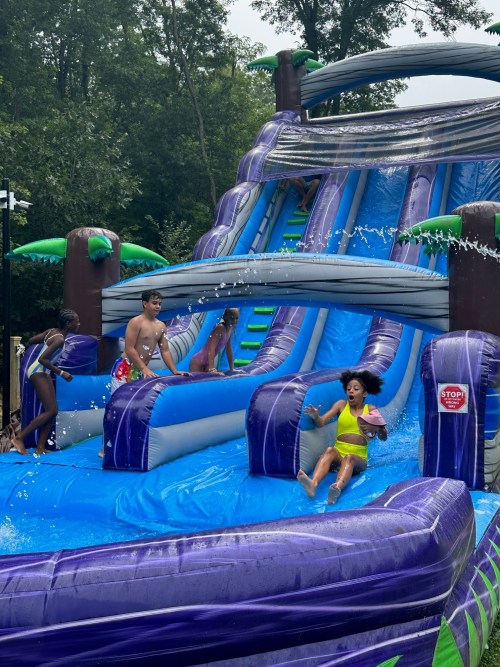
It expanded over the years. Mahackeno now includes a heated outdoor pool with a splash pad, a dock for canoeing and paddle boating, 2 large slides, a climbing and bouldering wall, laser tag and mini-golf.

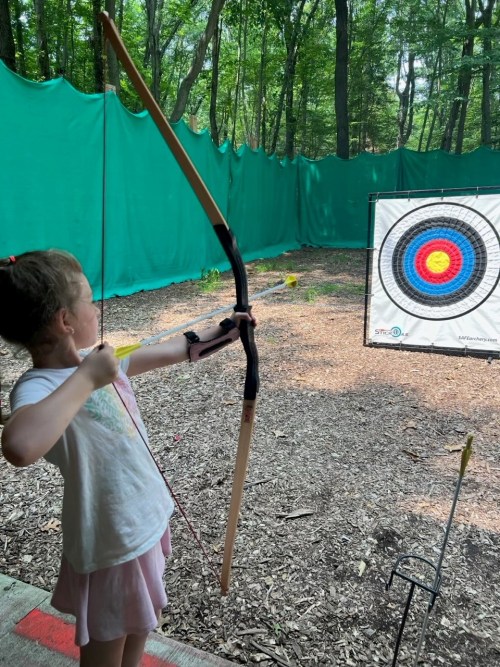
Campers also enjoy an archery pavilion, playgrounds, a gaga pit, basketball courts, sports fields, picnic areas, fire pits, wooded trails, and an amphitheater.

This year, over 1,000 youngsters attended Mahackeno. Plenty are 2nd, even 3rd, generation campers.

They were joined by nearly 200 teenage and young adult counselors — many of whom had been campers themselves.

Registration for Camp Mahackeno’s next season begins in January.

Until then, enjoy these photos of the early years.


(Most photos courtesy of Westport Weston Family YMCA archives)

 In 1953 — 8 years after the camp opened at Mahackeno — Westport artist Stevan Dohanos drew this Saturday Evening Post cover.

(Friday Flashback is one of “06880”‘s many regular features. If you enjoy this — or anything else on our website — please consider a tax-deductible contribution. Just click here. Thank you!)

Friday Flashback #362

Michael James graduated from Staples High School in 1960.

He co-founded and ran Chicago’s Heartland Café for 36 years. He is now working on a book about it: “Hot Grits & Politics.”

Michael has published 3 books of his photos: “Michael Gaylord James’ Pictures from the Long Haul.” He teaches a course called “Activists and Activism Since 1960″ at DePaul University; hosts the weekly Live from the Heartland Show, is active in politics (past president of Chicago’s 49th Ward Democratic Party), and as a member of SAG/AFTRA is currently on strike. He plans a visit to his beloved hometown of Westport this fall.  

He posts and writes about his photos on Instagram (@michaelgaylordjamesphotography). Many of his photos can be seen at michaelgaylordjames.com.    

This reminisce is from “Pictures from the Long Haul.”

I’m back home in Connecticut, an original colony—the “Nutmeg State” turned “Constitution State.” I grew up with constant reminders of the Revolutionary War. On Red Coat Road we played “fight the British” near where real Red Coats marched to burn hat factories in Danbury.

Westport is where I learned to love America, where we played in fields, in woods, and on the shores of the Saugatuck River and Long Island Sound. It’s where in the late 1940’s we hiked along the Wilton Road singing “John Brown’s body lies a-moldering in the grave, but his soul goes marching on; glory, glory hallelujah.”  And my town really supported the new United Nations.

My teen-dream romance comes rapidly undone one night at the beginning of the summer. That was it; young love, over and done. I spend the summer in pain, a shredded heart — “one mizzable bastard,” to use one of my dad’s favorite expressions.

Life goes on. I have a job at the YMCA’s Camp Mahackeno. It’s where artist Harold Von Schmidt — in full Indian regalia — taught us about the Sioux. The camp’s Rotary Pavilion became the Downshifters Hot Rod Club garage during off camp months, and we were there — and upset — when the Russians and their Sputnik machine beat us into space.

A young trumpeter, I was a Mahackeno bugle boy, blowing reveille in the morning before the Pledge of Allegiance. In the afternoon I blew taps while our beloved flag was lowered. At Camp Mahackeno I suffered major yellow-jacket abuse while trying to save the bees from a clean-up brigade with a forceful hose.

Pledging allegiance, Camp Mahackeno.

There I earned my Minnow, Fish, Flying Fish, Shark and Porpoise badges, and grew up through the ranks: a Papoose, Hiawatha, Brave, Sachem, and CIT (counselor in training).

Camp Mahackeno waterfront. In the distance in the Saugatuck River: the famed “Moby Dick.”

Now I was a counselor and unit leader. We marched our tribe through the woods to my family home on the Wilton Road. My mom Florence fixed lemonade and sandwiches.  Mom (Dad didn’t allow me to call her Ma) also gave me an illustrated kid’s book with stories of Bre’r Rabbit and his adventures. I read them to campers during rest periods.

Kids being kids, at Mahackeno.

I loved Uncle Remus, the storyteller. He took a lot of hits for being an “Uncle Tom” during the Black Power years. It’s hard today to find a copy of the Disney film Song of the South. In my mind he was kind and wise, a cool old dude. I am glad I saw that flick. Bre’r Rabbit was definitely cool!

I head to Rhode Island. Not to Charlestown and the drag races of my high school years, but this time to the Newport Jazz Festival. I’m with high school chum Don Law and his dad, a C&W producer with Columbia Records.

We party late into the night with Nigerian drums-of-fire-guy Babatunde Olatunji and jazz great Horace Silver. In 1963 the cultural activities committee at Lake Forest College will bring Olatunji, his drummers, and wild Haitian (and gay) dancers to campus during Africa Week. And Silver’s Sunday school teacher in Norwalk turns out to be the mother of my adopted brother, body builder Jim Arden.

I look forward to heading west and back to school. I do it via a run south to Birmingham with fellow Downshifter John Willoughby. On a late summer night we hit Bristol, Virginia and Bristol, Tennessee, and I swear the Bristol Stomp was on the radio. The tune is about a dance in another Bristol (Pennsylvania), and was being played nationwide.

The Downsifters were Michael James’ hot rod club. This photo was taken in the back yard of his Wilton Road home.

Willoughby’s mom nourishes me for a day. Then I don my sport jacket and hitchhike, mostly up US 41, back to college. Near Pulaski, Kentucky I get a short ride in a beat up car with a group of juiced up folks, both white and black. They’re having a fun time.

I am crammed into the back seat, surrounded by heat, wind, and people drinking — a scary-reckless-ride. I do accept a hit of whiskey from their pint. A feeling of relief engulfs me when the ride is over and I get to stick out my thumb again.

(To read more of Michael James’ writings, click here.)

Michael James, today.

“My First Job”: Mahackeno Mentors Teenage Staff

The 16-year-old applied to be a Camp Mahackeno counselor.

But he struggled when Westport Weston Family YMCA officials — who run the popular summer camp — asked for online forms.

Then he had difficulty getting to, and through, training sessions. He was about to lose his job.

When Y human resources director Brian Kuzmiak sat with the boy, he learned the full story. The teenager had a difficult home life. He had no ride to and from work, and the only time he used a computer was at the library.

Kuzmiak took a chance. He and Mahackeno director Emily Regan mentored him.

“He turned out to be one of our best and most energetic counselors,” the HR head says. “Kids always surrounded him.”

He returned this year, for a second summer. Again, he bikes to and from work every day.

That’s one success story among dozens. With 175 staff members — 35% of the Y’s total employees — the organization is one of Westport’s largest employers of young people.

175 young people work at Camp Mahackeno. Many are teenagers; nearly all are under the age of 25.

More than half of the counselors are 16 to 18 years old. For many, it’s their first job ever. They’ve never applied for work; never sat for an interview; never been entrusted with work responsibilities.

And at Mahackeno, those responsibilities include the safety and well-being of hundreds of younger kids.

So Kuzmiak, Regan and Westport Y CEO Anjali McCormick have responsibilities of their own, as they hire and supervise camp staff.

They take that aspect of their roles very seriously.

“The Y’s mission is ‘youth development, healthy living and social responsibility,'” McCormick notes.

“So we develop the whole youth. We prepare children for life, for being mature, contributing adults. We are there as they move from playing sports and doing our programs, to being in many cases their first employer.”

A young person’s first job is an important life milestone. 

That means not just hiring young people. It involves teaching life skills like punctuality, dressing respectfully, communicating with supervisors, treating others well, and being role models.

“It’s really leadership training, without being an official leadership program,” McCormick says. (That training includes helping staff members in college mentor those still in high school.)

Those are big challenge. But, she adds, “it’s great when kids excel and shine. We’re serving the community — and adding to the labor pool.”

The application process begins online. That’s the first hurdle for many teens: They’re not used to checking email.

“There’s a lot of ghosting” — no further communication — “after the application,” Kuzmiak says. “We try to make contact, but at some point we assume the kid is not interested.”

The hiring process weeds out those who really want to work, from those whose parents want them to.

Then — for those who follow up — comes an in-person interview.

“Kids are usually nervous,” Kuzmiak says. “We try to put them at ease, with a casual conversation. At the same time we look for things like, are they making eye contact?

“Eventually we want to know ‘Why are you applying? What are you looking for in a job?’ Most of them genuinely want to work, and they like kids. Some are doing it because their parents are making them.”

Parents can be an issue in other ways too.

“When a mom or dad asks me why their child wasn’t hired, I say, ‘Tell them to call us,'” Kuzmiak explains. “They’re the ones who applied for the job.”

How often do parents involve themselves in their child’s application (or eventual work, with questions about — for example — their pay)?

“More than you think,” Kuzmiak says.

Once hired, there are forms to fill out — contracts, information on sexual harassment and social media policies, direct deposits — and training sessions.

The most important element, McCormick emphasizes, is safety.

“We are a child-service organization. We’re licensed by the state. We have to train 175 people about counting heads, bathroom policies, you name it. It’s a mammoth exercise.”

Counting heads is an important part of camp policy.

And, of course, many of them are still teenagers.

“There’s a lot of hormones. Some of them have their own issues. It’s a lot,” McCormick says.

Most counselors quickly assume responsibility, and grow in the job. “I’m surprised at the number who ‘get it,'” Kuzmiak says. “Punctuality and professionalism has been great.”

Many counselors are only a few years older than their campers.

Of course, Y leaders must spend “a lot of time on those who don’t.”

“Emily really bumps them up,” McCormick says. “She makes sure they show up on time, dressed appropriately, and work as a team.”

But when late summer hits — and it’s hot, and their friends are at the beach — the “I don’t want to be here” feeling hits a few of the staff.

It’s Kuzmiak’s job to deal with those kinds of matters.

He’s an HR professional. But most of his career was spent with adult workplaces. This is only his second year at the Westport Y.

“Anjali has taught me to be patient with teenagers,” he says. “I’m not as quick as I would be to let them go.

“I don’t have a trigger finger for firing,” McCormick adds. “I have to show our older staff that these are not 50-year-olds. These are kids, who may not have been in certain situations before.

“There is an ‘acceptable level’ of mistakes — except for serious safety violations. We could never put kids, or the Y, at risk.”

Waterfront safety is a key concern.

For common issues — leaving a group to talk to a friend, disagreeing loudly with another counselor in front of children, speaking harshly to a camper — Kuzmiak, Regan or an assistant will speak privately with the teenager. They’ll explain ways to improve the behavior — and they document it.

In 95% of the cases, Kuzmiak says, “that’s enough.”

The Y’s approach seems to work. Staff retention is very high.

And campers must like their counselors: They too return year after year.

After all, they get a chance to hang out with counselors like the boy who almost did not get hired.

But Kuzmiak reached out to him, and took a chance. The Y mentored him, helping him grow.

Now he bikes to Camp Mahackeno every day.

Where he is a star.

(“06880” often highlights organizations, and people of all ages, making positive differences here. To support our work, please click here. Thank you!) 

Happy campers (and staff members). (All photos courtesy of Westport Weston Family YMCA)
Camp Mahackeno: 2023 Gallery

Charlie Taylor’s recent ode to Camp Mahackeno reminded readers of the long-time summer institution in the woods off Wilton Road.

The Westport Weston Family YMCA has run programs there for over 70 years. (The original name — “Camp Bedford” — was quickly replaced)

Director Emily Regan is — like so many Mahackeno predecessors — hands-on, creative, and kid-oriented.

Some things have changed over the decades. Girls long ago joined boys; there are now 360 youngsters, during each 1-week session. (Spots fill up as soon as online registration begins.)

A pool and waterslide provide aquatic options; no one swims in the Saugatuck River anymore, and the huge “Moby Dick” Navy surplus life raft is long gone.

There’s a climbing wall. Bicyclists train for a triathlon.

But some things never change: arts and crafts. Archery.

And — it wouldn’t be camp without them —  s’mores.

Take a peek below at Camp Mahackeno, 2023-style. If you have your own memories, click “Comments” below.

Staff breakfast.

(All photos courtesy of Westport Weston Family YMCA)


Mahackeno Memories

In 1958 Charlie Taylor, his parents, and younger siblings John and Fran moved to Westport from rural western Kentucky.

Charlie Taylor, in the 1959 Staples yearbook.

It was a culture shock for the Staples High School sophomore. He found friends on the football team and Downshifters hot rod club, and retains a fondness for the town.

Though long removed from here — he’s had successful dual careers with Vanderbilt University and as a Nashville singer/songwriter — he is an avid “0688o” reader.

This summer, Charlie’s thoughts turn to Mahackeno. Today’s it’s a thriving co-ed day camp, on the grounds of the Westport Weston Family YMCA.

Back in the day — when the Y was downtown — it was an equally beloved boys-only camp, in the woods off Wilton Road. Charlie writes:

Ah, Camp Mahackeno!


I was a counselor in training there when I was 15. Bruce Jamison was the director. He had come to Westport from a Y in Massachusetts, and was probably in his late 20’s with a young family. He was an early advisor to the Downshifters as well, along with football and track coach Paul Lane. 


Summers were spectacular, with canoe trips full of 6-year-old campers out on the Saugatuck River, and swimming lessons.


Swimming in the Saugatuck River.

All-night campouts were a highlight of the summer for the kids. I remember my first romantic adventures that summer with an older counselor, and my first beer party. (The names are redacted to protect the innocent.) 


I remember folk songs around the campfire by Steve Yollen, and in the mornings campers in a circle around the flag saying the Pledge of Allegiance. 


Pledge of Allegiance, at Camp Mahackeno.

Eventually my dad hired Bruce to work for the nascent American Cancer Society. He had a brilliant career there, before starting his own fundraising consulting career in Denver. 


Westport artist Stephan Dohanos used Camp Mahackeno — and campers there — for this Saturday Evening Post cover.

Camp Mahackeno was the winter headquarters for the Downshifters. It was well equipped, with acetylene torches for metal work. I remember a chain hoist rigged for engine removal/installations as well. Maybe it was attached to a tripod of metal poles.


A magazine story on the Downshifters.

There was a lot of camaraderie there. A radio helped us stay abreast of the newest hits of the day on the night shift from WINS, WABC, Murray the K and Alan Freed. 


The Downshifters at Camp Mahackeno, with a Model A Ford.

Westport was a hidden gem back then. It was close to New York, but just far away enough to have its own pristine identity.


Put another way: It was a million miles away from my home town of Mayfield, Kentucky (or what’s left of it now, after a tornado almost totally ripped it off the map in December, 2021; this week, it endured extreme flooding).


To move from rural Kentucky in 1958, and then grow up in Westport, were two radically different experiences. I’m lucky I was able to experience those two different worlds as a teenager. 


When I went back to visit my friends in Mayfield during high school, people thought I was making up stories about Staples and the Downshifters, the beach, the hot rods, and of course access to theaters in New York.


Not to mention Paul Newman sightings, working for the Bedford estate on Beachside Avenue, lifeguarding at Compo, Burying Hill and the rest.


Westport shaped me into who I have become. I’ll be forever grateful to my dad for having the vision to move our family there. 

Edward T. Bedford’s Legacy: Westport Y Turns 100

In 1864, Edward T. Bedford was 15 years old. He stood outside the Westport Hotel — a wooden building on the corner of State Street (the Post Road) and Main Street — watching men play pool. He could not go inside, “on account of the saloon.”

Edward T. Bedford.

Decades later, Bedford was a wealthy man. He had become a broker of lubricating oils for railroads, and helped chemist Robert Chesebrough sell his new product, Vaseline. He was a director of Standard Oil, and associated with many other very successful companies.

He still lived in Greens Farms, where he was born. Recalling his years outside the Westport Hotel — and knowing the town needed “some place for boys and young men to congregate” — he announced in 1919 plans for a Young Men’s Christian Association (YMCA).

He had a perfect place, too: The Westport Hotel. It was the same spot, in the heart of town, where half a century earlier he’d been denied entrance.

Bedford spent $150,000 on the Tudor-style building. It would be a place to exercise one’s body, and mind. It included reading and writing rooms, bowling alleys, a gymnasium — and of course, pool tables. (Bedford also financed a new firehouse next door on Church Lane, designed in the same Tudor style.)

The Westport YMCA.

The Westporter-Herald called the YMCA dedication on September 5, 1923 “second to none in the history of the town. Not since the day of the official opening of Westport’s new bridge over the Saugatuck River has there been anywhere near as great a gathering as notables, both local and out of town.”

The Bedford building lobby.

Connecticut Governor Charles E. Templeton was there. He pointed to Bedford, noting that while he did not have “the opportunities the young men of today … he didn’t smoke or wile his hours away; he didn’t stay up until midnight, not at all, but instead went to bed early and then was fresh for the tasks of the day to follow.”

Much has happened in the 100 years since. Several years after it opened, Bedford donated a pool. During World War II, boys walked the short distance from Staples High School on Riverside Avenue (now Saugatuck Elementary School) to learn how to jump off flaming ships into the sea.

An early YMCA youth basketball team.

In 1944, Y leaders searching for space for a day camp for boys found 30 acres of woods and fields along the Saugatuck River, near the new Merritt Parkway’s Exit 41.

Frederick T. Bedford — Edward’s son — said that his Bedford Fund would pay half the purchase price, if the town raised the other half. Within a few weeks Y leaders had collected $10,000. The Bedford Fund matched it.

Camp Bedford opened. At Frederick Bedford’s request in 1946, the name was changed to Mahackeno.

In 1953, Westport artist Stevan Dohanos used Camp Mahackeno for this Saturday Evening Post cover.

As Westport grew in the post-war years, so did the YMCA. The downtown building became an unofficial teen center, hosting everything from the Downshifters hot rod club to Mrs. Comer’s ballroom dance classes. (Y membership was eventually open to girls, too — as well as families, and senior citizens.)

In the 1970s and ’80s the Y added a new pool. Lucie Bedford Cunningham Warren and Ruth Bedford — granddaughters of the founder — provided $200,000 through the Bedford Fund to acquire the fire station, and convert it into a 2-story fitness center. (The brass pole stayed.)

There were squash courts, and other games upstairs. (Paul Newman was an avid badminton player.)

But the downtown quarters grew cramped. Y directors looked for new space, in places like the Baron’s South property. A protracted battle — legal, political, even involving the character of downtown and the Y’s responsibility to it — eventually ended.

The YMCA built a 54,000-square foot full-service facility — “The Bedford Family Center” — on a portion of its Mahackeno property. It opened in 2014, thanks in part to financial support from Lucie McKinney and Briggs Cunningham III — Edward T. Bedford’s great-grandchildren.

The Bedford Family Center, 2014.

Helping guide the construction process as members of the Y’s governing boards were 2 of Lucie’s children, John McKinney and Libby McKinney Tritschler. They’re the 5th generation Bedford’s involved with the organization.

Since then, the Y has added a gymnastics center, and more fitness rooms. They’ve upgraded nearby Camp Mahackeno. And they were stunned to receive a $40 million endowment from the estate of Ruth Bedford.

The Westport Weston Family YMCA — today’s official name — used a portion of the bequest to establish the Bedford Family Social Responsibility Fund, to continue developing youth, promoting healthy living and fostering social responsibility.

All of which is a long way of saying: Happy 100th anniversary, Westport Y!

Officials have planned a year of celebrations. Highlights include:

Share Your Stories: Members and the community are invited to share Y stories, memories and photos. They’ll be featured on the anniversary web page.

100 Faces of My Y”: a project for youth to create self-portraits in the medium of their choice, for display in and around the facilities.

Healthy Kids Day (April 29): a free initiative celebrated at Ys across the country. with fun activities, healthy snack demos, food trucks, sports lessons, games, art, and free t-shirts for the first 200 children.

The 7th Annual Golf Tournament (May 22, Aspetuck Valley Country Club, Weston): A fundraiser for the Y’s financial assistance program.

100-Year Anniversary Gala (“Sneaker Ball,” October 6, Mahackeno Outdoor Center): Donations and sponsors will fund financial assistance to under-resourced families and those in need. In 2022, $746,000 was awarded to over 400 families.

The Westport Weston Family YMCA is no longer limited to young Christian men.

The world has changed since Edward T. Bedford stood outside a hotel — and then bought it, to build both a building and a legacy.

If the next 100 years are anything like the last, our Y will continue to grow, evolve — and impact countless lives.

A relic from the Y’s downtown days. (Photo/Lynn Untermeyer Miller)

Pic Of The Day #1695

Merritt Parkway, from Mahackeno (Photo/Tracy Porosoff)

Pic Of The Day #1676

During the summer, the slides at Mahackeno are filled with happy campers. During fall, they lie fallow. (Photo/Katherine Bruan)

Mahackeno: An Old Camp For A New Age

Mahackeno — the Westport Weston Family YMCA camp just south of the Bedford Center — has a long, storied history.

It’s as old as the Merritt Parkway. And as new as the work currently be done there, not far from the Saugatuck River site.

The Y opened its camp in 1938. Six years later they were offered 30 acres of land — including the site of the present camp.

Enjoying the Saugatuck River, at Camp Mahackeno back in the day.

F.T. Bedford — son of the Y’s founder, Edward T. Bedford — said his family’s trust would pay half the price, provided the town ponied up the other half.

Within a few weeks, Westporters pledged their portion:  $10,000.

In March of 1945, the Y took possession of the property. That summer, 72 boys attended “Camp Bedford.” One of the highlights: a rope swing, dangling from the nearby Merritt Parkway.

A year later — at F.T. Bedford’s request — the name was changed to “Mahackeno.” That honored “Mahackemo” (with an “m”), a sachem (chief) of the Norwalke Indian tribe who in 1639 met Roger Ludlowe and traded land between the Saugatuck and Norwalk Rivers — including that very spot — for wampum and other goods.

Over the years, Camp Mahackeno grew. It added girls, a pool and other amenities. It (reluctantly) packed away the rope swing (and an enormous military-style float that it’s a miracle no one ever drowned underneath.

Summer Camp has been part of growing up for decades. In 1953, Westport artist Stevan Dohanos used Camp Mahackeno for this Saturday Evening Post cover.

This year, Mahackeno opened its new, now 34-acre facility. After a year of construction there’s a new amphitheater,  archery range, climbing walls, 2 slides and 5 rainy-day pavilions.

A counselor gives an assist at a new climbing wall.

The basketball court, Beck Lodge and swimming pool have been renovated (with a new splash pad too). Playing fields were leveled.

The refurbished pool. Y members can register to swim for one hour slots on weekends.

Every tree of 8 calipers or more has been replaced by 2 new trees. Oh, yeah: the port-a-potties are shielded too.

Westport Weston Family Y CEO Pat Riemersma checks out one of several new wood chip paths.

250 or so boys and girls attend one or more of 9 week-long sessions. This being a pandemic, they remain in strict groups of 10, with the same (masked) counselor all week.

Scroll down for some photos of Camp Mahackeno, 2020. It’s not 1938 — but then again, what is?

Between canoe sessions, a counselor sanitizes railings.

Gaga is a ground-level form of dodgeball.

Two new slides are a huge hit.

The new amphitheater seats 360 campers and staff members.

No camp is complete without an archery range.

The newly renovated basketball court gets plenty of action.

Rainy day pavilions: shelter from the storm.

The all-new playground.

A classic camp scene.

“Day Of Champions” Will Be Quite An Experience

Westport is awash in organizations that benefit young people — here, in the rest of Fairfield County, the country and the world. It’s one of the strengths of our community.

Many throw fundraisers. Westporters support them generously, with time as well as money.

But most of these kid-focused groups’ events don’t actually involve young people themselves.

That’s why Experience Camp’s Day of Champions is so wonderful.

Not to mention unique, cool, and tons of fun.

Experience Camp is the Westport-based network of summer camps for youngsters who have lost a parent, sibling or primary caregiver. The program builds confidence, encourages laughter, and allows them to navigate grief through friendship, teamwork, sports and the common bond of loss.

This year, Experience Camps will serve 1,000 boys and girls, at 5 locations from Maine to California.

Of course, running such a life-changing program costs money: $1,000 for a week at camp.

For much of its first decade, Experience Camps — founded by Westporter Sara Deren — relied on gala fundraisers in big cities, and foundation grants.

In 2017 Deren asked fellow Westport resident Gery Grove to help raise funds here. She teamed with Melissa Post, who like Grove loved the idea of the camp.

They thought about the usual events, like cocktail parties. But they realized the best way to raise money for kids was to involve kids themselves.

Together with a hard-working committee, they launched the first Day of Champions in 2018.

Fun at Experience Camps’ Day of Champions …

Camp Mahackeno was the perfect venue for the camp-like color war/field day. Twenty teams of 10 to 15 people each (kindergarten through adult) competed in sponge races, an obstacle course, toothpick pickup contest with oven mitts, archery and others activities. Many wore costumes.

Points were awarded for spirit, fundraising, cheering and more. It was a joyful day — and it brought in over $150,000.

… and funny hair …

To participate, teams had to raise at least $1,000. Some were well over $25,000.

Organizers feared the first year might have been a fluke.

It wasn’t.

Last year’s Day of Champions brought in more than $225,000. Over the past 2 years, Westport’s Michelle Yanover — who lost her mom at 7 — has raised over $45,000. Working with his New York Life firm, Grove’s husband Matt added another $40,000-plus.

… and a tug-of-war …

This year’s 3rd annual event is Sunday, May 17 (8 to 11:30 a.m.). Due to construction at Mahackeno, it’s moved to another great location: Fairfield County Hunt Club.

Yet as fun and financially important as the Day of Champions is, there’s another element that makes it special.

… and more fun. (Photos/Stephen Dodd)

“It teaches kids a lot,” Grove says. “They learn there are other kids who need their support — kids who don’t have their entire family here anymore.

“Kids get a chance to raise money for a resonant cause. And they have the best time doing it. Our lives are busy, but families come and do this together. Kids, teachers, parents, town officials — everyone puts concerns and differences aside for the day. It’s a great time!”

(Click here to register a team. Spectators are welcome too.)