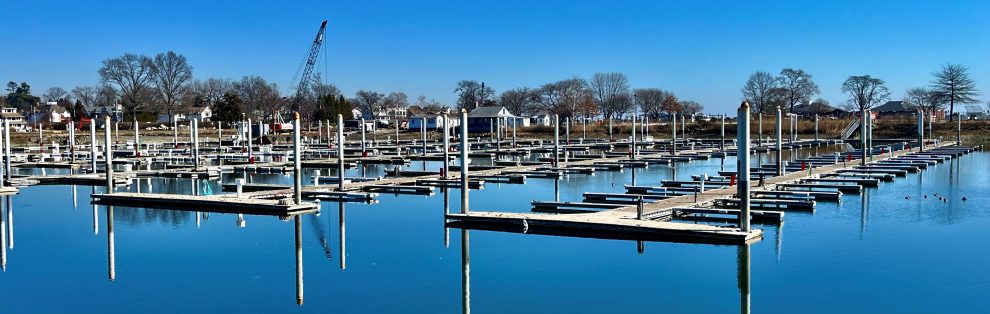
Saugatuck Harbor Yacht Club’s Intriguing Sequel: They DO Own The Water

This morning’s story about the Saugatuck Harbor Yacht Club’s claim that it owns not only the land under its water — but the water itself — drew a reaction from readers. A few pointed out special circumstances.

One reader — who asked not to be identified — emailed:

In fact, the yacht basin is privately owned. While the general rule is that the state has jurisdiction over tidal and navigable waters like this, as is the case with both the Cedar Point and Compo yacht basins, the Saugatuck yacht basin was deeded to the yacht club by the Governor of Connecticut, I believe when it was proposed to be dredged out or shortly after.

The reader sent a land record map of the basis. Note 2 on the bottom right shows that none of the other lots facing the yacht basin (Duck Pond) have “any riparian, littoral or other rights to said pond or the waters therein.”

The reader notes that the lots never relinquished those rights. Rather, they were created out of land that did not previously have waterfront access, and were created with the stipulation that they would not have access after the basin was dredged.

The same reader sent a second map (below), adding:

The residential properties facing the yacht basin each have deeds that refer to another map recorded with the town. The deeds refer to the parcels being owned, subject to the notes on this map, including the section calling out each lot as having no rights past their property line with the yacht club.

Evan Stein wrote in the comments section that the Saugatuck Shores homeowner who had been warned of trespassing (via kayak) by the yacht club had not Googled deeply enough.

Evan provided a link to a 2008 tax assessment appeal to the town by Saugatuck Harbor Yacht Club. Evan then cites relevant details from the ruling:

The subject property consists of 5 parcels aggregating to 14.68 acres of land, 10 acres of which are the land submerged beneath the body of water known as the Duck Pond, which serves at the plaintiff’s yacht basin.

The subject property is not waterfront property in the classic sense, as it is not on the waterfront of Long Island Sound. A boater must navigate from the Duck Pond boat basin through a dredged channel, past the Cedar Point Yacht Club, past the town mooring fields and the town marina in order to reach the open waters of Long Island Sound.

Harbormaster Bob Giunta responded too. He remembers as a child watching Kowalsky Brothers creating the yacht club, by excavating land.

So it appears that yes, Saugatuck Harbor does indeed own both the land underneath its basin, and the water itself. They do seem to be within their rights to restrict access to it, even by homeowners on its shore.

Saugatuck Harbor Yacht Club.

However, that does not settle the question of whether they should.

Matthew Mandell writes:

I used to do a lot of whitewater rafting. Many of these rivers ran through paper company land. While we could navigate the river freely, we could not set foot on the shore, unless it was an emergency. Often the company had a dam that generated its power. Deals were worked out to open the dam for an hour to create the bubble of water for rafting. Others were spring melt runoff.

Regardless of land/ownership the yacht club should act more like the paper companies and allow use.

And Deb Alderson raises an interesting point:

If the yacht club owns the land under the Duck Pond, then do the other homeowners around the Duck Pond own waterfront property, or do they own landlocked property with water views?

It used to be that property taxes were bumped up by about 10% for waterfront property. If those properties are paying a premium for waterfront property, they may have a case for a reduction in their taxes. It’s worth asking the question.

Despite living on the basin, this Duck Pond homeowner appears to have no legal access to it.


Yacht Club Claims: We Own The Water!

Last summer, a Westport homeowner walked out of her Saugatuck Shores home. She strolled through her back yard, to the edge of the water. She slipped into her kayak, and paddled a few yards.

Suddenly, she was stopped. A woman from Saugatuck Harbor Yacht Club, across the way, yelled that she was trespassing.

“We own the water!” the SHYC representative said. “We reserve it for our members!”

Stunned, the Westport resident retreated.

She’s not alone. A neighbor was reprimanded, the same way.

The Saugatuck Shores homeowner’s back yard.

Commodore Sandy Heller and Vice Commodore Roger Schwanhausser followed up with a letter. They sent it “as neighbors,” with “a significant safety concern for both you and our members.”

The letter continued:

We have received member reports, and have pictures, of kayaks stored on your property being launched by individuals crossing over our property line to access the water and into our Club basin.

This has created navigational hazards and safety to concerns to our members as they transit in and out of our basin. Recently, one of our members nearly collided with a non-member kayaker who was unable or unwilling to yield navigational right of way.

Kayaks, ready — but forbidden — to launch, near Saugatuck Harbor Yacht Club.

But safety was not the commodores’ only concern.

Further, as you may not know, the Saugatuck Harbor basin is private property. Our Club owns the land under the water, and per Connecticut law, also owns the water above that land up to the mean high tide line.

Any unapproved access to our basin is, therefore, trespass on our property and is not allowed by Connecticut law.

These facts are documented in our deeds and property records, which go back almost 60 years, and are recorded and memorialized at Town Hall in Westport.

We, at Saugatuck Harbor Yacht Club, have always strived to maintain good relationships with all our neighbors. We are fully aware of our presence in, what is largely, a residential neighborhood.

We want to be respectful of our neighbors’ privacy, their safety, and their property rights. We would expect the same of you, and request that you refrain from any further access to our basin in the future.

But is it really “their” basin?

The homeowner asked someone in Town Hall’s Conservation office. “She laughed,” the woman says. “She said, ‘No one owns the water!”‘

Kayakers and boaters — not including the Westporter in this story — enjoying the water near Saugatuck Harbor Yacht Club.

The Westporter — who notes that “people come in with kayaks and paddleboards all the time from the other side of the inlet” — did what any reasonable person would do. She Googled.

She found Connecticut’s Department of Energy and Environmental Protection’s “Living on the Shore” page. It says:

While much of the Connecticut shore is privately owned, the coastal tidelands actually belong to all the people—not just in terms of our environmental and cultural heritage, but in a specific legal sense as well.

Under the common law public trust doctrine, a body of law dating back to Roman times, coastal states (as sovereigns) hold the submerged lands and waters waterward of the mean high water line in trust for the public.

The general public may freely use these intertidal and subtidal lands and waters, whether they are beach, rocky shore, or open water, for traditional public trust uses such as fishing, ­shellfishing, boating, sunbathing, or simply walking along the beach.

In Connecticut, a line of state Supreme Court cases dating back to the ­earliest days of the republic confirms that in virtually every case private ­property ends at mean high water (the shore elevation, which is the ­average of all high tides) and that the state holds title as trustee to the lands waterward of mean high water, subject to the private rights of littoral access, that is, access to navigable waters.

Public Trust sketch

What is the boundary of the public trust area?

The public trust area includes submerged lands and waters waterward of mean high water in tidal, coastal, or navigable waters of the state of Connecticut. On the ground, the mean high water boundary of the ­public trust area can often be determined by a prominent wrack line, debris line, or water mark. In general, if an area is regularly wet by the tides, you are probably safe to assume that it is in the public trust. The public trust area is also sometimes referred to as tidelands and is defined as ”public beach“ by the Connecticut Coastal Management Act, C.G.S. 22a-93(6). While the public trust area extends up navigable rivers, it does not extend inland to areas landward of the mean high water line.

What rights does the public have within the public trust area?

According to the Connecticut courts, public rights to the shore include the
following:

  • The public has the right to fish and shellfish over submerged lands. Peck v. Lockwood, 5 Day 22 (1811);
  • The public has the right to pass and repass in navigable rivers. Adams v. Pease, 2 Conn 481 (1818);
  • The public may gather seaweed between ordinary high water and low water. Chapman v. Kimball, 9 Day 38 (1831);
  • “Public rights include fishing, boating, hunting, bathing, taking shellfish, gathering seaweed, cutting sedge, and of passing and repassing ….” Orange v. Resnick, 94 Conn 573 (1920);
  • “It is settled in Connecticut that the public has the right to boat, hunt, and fish on the navigable waters of the state.” State v. Brennan, 3 Conn Cir. 413 (1965).

Saugatuck Harbor Yacht Club

She found another page: “Access to Your Boat: Your Littoral Rights.”

Although shoreline residents must share the public trust area with their fellow citizens, every coastal property owner enjoys unique legal rights by virtue of owning waterfront land. Just as an upland property owner has the right to access a public road, a coastal property owner has an exclusive right to access navigable water from his or her property.

This coastal right of access is known as a “littoral” or “riparian” right. Technically, “riparian” applies to rivers while “littoral” applies to coastal waters, but the terms are often used interchangeably.

The littoral right of access provides the property owner reasonable access to the water from his or her property.

Reasonable access can be achieved by launching a boat directly from the shore, by use of a mooring, or by constructing a dock suitable for the site conditions and properly permitted by  DEEP and the U.S. Army Corps of Engineers. Littoral access does not imply a right to build whatever size dock or wharf a property owner wishes, nor does it mean that a littoral owner may routinely exclude boats or moorings from the waters in front of his or her property.

In terms of access, navigable waters are equivalent to a public road, and a dock serves the same purpose as a private driveway. A littoral landowner may not exclude the public from lawful uses of navigable water, just as an upland owner cannot exclude the public from driving or walking on the street in front of his or her house. However, a duly authorized dock or other littoral structure is private property, and no one can legally interfere with the exercise of this right of access, just as individuals cannot use or block someone’s driveway.

Seems like the Saugatuck Harbor Yacht Club neighbor “shore” has a good case.

PS: Someone from SHYC told the Saugatuck Shores resident, “you can join our club.”

“I don’t have a boat!” she replied.

Pic Of The Day #1457

Levitt Pavilion sunrise (Photo/Tom Cook)

Roundup: Remarkable Movies, Levitt Grass, Bald Eagle …

=================================================

It’s April break for the Westport schools. And “official” opening week for the Remarkable Theater.

The Imperial Avenue parking lot lineup is a great one.

Today (Tuesday, April 13, 7:30 p.m.): “Minari.” Nominated for 6 Oscars this year, including Best Picture. A Korean-American family moves to an Arkansas farm in search of its own American dream.

Prior to the movie, a documentary short featuring Westport’s Asian-American rally organizers will be shown. It’s produced by 4th Row Films, in association with the Remarkable Theater.

In it, local residents share their experiences growing up, their journey to Westport. and how they’re raising awareness of rising Asian hate by forming a group (they’re on Instagram: @AAPIWestport or email: AAPIWestport@gmail.com).

Official opening night is Friday, April 16 (7:30 p.m.): “The Goonies.” In this 1985 adventure comedy, a bunch of kids trying to save their homes from foreclosure embark on a treasure hunt adventure.

Saturday, April 17 (7:45 p.m.): “Mamma Mia!” ABBA stars in the best sing-along movie ever made.

Wednesday, April 21: “Butch Cassidy and The Sundance Kid.” One-time local residents Paul Newman and Robert Redford star in this 1969 classic.

The night includes 4 short non-fiction documentary films before the feature:

  • Gatsby in Westport“: Deej Webb helps convince you that Westport is the town that inspired F. Scott Fitzgerald’s “Great Gatsby.”
  • “Paul Shows Bob the New Playhouse”: A scene from the upcoming documentary about the Westport Country Playhouse.
  • “A Townie Breakfast Sandwich”: A tour of Westport’s breakfast sandwiches, including Calise’s, Village Bagels and Coffee An’.
  • “Westport This Used to Be”: featuring Jill Gault and Antonio Antonelli.

Click here for tickets. Not all shows may be available yet. The Imperial Avenue lot opens an hour before showtime, for tailgating.

A couple of local guys starred in “Butch Cassidy and the Sundance Kid.”

=======================================================

The Levitt Pavilion is planning for a summer season — and for at least one bit of housekeeping.

The Conservation Department has approved a request for turf installation near the stage, to replace existing grass (which sometimes turns to mud).

They’ll also install a drainage system to manage runoff in the lower area of amphitheater.

One of the great things about a Levitt performance is dancing in front of the stage. Now we won’t have to worry about “dirty dancing.”

Get on up and dance to the music!

=====================================================

Last March, Bank of America closed its 3 Westport branches.

Today, customers received letters saying that the one at 980 Post Road East — next to the drive-thru Starbucks — will be closed permanent.

The letter said that the downtown branch — next to Design Within Reach — is “still here for you.”

Great! Except that, a few days ago, it was still closed.

No word either on the fate of the branch near the Southport line.

The Bank of America branch at 980 Post Road East is permanently closed.

=======================================================

Starting May 2, children younger than 2 years old are welcome back to the Westport Library. A press release says, “We gladly welcome them to borrow books, audiobooks, CDs, and magazines.” I’m guessing most of that borrowing will be done for them, by somewhat older people.

The Westport Library welcomes children under 2 soon. (Photo/Lynn U. Miller)

=======================================================

Andrew Colabella snapped a great photo of a Sherwood Mill Pond bald eagle yesterday.

And he provides the back story: It took a position in this tree from 3 egrets. He had just swooped down on one, which had a fish in its talons.

(Photo/Andrew Colabella)

=======================================================

And finally … in honor of “Butch Cassidy” at the Remarkable Theater:


Remembering Amy Oestreicher

Amy Oestreicher — a multi-talented artist, performer and writer, who battled unfathomable medical issues with courage, grace resilience and humor — died last week. Her second book, “Creativity and Gratitude” was published a few days earlier. She was just a few days shy of her 34th birthday.

Amy almost died 16 years ago, when she was 18. Her life since then was remarkable — and remarkably inspiring. Here is a story I wrote in 2013.

=======================================================

In 2005, Amy Oestreicher’s life was good.

After years of acting and singing locally, and auditioning in New York, she had just been accepted into the very prestigious University of Michigan musical theater program.

Suddenly, Amy suffered a major blood clot.  Her stomach exploded.  She lapsed into a coma.

During the 1st week of that nightmare, she had 10 surgeries. Doctors removed her entire stomach. Her coma continued for months.

Amy Oestreicher

Amy Oestreicher

Through her long siege in ICU, “my father saved my life,” Amy says. (He’s Westport dermatologist Dr. Mark Oestreicher.) Her 3 brothers were constantly by her side. (The experience helped one decide to be a doctor. Jeff is now in his 1st year of residency — as a pediatric gastroenterologist.)

For nearly 3  years, she could not eat or drink. Not one morsel of food, or a drop of water.

The Oestreichers moved to a smaller house near Compo Beach, where they could better help Amy.

She was hungry and thirsty. But as soon as she realized what lay ahead, Amy vowed not to be a permanent patient. “I wanted to live life,” she says.

Curtain Call in Stamford had a casting call for “Oliver!” “I couldn’t eat or drink, and I was as skinny as a pole,” Amy recalls. “I had tubes and bags all over. I could hardly walk.”

But she got the female lead — Nancy — and managed to do the show. By the end of the run, she was drinking 2 ounces of water a day.

The next summer, she landed a role in Staples Players‘ production of “Cats.”

“I was still starving,” Amy says. “I just needed to be around people. Doing that show was great.”

During her long recovery, Amy Oestreicher also painted — in big, bold colors.

Surgeries continued. One took 19 hours, using 3 shifts of doctors and nurses. The outcome was not as good as expected.

Finally, though — 27 surgeries later — Amy can eat and drink.

She’s also — at 26 years old — just been accepted at Hampshire College.

Before she goes away to school, though, she’s working on another project. “Gutless & Grateful: A Musical Feast” is Amy’s 1-woman show.

First performed last October at the Triad in New York, it’s been called “a moving personal history told with grace and humor, and garnished with great songs sung from the heart.”

Amy Oestreicher onstage.

“Doing that show meant so much to me,” Amy says. “I had been so isolated. For 7 years I talked only to my parents and my doctors. Then to perform, and have people I don’t know hug me! It was so rewarding to share my story, and know it inspires people.”

Written by Amy and Jerold Goldstein — based on hundreds of pages of her journals — it returns to Bridgeport’s Bijou Theatre June 1 and 2. On June 16 and 24, Amy takes her show back to the Triad, and on July 16 to Pittsfield, Massachusetts.

“I’ve always written and performed,” Amy says. “So many things have happened to me over the years. I just wanted to tell my story.”

You and I may not call the past 8 years of Amy’s life “funny.” The fact that she does — and sings and talks about it with such intimacy, gusto and pride — is reason enough to put “Gutless & Grateful” on your calendar now.

Amy Oestreicher poster

In the years since that 2013 story was posted, Amy offered mixed media “Show Me Your HeART” workshops (click here for that story), and wrote 2 books. Her first was “My Beautiful Detour: An Unthinkable Journey  from Gutless to Grateful.” Click here for those links.

Amy Oestreicher

Pic Of The Day #1456

Sherwood Mill Pond (Photo/Zvi Cole)

Y Names New Jersey Leader As New CEO

The Westport Weston Family YMCA’s new CEO has corporate experience. Anjali Rao McCormick worked for American Express and Citibank. She graduated from Harvard, and has an MBA in marketing from NYU’s Stern School of Business.

But she’s also a Y executive. Since 2015 McCormick has served as COO of the 4-branch, 550-employee Summit Area YMCA in New Jersey.

Anjali Rao McCormick

Her key priorities there were revenue growth (membership, camp, childcare, programs), new business growth through partnerships and collaborations, ongoing digital transformation, and developing staff. In February 2020, Summit opened a new $17 million facility.

Her selection to succeed Pat Riemersma — who is resigning after 6 years at the helm — was made today. McCormick begins her new job on May 1.

Board president Jonathan Manela says, “After an exhaustive search, we are incredibly fortunate to have identified and hired a true transformational leader whose community focus, talent, and vision will ensure our viability for the next hundred years.”

A press release notes, “McCormick is passionate about the Y’s mission to bring meaningful growth and transformation to individuals and the communities it serves regardless of an individual’s needs, challenges, or goals.”

The new CEO adds, “I’m looking forward to working with the Board, staff team, and the extended Y community to strengthen the Y’s focus to be a vibrant, intergenerational community.”

McCormick’s first experience with the Y community was after her family moved to Summit from New York City, 20 years ago. She was hired by the Summit Area YMCA as a director of marketing in 2011.

“It is with great enthusiasm we welcome Ms. McCormick as we seek to reengage our community post-pandemic, with an organization my great-great- grandfather E. T. Bedford founded in 1923,” says John McKinney, chair of the Westport Y Board of Trustees.

Prince Philip: The Westport Connection

The death last week of Prince Philip at age 99 brought back memories for Jim Marpe. A quarter century ago, he spent 2 hours with the queen’s consort.

Marpe was not yet first selectman, so this is not a Town Hall-meets-Buckingham Palace story. Still, it’s a good one.

In 1996 Marpe was a partner with Accenture, the management and technology consulting firm. His British partners asked if he would introduce the prince to the leadership team of the major New York global bank that was his client, to help encourage their further expansion in the UK.

The meeting took place when Prince Philip was in New York.

Marpe recalls that while he and the other guests were briefed on a certain amount of protocol, he was pleasantly surprised with “the relaxed demeanor of the prince, his genuine engagement in the presentations and discussion, and a self-deprecating sense of humor.

“He knew what he didn’t know, but seemed anxious to learn,” Marpe says.

Prince Philip (left) and Jim Marpe. “You don’t shake a royal’s hand,” Marpe notes. “You just kind of clasp it.”

While this was more than 20 years before “The Crown,” and a year before the death of Princess Diana, Marpe was aware of the royal family’s “challenges,” and the prince’s propensity for making “tone-deaf” remarks.

Nevertheless, Marpe says, “our time together felt like a normal, friendly business meeting, and our conversation was comfortable.”

Reading the obituary this weekend, he noted that Phillip’s (as well as Queen Elizabeth’s) great-great-great-great-grandfather was King George III. The monarch was responsible for the British landing on Compo Beach, and the subsequent Battle of Compo Hill that is commemorated by our Minute Man Monument.

“That’s another Westport connection” with the British royal family, Marpe notes.

Roundup: Real Estate, Rabbis’ Honors, Raptors …

=====================================================

Westport’s real estate market roars along.

Roe Colletti reports there were 115 house closings in the first quarter of 2021, a 47% increase from 2020 — and the highest number of houses sold in that quarter since at least 2000.

The average closing price rose 33% to $1.84 million, the quarter’s highest since 2000. Homes sold on average for 99.7% of the list price.

There were 87 houses pending (signed contracts) on March 31, up 81% from last year. The average list price of those homes was $2.2 million.

Housing inventory on March 31 was 135  — down 47.3% from the previous March 31, when there were 256 houses on the market. (Hat tip: Chuck Greenlee)

This 12-bedroom, 15 1/2-bathroom estate, set on 7 1/2 acres, is listed for $20 million. (Photo courtesy of KMS Partners @ Compass)

=======================================================

======================================================

This year’s New York Board of Rabbis’ Humanitarian Awards will honor first responders and essential workers.

Dr. Anthony Fauci will be feted. So will the Greater New York Hospital Association.

And … Westport’s own Avi Kaner.

The co-owner of Morton Williams Supermarkets (and former Board of Finance chair and 2nd selectman) will be cited for the work his family-owned business did during the pandemic.

Morton Williams stores never closed. Employees kept working; senior executives ensured that the supply chain continued.

The company became a lifeline to New York. They worked with the CDC to adjust trucking regulations so that truckers would be comfortable making deliveries. They were among the first in the nation to set aside special hours for seniors and immunocompromised customers; they lobbied aggressively for mask use, and ensured that supermarket workers were included in phase 1B of the state’s vaccinations.

There’s one more Westport connection to the May 10 event: Rabbi Jeremy Wiederhorn of The Conservative Synagogue is president of the New York Board of Rabbis.

Avi Kaner in a Bronx Morton Williams store. (Photo/Danny Ghitis for the New York Times)

=======================================================

Business Networking International does exactly what its name says.

But there’s a twist: Only one person per profession is allowed to join a chapter. For example, there is one CPA, one architect, one insurance agent.

BNI’s Westport chapter is strong and active. They’ve got 48 members. Last year, they conducted nearly $2 million in business.

There are openings now in a few categories: interior designer, home inspector, developer, heating and air conditioning contractor, fitness club or personal trainer, chef, and attorneys who practice estate and elder law.

Weekly BNI meetings are now held over Zoom. They’ll transition to a hybrid or in-person format this summer or fall. Click here for information, or email info@salonpaulmichael.com.

=====================================================

Today’s osprey update:

Carolyn Doan reports that the Fresh Market ospreys had a busy week rebuilding and freshening up their nest.

Sometimes when they’re not at home, Carolyn and her son head over to Gray’s Creek. Those birds are usually eating. “The male’s chest is more white, while the female has tan markings,” she says. She took this photo of one finishing a fish.

(Photo/Carolyn Doan)

Meanwhile, a group of Y’s Men strolled past this osprey at Longshore:

(Photo/Molly Alger)

=======================================================

Five Wreckers are Staples High School’s Students of the Month.

Senior Henrik Hovstadius, junior Bruno Guiduli, sophomores Leo Fielding and Ari Lerner, and freshman Domenic Petrosinelli were nominated by their teachers.

Principal Stafford Thomas called the honorees “the glue of the Staples community: the type of kind, cheerful, hard-working, trustworthy students who keep the high school together, making it the special place that is.

Staples High School students of the month (from left): Henrik Hovstadius, Domenic Petrosinelli and Ari Lerner. Missing: Bruno Guiduli and Leo Fielding.

=======================================================

The 2021 Music at MoCA Concert Series features a diverse range of jazz, pop and classical outdoor concerts, from April through October. Highlights include performers from the Jazz at Lincoln Center Emerging Artist Spotlight series.

Multi-instrumentalist and soulful pop artist Matt Nakoa opens the series on Friday, April 30 (7 p.m). Click here for the full schedule, and tickets.

Season passes are available for all 13 concerts, along with jazz, pop or classical packages and individual concert tickets. MoCA members receive discounts. Food and drinks are available at each event.

Matt Nakoa

======================================================

And finally … so who is Matt Nakoa (the first MoCA concert performer this year — see above). Watch below:


Cramped RV Opens A Big, Wide World

The pandemic has taught thousands of Westporters that they can work anywhere.

Joe and Ashleigh Saponare knew that already.

In 2018, the couple hit the road. They’ve traveled around the country ever since.

Joe — a 1998 Staples High School graduate whose father Joe Sr. is Westport’s animal control officer — manages his PsiMac Apple consultancy — remotely. Ashleigh quit her former jobs teaching English, yoga and mindfulness, and now works for Go Zen!, whose animated programs help children learn social and emotional skills.

They work in their RV, in coffee shops and anyplace else with WiFi. They hike before breakfast, take fewer showers than before, and move whenever the spirit moves them.

Ashleigh Saponare works remotely, in Oregon.

Being together in the cramped quarters of an RV has strained their relationship. But the wide open spaces of national parks and other natural wonders has strengthened it.

Joe Saponare and the RV, in Gardiner, Montana.

Joe and Ashleigh have branched off on their own American dream. But the roots lie here, in suburban Westport.

From his early days at Kings Highway Elementary and Bedford Middle Schools, Joe’s life was shaped by access to technology. His Staples mentor was computer teacher Jim Honeycutt. When Joe hated his first corporate job, Jim encouraged him to call TBI, the Apple service provider then located on Post Road West.

Joe left later to start his own business. Life was good. But he and Ashleigh kept watching YouTube videos of people living nomadic lifestyles. They worked remotely, and documented their adventures for homebound viewers to enjoy (and dream about).

The couple spent 2 years trying to figure out how to join them. They realized that payments on an RV would be only slightly more than their car. They planned how to work from the road.

They found a renter for their condo. Three years ago next month, Joe and Ashleigh flew to California to pick up their new home.

They headed up the California coast, to the Pacific Northwest. They spent a lot of time in Montana, working and looking at bison.

They headed south, and fell in love with Sedona, Arizona.

Joe and Ashleigh Saponare,, in Sedona, Arizona.

Everywhere, the couple met people who wanted to talk. They offered tips on what to see, where to eat. Their desire to help was genuine — and invaluable.

In March of 2020 Joe and Ashleigh were temporarily back in New York, visiting friends. Coronavirus was closing in.

“We realized our lives were going to change,” Joe recalls. “We knew we had to be in a stable campground, near the outdoors.”

They headed back to Sedona. Despite the pandemic, it was a “great experience.” With tourists gone, downtown was deserted — so much that wild boars roamed the streets.

The couple hiked every morning. They had the trails to themselves.

Then it was off to Boulder. They stayed in the Rockies through the holidays.

“Once we took the leap, it changed our lives,” Joe says. “We’d sit somewhere in a town working. We’d get to know the people and the place. We’d take hikes they’d recommend. Our work and our lives were integrated so much better.”

Ashleigh Saponare at Wind River Canyon, Wyoming.

Ashleigh adds, “The morning routine of primping, and putting on a professional outfit, is not necessary.” They fill that time with hikes, meditation or yoga.

Of course, life was not always perfect. “We had epic fights in epic places,” Joe laughs. “It’s hard to have a relationship in a van. But after a normal domestic argument we’d open the door, and on one side would be Pacific Ocean waves. On the other would be rolling hills. That puts everything in perspective.”

A view of the Grand Canyon — and Ashleigh, outside — during the pandemic.

Also in perspective: the amount of waste 2 people produce, even in a van.

Living in a tight space magnifies waste. Ashleigh and Joe constantly throw out excess packaging.

The travelers’ eyes have been opened wide, both say: to the prevalence and effects of wildfires. The number of homeless people, particularly in warm climates.

And, says Joe, “I know it sounds trite, but I’m open now to much bigger ideas. I’m not trapped in the bubble of day-to-day experiences. There is so much natural beauty. There are so many great towns, with different ways of life.”

Joe Saponare at Glacier National Park, Montana.

Still, he notes, “people everywhere are a lot more similar than different.”

The prevailing wisdom is that the US is deeply polarized — divided into 2 opposite camps, with no overlap or even real contact.

In fact, he says, “sitting in coffee shops, we’ve had great conversations with lots of people. We didn’t realize we had completely different political views until the end.”

This month, the couple are temporarily back in the area. They’re seeing friends and family, checking in with their East Coast roots.

It’s great to have roots. But the West beckons.

Joe and Ashleigh also have wheels.

(Joe and Ashleigh blog about their adventures. Click here to see.)