Category Archives: Teenagers

“My First Job”: Mahackeno Mentors Teenage Staff

The 16-year-old applied to be a Camp Mahackeno counselor.

But he struggled when Westport Weston Family YMCA officials — who run the popular summer camp — asked for online forms.

Then he had difficulty getting to, and through, training sessions. He was about to lose his job.

When Y human resources director Brian Kuzmiak sat with the boy, he learned the full story. The teenager had a difficult home life. He had no ride to and from work, and the only time he used a computer was at the library.

Kuzmiak took a chance. He and Mahackeno director Emily Regan mentored him.

“He turned out to be one of our best and most energetic counselors,” the HR head says. “Kids always surrounded him.”

He returned this year, for a second summer. Again, he bikes to and from work every day.

That’s one success story among dozens. With 175 staff members — 35% of the Y’s total employees — the organization is one of Westport’s largest employers of young people.

175 young people work at Camp Mahackeno. Many are teenagers; nearly all are under the age of 25.

More than half of the counselors are 16 to 18 years old. For many, it’s their first job ever. They’ve never applied for work; never sat for an interview; never been entrusted with work responsibilities.

And at Mahackeno, those responsibilities include the safety and well-being of hundreds of younger kids.

So Kuzmiak, Regan and Westport Y CEO Anjali McCormick have responsibilities of their own, as they hire and supervise camp staff.

They take that aspect of their roles very seriously.

“The Y’s mission is ‘youth development, healthy living and social responsibility,'” McCormick notes.

“So we develop the whole youth. We prepare children for life, for being mature, contributing adults. We are there as they move from playing sports and doing our programs, to being in many cases their first employer.”

A young person’s first job is an important life milestone. 

That means not just hiring young people. It involves teaching life skills like punctuality, dressing respectfully, communicating with supervisors, treating others well, and being role models.

“It’s really leadership training, without being an official leadership program,” McCormick says. (That training includes helping staff members in college mentor those still in high school.)

Those are big challenge. But, she adds, “it’s great when kids excel and shine. We’re serving the community — and adding to the labor pool.”

The application process begins online. That’s the first hurdle for many teens: They’re not used to checking email.

“There’s a lot of ghosting” — no further communication — “after the application,” Kuzmiak says. “We try to make contact, but at some point we assume the kid is not interested.”

The hiring process weeds out those who really want to work, from those whose parents want them to.

Then — for those who follow up — comes an in-person interview.

“Kids are usually nervous,” Kuzmiak says. “We try to put them at ease, with a casual conversation. At the same time we look for things like, are they making eye contact?

“Eventually we want to know ‘Why are you applying? What are you looking for in a job?’ Most of them genuinely want to work, and they like kids. Some are doing it because their parents are making them.”

Parents can be an issue in other ways too.

“When a mom or dad asks me why their child wasn’t hired, I say, ‘Tell them to call us,'” Kuzmiak explains. “They’re the ones who applied for the job.”

How often do parents involve themselves in their child’s application (or eventual work, with questions about — for example — their pay)?

“More than you think,” Kuzmiak says.

Once hired, there are forms to fill out — contracts, information on sexual harassment and social media policies, direct deposits — and training sessions.

The most important element, McCormick emphasizes, is safety.

“We are a child-service organization. We’re licensed by the state. We have to train 175 people about counting heads, bathroom policies, you name it. It’s a mammoth exercise.”

Counting heads is an important part of camp policy.

And, of course, many of them are still teenagers.

“There’s a lot of hormones. Some of them have their own issues. It’s a lot,” McCormick says.

Most counselors quickly assume responsibility, and grow in the job. “I’m surprised at the number who ‘get it,'” Kuzmiak says. “Punctuality and professionalism has been great.”

Many counselors are only a few years older than their campers.

Of course, Y leaders must spend “a lot of time on those who don’t.”

“Emily really bumps them up,” McCormick says. “She makes sure they show up on time, dressed appropriately, and work as a team.”

But when late summer hits — and it’s hot, and their friends are at the beach — the “I don’t want to be here” feeling hits a few of the staff.

It’s Kuzmiak’s job to deal with those kinds of matters.

He’s an HR professional. But most of his career was spent with adult workplaces. This is only his second year at the Westport Y.

“Anjali has taught me to be patient with teenagers,” he says. “I’m not as quick as I would be to let them go.

“I don’t have a trigger finger for firing,” McCormick adds. “I have to show our older staff that these are not 50-year-olds. These are kids, who may not have been in certain situations before.

“There is an ‘acceptable level’ of mistakes — except for serious safety violations. We could never put kids, or the Y, at risk.”

Waterfront safety is a key concern.

For common issues — leaving a group to talk to a friend, disagreeing loudly with another counselor in front of children, speaking harshly to a camper — Kuzmiak, Regan or an assistant will speak privately with the teenager. They’ll explain ways to improve the behavior — and they document it.

In 95% of the cases, Kuzmiak says, “that’s enough.”

The Y’s approach seems to work. Staff retention is very high.

And campers must like their counselors: They too return year after year.

After all, they get a chance to hang out with counselors like the boy who almost did not get hired.

But Kuzmiak reached out to him, and took a chance. The Y mentored him, helping him grow.

Now he bikes to Camp Mahackeno every day.

Where he is a star.

(“06880” often highlights organizations, and people of all ages, making positive differences here. To support our work, please click here. Thank you!) 

Happy campers (and staff members). (All photos courtesy of Westport Weston Family YMCA)

Aubrey Hankin: Empowering Gen Z

Rising Weston High School senior Aubrey Hankin is passionate about social justice, political science, sociology and helping others.

She has been an activist. But she is frustrated by interference from school administrators, or “adults not caring enough.”

She wants the chance to talk about important issues, with people her own age — and “actual change.”

Aubrey Hankin

“Gen Z is a powerful generation that is deeply motivated to address important issues,” she says of her cohort.

But she’s noticed an inability by some to follow through with plans. Others simply repost activist stories on social media, without any action.

“This needs to change,” Aubrey says.

So — like any good activist — she has created an organization to address that issue.

And many other issues too.

The EmpowerHer Collective is a way for members to educate themselves by reading the works of respected writers. Members will then plan events that “truly make change in our community.”

All high school students in the area — whatever their political leanings or gender — are invited to join.

The format is intriguing. Every week, one member will choose a reading, or excerpt from a piece by a well-respected author or academic, related to the work the group is focused on. Topics could include feminism, mental health, LGBTQ+ issues, and others.

The next week, they’ll spend 30 to 45 minutes discussing what they’ve read (“debriefing and educating ourselves,” Aubrey says).

EmpowerHer Collective logo

She aims for college-level readings. “We will fully dissect them in meetings, so it’s okay if not everyone gets every single part” of an essay, she notes.

“But I hope they push us to think critically, and truly analyze the deep impacts and meanings behind social issues.”

They’ll also plan activism: creating events, working with non-profits, raising money or trying to affect legislation.

The readings and discussions will ensure that the decisions the Empowerment Collective makes are “well informed, and have the perspectives of many people with different backgrounds,” Aubrey says.

She has asked the Westport Library for meeting space.

To learn more about the EmpowerHer Collective, click here.

(“66880” often highlights local youth. To support our work, please consider a donation. Click here — and thank you!)

E-Sports: Weston High Prepares For Another Varsity Season

It’s early August. Soon, high school sports teams start pre-season practice. The fall season is just a few weeks away.

At Weston High, that means cross country, field hockey, football, soccer, swim and dive, and volleyball.

Plus e-sports.

Don’t laugh. Don’t make snide remarks about “sitting in front of a computer playing video games.” Don’t show your ignorance.

E-sports is a billion-dollar business. Nearly 200 colleges offer $10 million in scholarships to players.

Weston — which includes e-sports as a varsity sport — is a leader in Connecticut. And Connecticut is a leading state, nationally.

Dan Ungar is the Trojans’ coach. It’s one of his many jobs in Weston — he’s also a special education paraprofessional, and runs an after-school fitness program — and his passion for it is clear.

Dan Ungar was featured on the PlayVS e-sports website.

He’s quick to note that e-sports — aka “online gaming competition” — really is a sport.

It involves teamwork. It demands communication, collaboration, critical thinking, creativity, problem-solving and leadership.

The action moves fast. Situations change rapidly. Teammates must be laser-focused.

And they’re in it to win it.

The Connecticut Interscholastic Athletic Conference (CIAC) oversees all high school sports in the state. They were the first state organization in the US to sanction e-sports, back in 2018.

Five years later, the National Federation of High School Associations — the official US oversight body — has e-sports partnerships with nearly 2 dozen states.

Games include League of Legends, Rocket League and Super Smash Bros. Ultimate. One season runs from fall through December. A second one is January through the end of April.

Weston High School Trojans

Ungar is a full varsity coach. He goes to the same meetings, and is held to the same standards, as any basketball or lacrosse coach. He has “the full backing” of school administrators.

Athletic director Mark Berkowitz often asks, “What do you need?” Ungar says.

(Other resources come from PlayVS, the official CIAC and NFHS e-sports platform partner.)

E-sports players are, in many ways, treated equally too. Flyers show upcoming matches; results are announced on the morning TV show; the team has a dinner, and gives awards.

There are differences, of course. Instead of crowded bleachers at fields or the gym, only a few spectators fit in the computer lab, where competitions are held.

Though meets are virtual, the state championship is live, at Quinnipiac University’s modern e-sports arena.

“That was like playing with the pros,” Ungar says. “It was so exciting. The kids deserved that atmosphere. They represent our school, and are proud of it. They work hard.”

Their hard work pays off. Both captains who graduated this June earned e-sports scholarships — one to Clark University, the other to Clarkson.

Ungar — who was one of the first 8 e-sports coaches in the country, when he started 6 years ago — has a roster of about 20 players. (Some schools in the state have up to 60.)

They represent “every type of kid imaginable,” the coach says.

“We’ve got both genders, and non-binary. They’re difference races. But they’ve become a team, and a family.”

Like any varsity coach, Ungar balances the demands of the present with the need to build for the future. This year, he’s excited to welcome a talented crop of incoming 9th graders.

“The sky’s the limit,” he says — referring both to the Weston team, and the future of e-sports.

ESPN airs competitions. They sell out Madison Square Garden.

Ungar’s e-sports players dream of being engineers, computer and software programmers and game designers.

One may even become a professional e-sports player.

Hey, any varsity athlete can dream…

“Liquor Sticker” Campaign Adds Stores

Westport has lots of liquor.

And liquor stores.

Eleven now participate in the Westport Prevention Coalition’s “Liquor Sticker” campaign.

Participating shops display “liquor stickers” and informational material at their counters.

The stickers are used to seal previously opened bottles. The idea is that teenagers will see them in their parents’ liquor cabinets, and decide not to open them.

It’s an awareness and education tool for both youngsters and adults, says Margaret Watt. She co-chairs the WPC, a partnership of Westport’s Youth and Human Services Department, Positive Directions, and other local groups.

Liquor stickers, at a store counter.

“Many residents have more alcohol on hand for summer get-togethers,” Watt says.

“This is a great time for parents to discuss underage drinking with their kids and take precautions at home to prevent children from accessing it.”

The WCP notes that a 2021 Positive Direction youth survey showed Westport teens drinking at a rate higher than the 2019 state average.

That’s “eye-opening,” the Coalition says, because ’21 occurred during the pandemic, when social opportunities were somewhat limited.

Store owners have reported positive customer reaction to the “Liquor Sticker” campaign.

“They’ve been very popular,” says the owner of Dan’s Liquors. “Everybody says that they’re a great product, that it’s a really interesting idea.”

Participating stores include:

  • Castle Wine and Spirits
  • Black Bear Wine and Spirits
  • Dan’s Liquors
  • The Fine Wine Company of Westport
  • Ninety 9 Bottles
  • The Grapevine
  • Kindred Spirits
  • Greens Farms Spirit Shop
  • International Wine Shop
  • Westport Wine and Spirits
  • BevMax

Retailers and community members can emailinfo@positivedirections.org to learn more.

(Want to support “06880”? That’s the spirit! Please click here — and thank you!)

Sam Rossoni: Service In the Amazon Rainforest

Sam Rossoni leads a busy Westport teenage life.

He played varsity soccer for Staples High School last year, as a sophomore. He’s vice president of the 3-D Enable Club, which prints for people in need. He’s in 2 honor societies: Math and Science. He just got his driver’s permit. 

But he has not forgotten people in need in Brazil, his parents’ native land.

Sam — who speaks fluent Portuguese — volunteers with Associação Médicos da Floresta. The NGO provides high-quality treatment to indigenous tribes in places like the Amazon rainforest.

People there face many challenges, including trachoma, cataracts, lack of dental care, and inadequate access to clean water.

The organization runs missions to those remote areas. They bring doctors to work with many different tribes, with a variety of cultures and traditions.

Next month, Sam will join a team in Rio Negro. He’ll spend a week in northwestern Brazil.

In addition to working, he’ll make videos to spread awareness of the tribe’s needs, and the richness of their heritage.

Sam Rossoni sold books, Brazilian bread and cheeses, and more to raise funds for indigenous tribes.

Sam believes it is crucial to protect unique areas like the Amazon rainforest. “The richness of life there can be seen by the very diverse populations of native tribes,” he says. “They use the rainforest to survive, while also preserving it for the good of the world.

To spread awareness, Sam created a club at Staples. “The Amazonian Crew” helps with his advocacy and fundraising efforts. To contribute via Venmo, click here.

To learn more, or volunteer with Associação Médicos da Floresta, text Sam at 917-535-0327, or email the club: theamazoniancrew@gmail.com.

PS: Brazil’s indigenous tribes are not Sam’s only concern. He recently helped raise over $1,000 for Westport’s sister city of Lyman, Ukraine. Thanks, Sam, for all you do!


Special “06880” Podcast: Wynston Browne

A year ago, “06880” introduced Wynston Browne to Westport.

He was a non-speaking autistic 15-year-old. But in the previous month — using a spelling board — he’d made stunning advances.

Suddenly, his parents Lynda and David realized, he was not only not intellectually disabled — he is very intelligent.

Very, very intelligent.

Wynston and Elisa Feinman, with his spelling board last year.

That was just the start. A year later — now using a QWERTY keyboard — Wynston continues to amaze. His goal is to become a neuroscientist.

Wynston’s story is remarkable. But don’t take my word for it.

See for yourself.

Today’s “06880” podcast is just 13 minutes — the shortest I’ve ever done.

Yet it may well be the most powerful, important and inspiring of all 62.

Wynston, his mother Lynda Kommel-Browne and trained communication partner Elisa Feinman joined me last week at the Westport Library.

I visited him at home a few days earlier. We chatted for nearly an hour.

Because of his motor control issues, typing is not easy. But every word was his. Watching them emerge on screen was profoundly moving.

The podcast shows him typing answers to the first couple of questions. Verso Studios producer David Bibbey edited the rest, for ease of viewing.

I hope you’ll take 13 minutes to watch the video below.

You won’t hear Wynston’s voice.

But you will never forget his words.

Horizons Limitless For GFA

It’s a long way — by every measure except physical distance — from Greens Farms Academy to the Bridgeport public schools.

But for nearly a quarter century, the elite private school has bridged those gaping academic, financial and resource gaps.

Thanks to the time, talent and energy of GFA staff, students and parents — and the enthusiastic participation of their city counterparts — a strong, productive partnership links Beachside Avenue and Broad Street.

Christina Whittaker — executive director of Horizons GFA — describes it succinctly: “a pre-K through college, outside of school, tuition-free enrichment academic program for Bridgeport students.”

Enjoying the Greens Farms Academy campus.

Horizons is a national program. Greens Farms Academy is one of 60 affiliates.

It’s hard to imagine a more active or far-reaching one than theirs.

From a modest start 24 years ago, Horizons GFA has grown to a 3-pronged, year-round effort, with over 330 current participants.

The pre-K through 8th grade program runs primarily in summer. For 6 weeks, nearly 200 youngsters spend Mondays through Thursdays at GFA. Mornings are devoted to academics, and a social emotional learning (SEL) curriculum developed at Harvard especially for the school.

Learning in the morning …

Afternoons are devoted to activities like sports, swimming, cooking, gardening and dance.

Fridays are for field trips. Popular destinations include the Connecticut Science Center and Mystic Aquarium.

… and a Friday visit to the aquarium.

Parents apply Horizons before their children enter kindergarten.

“Because they are with us for 16 or 18 years — through college — we want to make sure it’s a good fit,” Whittaker explains. “We learn about their hopes and reams.”

The application process includes interviews. The application form is in English and Spanish

In high school, each Horizons participant is paired with a “coach” — a Bridgeport public school teacher, counselor or social worker.

Once a week at Horizon’s Bridgeport office, they work on the Harvard-designed SEL curriculum, and whatever else the student needs, like help with a school project or job application.

Content-specific tutoring is available too, along with college counseling.

Horizons also offers special workshops: transition to high school for 9th graders; career exploration for sophomores; SAT preparation junior year, and FAFSA/scholarship information for seniors.

High school graduation.

Horizons has a 100% high school graduation rate, and 100% post-secondary enrollment. Two-thirds of students go to 4-year colleges; one-third enter community college or vocational training programs.

The summer after graduation, students take part in a transition-to-college workshops.

Once in college, students check in monthly with Horizons staff. They cover 4 areas: personal well-being, academics, finances and “employability.”

The goal is for all students to have a job, or be in grad school, within a year of college graduation. Horizons’ first “class” graduated in 2020. They, and the classes after them, all have 100% success rates.

Proud college graduates.

Horizons is “a very strong community,” Whittaker says proudly. “Once people enter, they tend not to leave.”

Two alums have become program coaches. One teacher has been involved for 20 summers.

Whittaker herself is a former Horizons volunteer. She started as a GFA middle schooler.

Christina Whittaker

That experience sparked her passion for education. After college, Christina taught at Bridgeport’s Harding High School, and worked in Horizon’s summer program. In 2018 she joined Horizons GFA full time. Now she’s the director.

She is inspired by the “results, commitment and partnership with students and families. I’ve known some of the students since 2012. It’s been so great to see what they’ve accomplished.”

Greens Farms Academy’s contributions to Horizons are profound. They provide full use of their campus each summer, and some Saturdays during the year. GFA staff and parents serve on the board and committees. Many students volunteer too.

All funding is private, through donations and grants. This year’s budget is $1.85 million.

There are 2 major fundraisers: a golf event (upcoming June 5 at the Country Club of Fairfield) and fall gala (November 17 at The Knowlton).

After years of quietly supporting Horizons, GFA wants more people to know about the program. Visitors are welcome on select days in July; click here for details.

Nearing the quarter-century mark, Greens Farms Academy’s Horizons — and the horizons of scores of Bridgeport students — are limitless.

(To learn more about Horizons GFA, click here.)

(“06880” covers all Westport schools, public and private. Your help helps us. Please click here to make a tax-deductible contribution. Thank you!)

Bright Horizons, for these children.

“Lord Of The Flies”: Powerful Drama Set For Staples Stage

Staples High School’s Black Box Theater is an intimate space.

With a movable stage and seating, it’s been the setting for memorable shows like “Twelve Angry Men,” “The Laramie Project” and “The Diary of Anne Frank.”

Players’ next Black Box production — “Lord of the Flies” — is equally powerful and thought-provoking.

It may also be the most intriguing production there yet.

Directors David Roth and Kerry Long have cast males and females in the roles of 11- and 12-year-old boys. Marooned on an island and struggling to govern themselves, the tension between morality and individuality — and groupthink and immorality — is palpable from the opening scene.

Part of the “Lord of the Flies” cast. (Photo/Kerry Long)

Each performance features a different cast of actors. Some are mixed genders; one is all male, one all female.

Each show will look a bit different. But all force audiences to explore universal ideas like what it means to be human, and the desire for power.

Written in 1954, the story is “fresh, modern, and very relevant to our world today,” Roth says.

Though “Lord of the Flies” is best known as a novel (and film), Roth and Long found a YouTube video of a Sydney theatrical production. Both had read the book as Staples students.

Watching the video, they were reminded again of its power — and attracted to the Australians’ mixed-gender cast.

They relished the challenge of bringing the show — with its ever-shifting dynamics, both thematically and because of the several different casts — to the Black Box stage.

Cameron Mann (Jack) and Quinn Mulvey (Ralph). (Photo/Kerry Long)

Like the directors, some Players have read “Lord of the Flies” in school. Some are reading it right now. All understand its messages about human nature, and are growing as actors as they learn how their characters change — some for better, some worse — on the island, as democracy crumbles.

That island will look spare. The set is abstract, with a sandbox and just 3 props: a pig’s head, Piggy’s glasses, and the iconic conch.

There is, however, plenty of movement. Fight choreographer Chris Smalley — who has worked with Players for over a dozen years — ensures that the intense scenes are performed both authentically and safely.

It’s a different show for Staples, certainly. The theme and emotions are raw. Plus, Long notes, “the kids get spears, and get to act savagely.”

“Lord of the Flies” is not “Mamma Mia!,” “Grease” or “The Music Man” — some of the shows that Players perform on the main stage.

But the Staples troupe is known for their versatility and professionalism. This is the perfect vehicle for them.

And the Black Box Theater is the perfect place to perform it.

(“Lord of the Flies will be performed Thursday, Friday and Saturday, May 25, 26 and 27, at 7:30 p.m.; Saturday, May 27 at 3 p.m., and Sunday, May 28 at 1 p.m. Click here for tickets and cast lists. The show is recommended for audiences 12 and older.)


Westport Tech Museum Welcomes (Virtually) The World

New York City boasts remarkable museums: the Metropolitan Museum of Art, Museum of Natural History and dozens more (including the Museum of Sex).

Hartford is known for the Wadsworth Atheneum; New Haven, the Peabody and Yale Center for British Art.

Westport has MoCA, and the Museum for History & Culture.

And now, the Westport Tech Museum.

You probably never heard of it. Unless you’re a family member of friend, you can’t get in.

But founder/curator Jay Babina has amassed — and displays, in an attic and online — an astonishing collection of over 400 computers, video games, calculators, cameras, radios and more.

That’s one fascinating fact.

Here’s another: Jay is just 17 years old.

The private school junior comes from a tech family. His father was into computers; his grandparents started radio station WMNR.

One day in 2018, in his dad’s 15-year-old car, Jay found a circa-2002 iPod. Then, in his basement, he discovered a box of old phones: a Palm Pilot, Treo, Startec and others.

He brought the box to his room. Months later, he put the objects on a shelf. To add context he researched their backgrounds, and added information cards about their designers, production and more.

As Jay added to his collection, he needed more space. The attic was perfect.

Now — even with added shelves — it’s almost too small. His 400-plus items fill most of the space.

A wide-angle view of Jay’s Tech Museum. Not all of it could fit in this photo.

Every day, Jay works on his museum. He does more research, writes new cards, finds new stuff. (Click here for a virtual tour.)

A great source is eBay. He goes to tag and estate sales, and the Elephant Trunk flea market in New Milford.

Westport residents donate objects too. One recently offered a rare Osborne 1 computer.

Jay’s personal favorites include a Commodore Amiga 1000 (his most expensive purchase — $825  — but “definitely worth it”); an original Macintosh, and (newly donated by his grandfather) a 1937 radio. “It’s a work of art,” Jay says.

The actual radio Jay’s relatives used, to listen to news after the attack on Pearl Harbor.

His wish list includes an Apple Lisa (“they’re expensive, and hard to find — all the listings are in places like Slovenia,” Jay says), and a Virtual Boy video game system.

Jay’s creativity is boundless. Here, he carefully recreates Steve Jobs’ iconic photo, with Apple’s ground-breaking Macintosh.

Jay’s museum is not open to the public. He doesn’t want random strangers walking through his parents’ house.

But the people who see it (spoiler alert: I’m a lucky one) are amazed.

Fortunately, the rest of the world can experience the Westport Tech Museum virtually (click here to enter). “Visitors” have come from as far as India, Malaysia and South Korea.

They marvel at his collection.

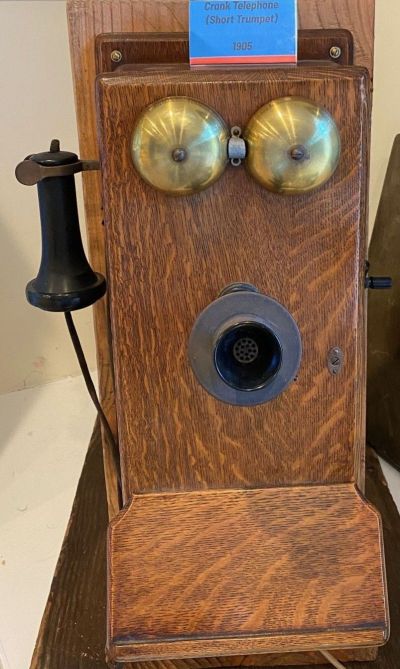
But they can only see its wonders — including a 1910 Edison light bulb that still shines; a 1905 crank telephone that still rings, and microphones and a 1940s-era television that once belonged to legendary voice actor Mel Blanc (Bugs Bunny, Porky Pig, Yosemite Sam, Barney Rubble) — in cyberspace.

A still-working 1910 GE “Edison bulb,” and an early, pre-QWERTY keyboard typewriter.

They won’t get a personal tour, as I did. They can’t hear the excitement in Jay’s voice, as he describes each piece — and its back story — to me.

There are some things technology just can’t do.

But if it’s related to technology — particularly whatever was cutting-edge, whether in the early 1900s or early 2000s — it’s there in Jay’s attic.

He’s not sure what the future holds, for his museum or technology in general.

But perhaps a few years from now, Jay will find a way to display today’s amazing — but tomorrow’s ho-hum — ChatGPT.

================================================

Now, scroll down for a tour of a few highlights from Jay’s Westport Tech Museum.

Welcome!

This crank telephone from 1905 still rings.

This 1914 Victrola still plays music.

An early television (top) and microphones owned by Mel Blanc.

The “History of Audio” shelves display short-wave radio, a reel-to-reel tape, 8-tracks and much more …

… and continues with LPs and 45s, cassettes, mini-discs, Walkmen, a Watchman and iPods.

Atari 400 (1979): early personal computer with Pac-Man.

A 1981 Osborne 1 — the first commercially successful portable computer. It was donated to Jay’s Tech Museum by a Westporter.

The very popular Apple IIe (left), and the first commercially successful computer with a mouse: the 128K, introduced with great fanfare as the “Big Brother” Super Bowl commercial in 1984.

A 1984 Commodore 64 — the best-selling personal computer ever.

This Commodore Amiga 1000 (1985) is Jay’s favorite. 

Early Apple laptops.

Jay with a NeXT computer. The company was Steve Jobs’ venture after being forced out of Apple. It was a bit pricey, and sold only 50,000 units. But its graphical user interface was very influential.

An iMac: the first Apple product with a USB mouse (1998).

An Apple Cube (2000-2001) was a rare Steve Jobs failure. Priced incorrectly for its features, it sold only 150,000 units.

Descriptive cards and posters add information about many items. Jay writes every one himself.

Top: a 1992 “brick phone” and rotary phone. Bottom: pagers and beepers.

A collection of camcorders includes the JVC product used in 1985’s “Back to the Future.”

Jay’s museum includes “tech toys.” He also displays Cabbage Patch Kids (which saved Coleco — originally the Connecticut Leather Company — from bankruptcy after its video games were supplanted by home computers. Also, though not high-tech, on the 2nd shelf from the top: an original pie plate from Bridgeport’s Frisbie Co.

(Westport is filled with people doing amazing things. “06880” is proud to bring you their stories. Please click here to support our work.)

Sixty Years Later, Town’s “Teenage Mummy” Lives On

“Citizen Kane,” “The Godfather” or “Raiders of the Lost Ark” it’s not.

But “I Was a Teenage Mummy” holds a place in movie history.

In Westport, anyway.

And if you were in town 60 years ago today, you remember it well.

The film had its world premiere on April 26, 1963 in the Staples High School auditorium.

A full house — 1,200 people — packed the place. The next night there were 2 more showings, both also sellouts. Tickets were 75 cents in advance, $1 at the door.

Life Magazine and the New York Times covered the event. Hugh Downs invited the cast onto the “Today  Show.”

Not bad for a 90-minute film, produced and acted by a group of feisty Long Lots Junior High 9th graders.

Of course, they had adult help: a 21-year-old, with fantasies of Hollywood.

Jeffrey Mullin — one of the “Teenage Mummy” stars — went onto a 40-year career as a documentary filmmaker. He learned editing and cinematography from legendary documentarian Bill Buckley, and between 1985 and 2008, worked with Buckley and fellow Westporter Tracy Sugarman.

These days, Mullin is retired. But as the 60th anniversary of his teenage adventure drew near he checked in with “06880” from his Cape Cod home, with a trove of materials.

Life Magazine covered the movie story.

“Mummy” — a satire on horror movies — was the brainchild of that 21-year-old, Ralph Bluemke (part-time manager of a Stamford theater).

He enlisted his Half Mile Common neighbor Mullin, Allen Skinner of nearby Cross Highway, Steve Emmett and Jayne Walker. Michael Harris played the mummy. Jeff’s 8-year-old brother Scott was the villain.

They raised funds by selling “stock” in Jerall Films (a combination of their names) to parents and friends.

Filming began in September of 1962. Locales includes beaches (for “the desert”), Longshore, and an auto chase scene throughout town.

The Westport Police Department let the teenagers “borrow” a police car — and officer. An auto dealer provided a Cadillac. And, Life reported, “one mother was conned out of her new Mercedes.”

The movie also includes a scene at Idlewild (now John F. Kennedy) Airport. Jayne Walker’s father — a TWA pilot — held his passengers on board for half an hour while the main characters scurried up the steps, and were filmed “disembarking.”

It ran through January, with interruptions when the cast had to raise more cash. The go-to job was babysitting.

The total cost: about $375.

After its Westport premiere, Life magazine said, the film was booked into theaters in Fairfield and nearby counties.

Teen idol Pat Boone gave the movie a boost.

“I Was a Teenage Mummy” did not reach the enduring fame of “The Wizard of Oz.” It’s not mentioned with classics like “The Jazz Singer” or “Star Wars.”

But for a few brief springtime weeks — beginning 60 years ago today — “Teenage Mummy” was very much alive and well in Westport.

(If a story happened — or happens — here, “06880” covers it. Please click here to support our non-profit. Thank you!)

The cast of “I Was a Teenage Mummy.”