Category Archives: Looking back

Salzburg On The Saugatuck?

Westporters are proud of our protests.

The Nike missile site, a nuclear power plant on Cockenoe Island, moving the Y from downtown — win or lose, we love to fight.

And we did it long before Westport became a baby boom ‘burb. Alert “06880” reader Mary Palmieri Gai has unearthed 2 fascinating Time magazine stories from 1938. Had a group of protesters not prevailed, Westport might look very different today.

On March 28, 1938 Time reported that Westport was bidding to become the next Salzburg, Austria — a world musical capital.

In this “arty village lying on the sluggish River Saugatuck,” Hendrik van Loon’s Connecticut Society of Friends of Music announced plans for 6 summer concerts.

While this would still leave Westport “trailing in competition with such established U. S. summer festivals as the Berkshire, Hollywood Bowl, St. Louis Municipal Opera, and Manhattan Lewisohn Stadium,” Time said, “such Westporters as van Loon, Grace Moore and Lawrence Tibbett hope for glamorous future expansion, to help keep American music lovers from stumping off to Europe every summer.”

Westporter Patrick A. Powers — “an enterprising Irishman, onetime backer of Walt Disney,” and organizer of a forerunner of RKO, had already purchased a 200-acre estate, where he built the Longshore Country Club. In mid-March he “promised Westporters a great gift: he would build a $100,000 ‘marine stadium’ at Westport” — presumably Longshore — and lease it to Friends of Music for $1 a year.

Longshore Country Club, back in its private days.

Longshore Country Club, back in the day. What a perfect site for a “marine stadium”!

It did not take long for Westporters to howl. The following week, Time reported:

200 embattled citizens of arty Westport, Conn, nearly shattered the rafters of their Town Hall with furious protests against the plan to make Westport a “Salzburg on the Saugatuck”…. Following the meeting, Westport’s Board of Zoning Appeals refused to grant Millionaire Patrick A. Powers a permit to continue construction on his $100,000 “Dream Stadium.”

Protesting Westporters, preferring rural quiet to culture and glory, feared that their “simple” village would be turned into a Connecticut Coney Island instead of an American Salzburg. “We don’t want to be the Salzburg of America,” declared one anxious Westporter. “We want to die in peace.”

So did those protesters exactly 75 years ago get it right? Or would it be pretty cool if today Westport was known worldwide as “Salzburg on the Saugatuck”?

Raise your voices. Hit “Comments” to join the debate.

50 Years Later, Staples Grads Still Show Concern

In the early 1960s, America was slowly rousing itself from the vanilla Eisenhower years.

Many teenagers’ lives revolved around sports and parties. The political activism that characterized the rest of the decade was still on the horizon.

An ad for Bigelow Tea, featuring typical Staples girls. Note the book covers at the bottom of the photo.

An ad for Bigelow Tea, featuring typical Staples girls. Note the book covers at the bottom of the photo.

But a small group of youngsters saw it coming. Alienated from the popular culture of Bedford and Long Lots Junior Highs, and Staples High School, they found themselves — and their place — in Burt and Honey Knopp’s house.

Politically active — Honey started the World Affairs Center, a downtown meeting place — and warmly open to young people, the Knopps and their daughter Sari formed a loose group that, for a couple of years, met every 3 weeks or so.

Calling themselves “Concern,” they talked about important issues of the day. They brought in speakers. They picketed the Norwalk Woolworth’s, in solidarity with civil rights protesters at North Carolina lunch counters.

The Woolworth's sit-in in Greensboro, North Carolina.

The Woolworth’s sit-in in Greensboro, North Carolina.

They demonstrated at Westport’s Nike missile site, advocating for nuclear disarmament.

And — though they didn’t know it at the time — the small group of teenagers made a commitment to social justice that has influenced the rest of their lives.

The group included Richard Hill, Martha Honey, Barbara Kelman and Bob Rubinstein.  Another member — Doug Biklen — later became Sari Knopp’s husband.

Half a century later, the participants have different memories of Concern, Sari says. But earlier this month — during the Staples Class of 1963’s 50th reunion — they got together once again.

They wanted to look back on the group, examine its importance to them — and find out what they’d done with their lives ever since.

They realized that over the span of just a couple of years, Concern helped set them on their life paths. Some spent their careers working for the environment. Others dedicated themselves to urban youth, or international crises. Sari is now a professor at Syracuse University, studying race and gender.

Honey Knopp

Honey Knopp

The early 1960s were a vastly different time than today. The young people in Concern did not talk about women’s or gay issues, because virtually no one else did either.

But they were concerned then about the world, and their place in it.

They still are.

And — when most of their peers were cheering at football games and thinking about the next party — Burt and Honey Knopp gave them a place, and a space, to lay the foundation for the rest of their lives.

F. Scott Fitzgerald: The Movie

Last spring, Westport Historical Society audiences loved Robert Steven Williams’ video featuring famous writers who lived here.

But Williams’ budget had been “zero.” He knew he could do better.

The segment on F. Scott Fitzgerald was particularly intriguing, for viewers and the filmmaker himself. To move forward, Williams contacted Westport resident Richard “Deej” Webb — an amateur historian and Fitzgerald buff — who offered to help.

The pair raised $20,000 for a film. Shooting began this summer.

Williams and Webb are giving the WHS rights for unlimited use and sale, including the premiere as a fundraiser. Attorney Alan Neigher is donating his time for legal issues, while Keir Dullea will narrate the film for a nominal fee.

Earlier this month, Williams and Webb interviewed Barbara Probst Solomon. In 1996 she wrote a groundbreaking New Yorker story linking Fitzgerald, The Great Gatsby and Westport. For Williams, she recalled her childhood in Westport, and provided insights into F. Scott and Zelda’s own summer here in 1920.

F. Scott and Zelda Fitzgerald, in front of what appears to be their Westport home.

F. Scott and Zelda Fitzgerald, in front of what appears to be their Westport home.

That evening, the filmmakers shot the Bridge Street bridge. The scattered lights were described in The Beautiful and Damned, which Fitzgerald wrote while in Westport.

The next day they filmed Main Street without traffic, and Nyala Farms (between Green’s Farms Road and the Sherwood Island connector).

Then came the coup de grace: the Fitzgerald house on South Compo. Built in 1758, and called Wakeman Farm in 1920, it looks much the same today as it did then.

F. Scott and Zelda Fitzgerald slept -- and partied -- here.

F. Scott and Zelda Fitzgerald slept — and partied — here.

“I wasn’t expecting Jeannine Flower, one of the owners, to be there,” Williams said on his blog.

“But she not only welcomed us into her home, she took the time to explain what she knew about the house. She was extremely knowledgeable about Scott and Zelda’s time there, and she was passionate and committed.”

Williams and Webb are passionate and committed too. They love this project — though a “black hole” is the unknown cost of securing the rights to photographs, archival footage, and use of lines from Gatsby.

But they’re forging ahead. Meanwhile, Webb is getting preparing to present the film’s thesis in November at a Fitzgerald academic conference in Montgomery, Alabama. That’s where Zelda was born.

Even in 1920, Westport must have seemed like a far different world.

PS: According to Williams, the Fitzgerald home in Westport is up for sale. It can be yours for $2,750,000.

Saving 20 Maplewood Avenue

Yesterday’s “06880” post — on 3 Evergreen Avenue — brought plenty of comments on the importance of preserving older homes. Several readers referenced 20 Maplewood Avenue. It’s off Main Street, just before Clinton Avenue heading east.

Jennifer Tedesco Alfano  provided great background info. She writes:

My kids are the 3rd generation of my family to live in our house on Maplewood — and 5th generation Westporters. My husband and I are both veteran Westport teachers. The issue of this town being essentially “wiped out” is near and dear to my and my neighbor’s hearts.

We are a modest neighborhood consisting of (but not limited to) teachers, a freelance writer, a retired Gault employee who is also a special police officer, a tile layer and a musician.

Back in the day there was my dad, acting assistant fire chief Larry Tedesco. Frank DeMace (Mario’s owner), who was my godfather, lived in my house on Maplewood before my parents bought it when I was a toddler.

Currently 3 homes, including ours, consist of native Westporters. Maplewood is a street not only with lots of architectural and structural history, but a lot of “old Westport” history, too.

20 Maplewood Avenue...

20 Maplewood Avenue…

New or native, we love the charm and quaintness of our neighborhood so much that we felt it was worth fighting for. We have not had one teardown.

The most dilapidated home was refurbished a couple of years ago by Robert Mills IV. His family owned one of the houses next door to 20 Maplewood. #20 is a near-100-year-old house, once the home of Jim McKay.

The public notice for “demo”  of #20 was placed toward the back of the house, where no one could see it. We felt that the builder was trying to hide it, so my kids delivered 2 sets of letters to the neighbors to alert them to what was happening.

Robert Mills IV doesn’t even live there. He rents the home. But he was so concerned, he came to a Historic District Commission meeting to speak out against the teardown. So many neighbors showed up, a partition was opened so more people could sit.

Award-winning restoration expert William Dohme did what he’s done to numerous Westport buildings. He made it impeccable.

...and the newest refurbishment (left), next door.

…and the newest refurbishment (left), next door. (Photos by Morgan Whelan)

We are now going to try to get our street registered as a historic district, as more than half the homes on Maplewood Ave. were built in the early to mid 1900’s.

Neighbors should know that they can make a difference and perhaps change the mind of someone who wants to just make a profit on their street. I had never been to an HDC meeting before. I was amazed at the background, knowledge and experience of the people who serve on this committee.

Thanks to their careful consideration of our argument and dismay that a perfectly well maintained, 100-year old home would be demolished for no reason other than profit, a delay was granted.

Maplewood Avenue is not going down without a fight. I hope that more residents who live on the few streets like ours that are still left will stand up for what is right.

We made a difference. At least, for now!

A Historic Home Gets New, Loving Life

When Rondi Charleston and her husband Steve Ruchefsky moved to Westport from Manhattan, they thought they’d landed in the friendliest place on earth.

Every time they worked in their garden, sat outside — or simply opened their doors — people waved.

Eventually, the couple realized, it wasn’t them.

They lived at 3 Evergreen Avenue. Their property — smack on the northern corner of Myrtle Avenue — is one of the most visible spots in town.

It’s long been one of the prettiest. Now — following years of renovation, planting and tender loving care — it’s one of the most stunning.

It’s also one of Westport’s most historic homes.

Rondi Charleston's porch and gardens.

Rondi Charleston’s porch and gardens.

Built in 1845 by James W. Jauncey for his brother, Dr. Joseph Jauncey Jr., it was sold a decade later to Jonas H. Phelps, a manufacturer of astronomical instruments. His shop on Richmondville Avenue made the largest telescopes used by the US government. Phelps also built the “town clock” in the steeple of Christ & Holy Trinity Church, across the street.

The house passed on to the Coley family (of Coleytown fame). It remained in their hands for 99 years.

Now Rondi and Steve own it. And — unlike many new owners of older homes — they relish its quirks, and revere its history.

The breezeway opens, and offers a view of Christ & Holy Trinity Church in the distance.

The breezeway opens up. The view is of Christ & Holy Trinity Church in the distance.

They opened the walkway, relocated the driveway and modernized the breezeway. But they retained all its bones. And some may actually be buried in the basement.

When the couple bought the home, that basement had a dirt floor. “It was original, 1845 dust,” Rondi says. They suspected it had been a stop on the Underground Railroad. (The house next door, owned by Estelle Margolis, almost certainly was.)

In a coal bin, Rondi and Steve found old newspaper clippings. A rusty spoon. Other artifacts too. “It was like an archaeological dig,” she says.

In a corner of the low basement — behind a nondescript door — Rondi and Steve created a modern amenity: a wine cellar. But it pays homage to the past: Everything was built from leftovers. The racks are made of old wine cases. The bench is an original from the Westport Country Playhouse. The ancient fireplace mantel holds a horseshoe and farm tools found by the couple.

Steve Ruchefsky and Rondi Charleston in their wine cellar. The bench comes from Westport Country Playhouse.

Steve Ruchefsky and Rondi Charleston in their wine cellar. The red bench comes from Westport Country Playhouse.

The rest of the home is equally cool. A beautiful piano fills a music room where Rondi — a renowned jazz singer who recently returned from a West Coast tour, and who wrote “Signs of Life” inspired, in part, by her cellar — creates music. A shelf holds her Emmy and Peabody Awards, earned as a TV producer/journalist with Diane Sawyer.

Every corner of the house holds surprises. Pocket doors disappear, opening up a breezeway that leads to a garden with a spectacular view of downtown. That garden is what Westporters watched grow — and caused them to wave — in the years it took Rondi and Steve to bring it to fruition.

“This is paradise,” Rondi says. “I don’t know how we got so lucky.”

Countless Westporters — who walk or drive by and admire the ageless, but now handsomely renovated, home — don’t know either.

But we’re very, very happy they did.

(Click here if your browser does not take you directly to Rondi Charleston’s “Signs of Life.”)


Westport’s Muddy Waters

The Blues, Views & BBQ Fest earlier this month was fantastic. Yet I am sure I am not the only Westporter to wonder, “WTF?”

Westport is many things. But “Blues City USA” is not one of them.

Then again…

Jeff Van Gelder — a native Westporter now living in Germany — reminds us of an intriguing moment in town history.

Muddy Waters Hard AgainOn Facebook, he writes: “The last great trio of Muddy Waters albums — ‘Hard Again,’ ‘I’m Ready’ and the somewhat-less-than-stellar ‘King Bee’ — were recorded in Westport.”

It turns out, Jeff says, that the late Dan Hartman — who wrote and recorded “Relight My Fire,” and worked with Edgar Winter — bought a house in Westport, and set up a studio there.

Jeff says:

After Muddy got out of his contract with Chess Records, his #1 fan, Johnny Winter, signed him to his Blue Sky Label. They recorded these wonderful LPs (in Westport) over a period of 2 years. Two years before, Johnny had recorded his “Nothing But The Blues” with members of Muddy, Pinetop Perkins and James Cotton at the Hartman house (called “the Schoolhouse”).

Blues and Music News  explains that Muddy and Johnny wanted to record “Hard Again” live, with Winter handling production and also playing.

If the band was composed of competent musicians, then they could make the Blues come across alive and fresh. And make no mistake; the band backing up Muddy Waters for this recording was far beyond competent. They lived their lives for this man and his music!

(Click here if your browser does not take you directly to YouTube.)

Jill Turner Odice adds a bit more on this little-known piece of Westport music history:

I lived next door to Dan when he rented the Reynolds house (6 Edgehill Lane) for $2500 a month…. I got to meet Johnny and Edgar Winter, Rick Derringer and .38 Special while they were recording there. Patti LaBelle, Foghat, James Brown, Peter Frampton as well as others made recordings there.

Just as fascinating as the fact that some great blues were recorded in Westport is the look of the house where it all happened.

"The Schoolhouse" -- 6 Edgehill Lane.

“The Schoolhouse” — 6 Edgehill Lane, off Wilton Road.

Chicago or Memphis, it sure ain’t.

The Westport Y, 90 Years Young

The Westport Family Y has changed a lot in 90 years — including its name. It’s no longer the “Young Men’s Christian Association.” So even though the Y’s actual 90th anniversary was last Thursday, officials did not plan a public birthday bash.

It was also Rosh Hashanah.

The 90th anniversary will be celebrated instead on Wednesday, September 18 (4 p.m.), with a street party on Church Lane.

Scott Smith — the Y’s communications director (a position that did not exist for most of the Y’s history) — passed along some tidbits from opening day.

The Westporter-Herald called September 5, 1923 “second to none in the history of the town. Not since the day of the official opening of Westport’s new bridge over the Saugatuck River has there been anywhere near as great a gathering as notables, both local and out of town.”

The YMCA's Bedford Building, on the corner of the Post Road and Main Street.

The YMCA’s Bedford Building, on the corner of the Post Road and Main Street.

Connecticut Governor Charles E. Templeton was there. So was Edward T. Bedford, the donor of “this new and handsome Y.M.C.A. building.”

Bedford described how, as a 15-year-old, he stood outside the old Westport Hotel, watching games of pool inside. He could not go inside, “on account of the saloon.”

Years later — a wealthy man, as a director of Standard Oil — he felt honored to fill “the need of some place for boys and young men to congregate.” His “new and handsome” YMCA stood at the corner of the Post Road and Main Street — the exact site of the former Westport Hotel.

The Bedford Building lobby in 1923. Not much has changed in 90 years.

The Bedford Building lobby in 1923. Not much has changed in 90 years.

The new building featured bowling alleys, billiard tables, a gymnasium and reading room. It would be a place to exercise one’s body, and mind.

Governor Templeton noted that Bedford did not have “the opportunities the young men of today have. (However), he didn’t smoke or wile his hours away; he didn’t stay up until midnight, not at all, but instead went to bed early and then was fresh for the tasks of the day to follow.”

Bedford’s work ethic, the governor implied, would be a good model for all the young people enjoying the new YMCA to follow.

Presumably, this advice remains true today — 90 years later. Even if the Westport Family Y serves more than “young men.” More than “Christians.”

And plans to celebrate its next big anniversary in yet another “new and handsome” building.

An early YMCA youth basketball team.

An early YMCA youth basketball team.

From Compo Inn To Chaverim

For several years, plans to build a synagogue on Ludlow Road have stirred controversy.

beit chaverimBeit Chaverim would like to move across the street and up the hill from its present, cramped quarters on Post Road West. Some neighbors fear increased traffic and congested parking.

This is not the first time a new use for Ludlow Road has been proposed.

In 1977 — according to a Norwalk Hour story unearthed by Mary Palmieri Gai – a developer proposed building a 3-story, 17,540-square foot office building on the corner of the Post Road and Ludlow.  There would be parking for 41 cars, plus another 16 spots in a new underground garage.

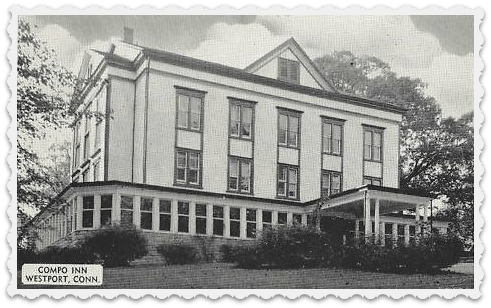
The office was planned for the site of the old Compo Inn. Back in the day, the Inn was a popular gathering spot for teachers, Famous Artists Schools employees, and others who worked nearby.

A very popular spot. And it had been for a long time. According to this photo (courtesy of Paul Ehrismann), it featured “dancing, music, cafe and grill room.” The telephone number was simply “98.”

Compo Inn

From the looks of it, there’s nothing like it today.

If the synagogue is approved, the last vestiges of the Compo Inn — and the nearby Marion Levy apartments — will finally meet the wrecking ball.

A later view of the Compo Inn.

A later view of the Compo Inn.

You Know You’re From Westport If…

Facebook pages usually have the shelf life of a Kim Kardashian marriage.

But for weeks, “You Know You’re From Westport, CT … If…” has roared along, gathering comments and steam.

Long-gone stores, dimly remembered teachers, beloved events — they’re all mentioned (and oohed and aahed over). It’s a random potpourri of long-ago Westport memories — I sure as hell wasn’t around in World War II — and those that are long-ago only if you’re still in your 20s.

In no order whatsoever, here are some recollections of people from Westport:

  • The Crest Drive-In
  • Caldors
  • Coach Ed Hall, including his trampolines at the golf driving range, his posing as the Marlboro Man, and his frequent sightings at Bunyan’s and Crossroads
Coach Ed Hall

Coach Ed Hall

  • The fire station whistle blowing every day at 5 p.m.
  • Growing up with Gene Tierney
  • Bill’s Smoke Shop
  • Mark’s Place disco, complete with go-go girls
  • The Sanitarium on what is now Winslow Park, complete with strait jackets and restraining cuffs
  • The Ship’s Lantern on the Post Road, which then moved a few doors west to take over the old Buffalo store
  • Teachers like Mr. Birnbaum, Mr. Marciano, Mrs. Wachob, Mrs. Crews, Mr. Lomnitzer and Mr. Morrison
  • The house on Gorham Island, where a murder led to a shootout at the police station on July 4, 1961
The old Victorian house on Gorham Island. Today there's an office building.

The old Victorian house on Gorham Island. It’s been replced by an office building.

  • Skating ponds, fishing ponds, and the rope swing at Nash’s Pond
  • Davy Jones’ Locker — the predecessor to the Black Duck
  • Grub’s — the predecessor to Elvira’s
  • CApital 7 phone prefixes
  • Cannonballs by the Compo Beach marina
  • Assumption School, with uniforms
  • The Penguin (allegedly a whorehouse), with Top Hat mini-golf across the street on Hillspoint
  • Working at Trendex — an early market research firm — and tabulating surveys by hand
  • Rob Carlson and the Triumvirate band
  • Bringing apples to Rippe’s Farm, and getting apple cider in return
  • Lester Lanin’s Nines Club, on the site of the old skating rink
  • The Troll Bridge next to Devil’s Den
The "troll bridge."

The “troll bridge.” There are warnings: “Beware of Trolls.”

  • The Ice Cream Parlor
  • Milkmen
  • Bonanza Steak Pit
  • Ben Franklin’s
  • Being called a “walker” at school
  • The ping pong factory on Riverside Avenue
  • Buying beer at Vista Market, just over the New York line past New Canaan
  • The African Room
  • A choice for Chinese food: Golden House or Westlake?
  • Waterskiing in the salt marsh between Bermuda Lagoon and Calf Pasture
  • Chez Pierre
  • The Holly Ball — a formal dance for 9th graders
  • Bessie Jennings’ historical bus tour of Westport for elementary school students
  • Players’ Tavern, with bands like White Chocolate
  • Monday night dances at Longshore
  • Saturday matinees at the Fine Arts Theater — and what went on in the balcony during them
  • Rocks — not sand — at Compo Beach, and floats offshore.
The rocks at Compo were no fun. But the floats offshore were.

The rocks at Compo were no fun. But the floats offshore were.

You get the idea. If you lived in Westport then, you’re probably OD’ing on nostalgia.

If you didn’t, you may wish you did.

Click “Comments” to add your own “You Know You’re From Westport If…” memories. There must be millions.

Marilyn Chambers: The Sequel

Since my 1st “06880” story in March 2009, I’ve written nearly 3,000 blog posts.

None has been viewed more than one from my 2nd month. It began:

Marilyn Chambers died today.

Tomorrow the newspapers will call her a “former porn star.”  They will mention the scandal that erupted when Marilyn — the “99 and 44/100% pure” model holding a baby on the Ivory soap box — moved into hard-core films.  They may say that some of her movies were produced by the infamous Mitchell brothers, or that she worked with legendary male porn star Johnny Wadd.

Marilyn Chambers was barely out of high school when she modeled for the Ivory Snow package. At the same time, she was beginning her career in porn.

Marilyn Chambers was barely out of high school when she modeled for the Ivory Snow package. At the same time, she was beginning her career in porn.

They might even mention that she grew up in Westport, Connecticut, the daughter of an advertising executive father and a nurse mother.  The obituary writers will describe Marilyn Chambers, but they will focus only on her titillating past.  That’s natural; they didn’t know her.

I did.

And as a Westporter a grade behind Marilyn Briggs at Long Lots Junior High School and Staples High, with plenty of friends in common, I knew her when it counted — when we were young.  She was a field hockey player and cheerleader.  She was cute — very cute — and outgoing.  And though she was way ahead of most of us even then, and was already modeling in New York, she was still just “Marilyn.”

The reason that story received so many views — and still does — is not because it’s on “06880.” It turns out that every porn site in the universe linked to it. Who knew they run text, as well as photos and videos?

Now — 4 years later — Marilyn Chambers is back in the news.

Marilyn Chambers, in her heyday.

Marilyn Chambers, in her heyday.

Her 1975 autobiography (My Life) will be re-released in October. A remake of her most famous film (Behind the Green Door) may also come out this fall.

According to The Daily Beast, there’s even talk of naming a street in Providence, Rhode Island — where she was born — for her.

The Daily Beast story runs more than 2500 words. It details her too-short life in great detail.

Marilyn died “in relative anonymity in a trailer park, surviving on porn residuals, Comic-Con appearances, and a job at a car dealership.” But, a close friend told the Daily Beast, “She was a classy lady.” She planted gardens for her neighbors.

Marilyn Chambers in 2004 (Photo by Barry King/WireImage)

Marilyn Chambers in 2004 (Photo by Barry King/WireImage)

“I do know that the thing she was most proud of was being a mother to her daughter” (McKenna Taylor, from her 3rd marriage), Daryl Coates Manning — a longtime Westport friend — said. Marilyn was cremated the same day McKenna went to her senior prom.

McKenna is a driving force behind the reissue of her mother’s autobiography. She says Marilyn was proud of being “part of the sexual revolution. She didn’t regret anything she did. It wasn’t just porn. It was way more than that. People didn’t have the right to talk about their sexuality freely back then.”

This fall — in an era when talk about sexuality is as common as porn on the internet — Marilyn Chambers will be back in the news.

And those of us who knew her as Marilyn Briggs will remember her once again.