
Werner Liepolt is a longtime resident of Bridge Street, and a former Westport teacher. He writes:
As Westporters prepare for Thursday’s state Department of Transportation meeting about the Cribari Bridge (November 12, 7 p.m., Town Hall auditorium),
a look at the Bridge Street National Register Historic District can help clarify what’s at stake.
The National Register nomination shows how the bridge, houses, stone walls and a former school tell the story of a neighborhood that grew around the river
crossing.
That history can help residents assess CTDOT’s presentation, ask specific questions, and submit informed comments by November 27.
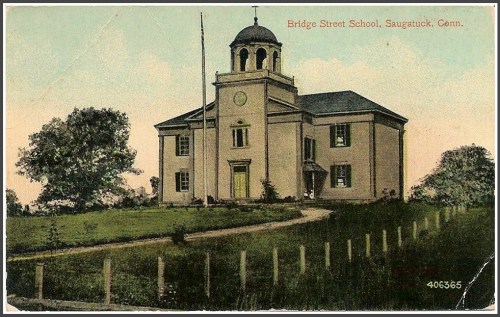
The original Bridge Street School. It later became Saugatuck Elementary; it is now The Saugatuck co-op housing.
Westport residents and the Representative Town Meetings’s Cribari Bridge Subcommittee still need clear information from CTDOT and the Federal Highway Administration about how the preferred alternative and other
feasible options could adversely affect the historic district.
The agencies should:
- Identify the 10 properties and 1 dock that CTDOT indicated last April could be affected by right-of-way acquisition, including possible use of eminent domain.
- Provide studies assessing potential changes in truck traffic, noise, vibration and diesel pollution.
- Clarify whether the Area of Potential Effects has been revised to include the entire Bridge Street National Register Historic District.
- Provide updated visual assessments that show views when trees are bare, and from higher ground.
With this information, residents and consulting parties could propose specific measures to avoid, minimize or mitigate adverse effects.

The Frederick Hotchkiss House dates to 1876.
Bridge Street tells a story larger than the history of its houses. Its winding roadway, low stone walls, former school and iron swing bridge record how Westport grew from separate settlements into a connected community.
Together, these features form a historic landscape whose significance rests on the relationships among its parts.
The Bridge Street Historic District nomination, prepared by architectural historians at the Public Archaeology Laboratory, describes approximately 22.46 acres extending from the western bank of the Saugatuck River east to Compo Road South, with a branch along southern Imperial Avenue.
It identifies 28 contributing buildings and 3 contributing structures, including the bridge. Its period of significance stretches from 1809 through 1945.
The district’s oldest building, the Delancy Allen House at 192 Compo Road South, predates Bridge Street itself. Built in 1809, it recalls a time when much of the land between Compo Road and the river belonged to the Allen family.

Delancy Allen House, Bridge Street
Before a local crossing existed, residents on the east side faced an inconvenient journey to reach Saugatuck’s businesses and railroad station. The
river connected Westport to maritime commerce, while also dividing its neighborhoods.
The nomination traces the neighborhood’s development to the Allen family’s donation of land for Bridge Street in 1869, and the establishment of a river crossing.
Those changes opened land for subdivision and residential construction. The present swing bridge followed in 1884, replacing the earlier crossing.
Bridge and neighborhood consequently developed as parts of the same story: the crossing made the residential district possible, and the district preserves evidence of the community that grew around it.

The Bridge Street Bridge once carried trolleys.
Today’s William F. Cribari Memorial Bridge remains the district’s most recognizable structure.
Its iron trusses frame the river crossing. and mark the transition between Saugatuck and Bridge Street. The nomination explains that substantial rehabilitation in the early 1990s changed the bridge’s structural system, leaving the historic trusses supporting their own weight above a newer platform.
Nevertheless, it identifies the bridge as a contributing resource and an integral
part of the neighborhood’s development. The bridge had already been individually listed in the National Register in 1987.
East of the crossing, the houses reveal successive generations of residential architecture.

The 1884 Rufus Wakeman House.
Italianate, Queen Anne, Colonial Revival, Craftsman, and other styles give the district variety within a generally consistent domestic scale. Porches, projecting bays, decorative shingles, wood clapboards and traditional windows distinguish individual buildings.
Setbacks, vegetation, fences and retaining walls connect them into a recognizable streetscape.
The inventory also includes more modest 20th century residences.
The Anna E. Dolan House at 12 Bridge Street, built in 1932, contributes to the district alongside its 19-century neighbors. This range matters: the neighborhood records and preserves continuing development across generations.

The Anna Dolan House was built in 1932.
Some of its most significant features stand close to the ground. The nomination identifies the Bridge Street System of Stone Walls as a contributing structure in its own right.
Portions may date to the roadway’s layout around 1869; others reflect later replacement and repair.
Sections appearing original are identified in front of 12 and 20–24 Bridge Street, and along the south side of 192 Compo Road South. These walls help define the roadway’s historic edges. and the relationship between public passage and private property.
The former Saugatuck Elementary School at 35 Bridge Street adds another dimension. Its 1931 building represents the neighborhood’s educational and civic life, while its later conversion to Westport’s affordable housing illustrates continued use of a substantial community landmark.

Former Saugatuck Elementary School, now co-op housing.
The nomination’s photographs also document the adjoining athletic fields open to the public, placing the school within its broader setting.
The historians found that the district retained integrity of location, design, setting, workmanship, materials, feeling and association.
Their assessment recognizes a coherent neighborhood whose historic character survives through both buildings and surroundings.
For Westport residents, that provides a practical way to understand what deserves attention when major infrastructure changes are proposed: the bridge, homes, walls, roadway, and setting belong to an interconnected place.

1886 Orlando Allen House.
Residents can use this nomination and its property inventory to support specific Section 106 comments by November 27, the extended deadline communicated by RTM subcommittee chair Melissa Levy.
In your comment, identify the historic feature, explain how the project could affect it, and request a specific measure to avoid, minimize or mitigate that effect — for example, protecting stone walls, monitoring construction vibration, or evaluating traffic-related changes to the district’s setting.
Ask that agreed protections be incorporated into the project’s Memorandum
of Agreement, with responsibility, timing, and follow-through clearly stated.
Email: James.Barrows@ct.gov; Copy: Mandy.Ranslow@ct.gov
Subject: Project 0158-0214 – Section 106 Mitigation Request – [your address]
Mail: ATTN: James Barrows, Connecticut Department of Transportation
2800 Berlin Turnpike, P.O. Box 317546, Newington, CT 06131-7546
Project documents and updates: https://portal.ct.gov/Cribari-Bridge
(“06880” has covered the Cribari Bridge controversy since we began in 2009. We’ll continue to do so — with reader support. Please click here to donate to your hyper-local blog. Thank you!)
