Yearly Archives: 2011

Memories Of Manny

Longtime Westport activist and civil rights advocate Manny Margolis was memorialized last weekend, in a service at the Westport Library.

After many touching tributes from family members, friends and admirers, his wife Estelle spoke eloquently and lovingly.

Three of her stories stand out.

Manny Margolis worked all his life in the law to protect the basic rights guaranteed to us in our constitution.

Manny Margolis

He took the case of a college student (from Westport) named Timothy Breen, who gave his draft card to Reverend William Sloane Coffin at an anti-war rally during the Vietnam war.  Tim had a student deferment, but was immediately reclassified 1-A and told to report to the draft board in Bridgeport for induction into the Army. Manny won his case on the basis of the right of free speech.

A homeless man was arrested for murder in his “home” under the I-95 abutment in New Haven.  His clothes were neatly wrapped in a couple of plastic bags.  The police went through his bags without a warrant.  Manny won his case on the basis of the right to privacy in his “home.”

In the spring of 1982 the Ku Klux Klan applied for a permit to march and rally in Meriden, Connecticut.  They were denied.  Manny fought for their rights of political speech, and they won the permit.  Imperial Wizard Bill Wilkinson wrote Manny a wonderful letter that said in part:

I would like to thank you for the many hours of hard work on our behalf.  Knowing that you almost certainly disagree with my beliefs, makes me even more humble in my thanks.  I must admit, I have never had the concern or the rights of those who oppose me that you obviously possess, but you may rest assured that I have been feeling more and more sympathy for them …..my association with you has made me even more aware of the importance of allowing everyone free speech.  Your dedication to your principles has truly touched me deeply.

I am not merely writing words on paper in writing this letter.  It is coming from deep within me.  I know that I will probably die a strong segregationist and anti-communist, but I have no hatred for any individual human being.

Wilkinson called Manny shortly after that letter arrived and said:  “I didn’t know you were Jewish when you were defending us in Court!  I am going to present a motion to the Board to allow Jews to join our organization!”

Estelle did not mention whether Wilkinson ever followed through.  But it’s a story that Manny Margolis’ many, many admirers — everywhere on the political spectrum — could relish.

Steve Jobs, According To Pogue

When Steve Jobs died, many Americans felt they lost someone they knew.

David Pogue really did know him.

Last week Pogue — the Westporter who is arguably the most influential tech journalist in the world — honored Jobs’ memory on CBS Sunday Morning

As usual, Pogue nailed it.  You can read his comments below — including the intriguing tidbit that Jobs occasionally called him at his home near Cross Highway, to rip (or praise) something Pogue had written or recorded.

As a journalist myself — and an Apple fanboy — that makes me feel even more connected to Steve Jobs than I was.

And sorrier for his passing.

Image courtesy of Jonathan Mak

This week, Steve Jobs passed away. And we lost four of this country’s greatest minds.

That’s not a joke. Steve Jobs was one of the greatest designers to come along in decades—and one of the greatest marketers, and businessmen, and visionaries. All of those things.  In one person.  One in a million.

As a designer, he was obsessed with purity, simplicity, perfection.  Obsessed in a way that no other CEO has ever been.  He dictated the color of the power cords, the placement of the buttons, the iPod colors.  Did you ever notice that every single Apple product has gracefully curved corners?  The screens, the laptops, the phones, the tablets, even the windows.  That’s all Steve.

Now, beautiful components cost more.  There’s never been a $400 Mac.  But Steve Jobs didn’t care.  Beauty was more important than price.

Then there was Steve Jobs the marketer.  This guy was hypnotic.  People used to call it his “reality distortion field”—how when you were in his presence, everything he said seemed persuasive.  You saw his vision.  You wanted what he wanted.

Who else could have convinced the record companies to let us download individual songs for $1 each?  Download TV shows for 2 bucks?  That’s the reality distortion field at work.

He’d even try to sway the media.  He’d call me at home to rant about something I’d written that he disagreed with—that I got “completely wrong”—or, sometimes, to praise me for seeing the big picture.  A CEO calling a reporter at home to yell at him?  Sorry, that’s really not done.

And then there’s Steve Jobs, the businessman.  The guy who made Apple the world’s most valuable company, tied with Exxon Mobil.

Steve Jobs

Nobody would have bet on Steve Jobs to be that guy.  Never finished college, never went to business school.  Wasn’t exactly known for being warm and fuzzy.

And he violated every shred of conventional management wisdom.  You don’t micromanage.  You don’t price your product at twice the going rate.

And you don’t keep taking out features!  He took away our floppy drives, our dial-up modems, our DVD drives, our removable laptop batteries.  He wouldn’t put Flash on our iPhones and iPads, software you need to watch videos on the Web.  All because he sees these as dead or imperfect technologies.

But the greatest loss is Steve Jobs, the visionary.  This guy never conducted focus groups—he knew what we wanted before we did.  He could look at some brand-new, clunky technology—like the mouse, or the CD-ROM, or WiFi—and immediately get what it could become with some polish and a little Apple-ilification.

These days, every electronics company tries to imitate Apple’s products.  There are enough iPhone and iPad clones to pave the earth six times over.

But now that Steve’s gone, I’d like to suggest a different tack.  Instead of trying to copy Apple, why don’t we strive to emulate what made Steve Jobs unique?  See the potential in raw new ideas. Keep questioning why do things the old way.  Build beauty into everything we do.

I know, I know—that’s just not done.  But if Steve Jobs the designer, the marketer, the businessman, and the visionary showed us anything, it’s that you can make beautiful, elegant, simple things—and still make billions in the process.

The world will miss you, Steve.  In a thousand different ways.

(To watch David Pogue’s CBS tribute to Steve Jobs, click here.)

Honoring Our Arts

The Westport calendar is filled with little events that should be big ones.

They’re the ones you vaguely hear about before they happen.  Afterward, someone tells you how great it was to be there.  You vow you’ll go next year — but don’t.

The Westport Arts Awards is one of those you-really-shouldn’t-miss events.  This year’s 18th annual ceremony is Sunday, October 23 (2 p.m., Town Hall).  If you want to see all that’s right with this town — its long-time residents, its young people, its support of creativity and achievement — save the date right now.

The event honors artists in 4 disciplines — music, film/theater, visual arts and literature — as well as 3 young people, 2 Westporters who work quietly in the background, and 6 local artists who died this year.

Miggs Burroughs

You should go to the ceremony if for no other reason than to pay tribute to Miggs Burroughs.  For 4 decades, the 1963 Staples grad has shared his graphic design talents — often gratis — with countless area organizations.

The Westport town flag; Levitt Pavilion, Westport Historical Society, Westport Y, Project Return logos; every First Night button; t-shirts for local races — all are Miggs’ creations.

That’s in addition to his postage stamps, Time Magazine covers, lenticular images, cable TV show…  No wonder Miggs has earned the “Mollie Award,” named for the indefatigable arts advocate Mollie Donovan.

Mimi Levitt

Speaking of the Levitt Pavilion, Mimi Levitt will receive the “Champion of the Arts” award.  The Austrian native — who served as a translator at the Nuremberg war trials — was, with her husband, a major benefactor of the outdoor performing arts center when it was founded on the Saugatuck River in 1973.  She still serves on its governing committee.

The Arts Awards span all ages, from 90-year-old Mimi Levitt to a trio who are just beginning what will be spectacular careers.

Drew McKeon

“Horizon Awards” — to emerging artists under 32 — will be presented to drummer Drew McKeon (he’s toured with Hall & Oates and Jimmy Buffett, and played off-Broadway); filmmaker Nick Ordway (whose “God of Love” earned an Oscar for Best Live-Action Short), and dancer Katrina Gould (she’s performed with the Boston and Los Angeles Ballet companies).

Lifetime Achievement Awards will go to Naiad Einsel (art), Hans Wilhelm (literature), Millette Alexander (music), and Maureen Anderman and Frank Converse (theater/film).

Six names will be added to the Heritage Honor Roll.  Sculptor Stanley Bleifeld, violist Keith Conant, artist Tony Marino, architect Abe Rothenberg, author Max Wilk — and of course uber-volunteer Mollie Donovan — all passed away recently.

If you think the Westport Arts Awards are a dull, stand-up-and-give-a-speech affair:  think again.

These are creative people.  There are short videos, along with brief dance and music presentations.

And, of course, a reception afterward.

The Westport Arts Awards are Westport at its best.

Its artistic, musical, theatrical, literary — and very, very talented — best.

Doggin’ It

As anyone everyone who was down at the beach this past weekend can attest, the scene was straight out of midsummer.

That’s what 85-degree weather, brilliant sunshine and a holiday will do.

Only one things was different:  dogs.

An alert “06880” reader emailed to say how delightful the scene was — except for so many Spots, Fidos and Rovers “peeing and pooping” (to use the technical terms).

Another equally alert reader wrote:

After a glorious weekend, I wonder if you can provide some background as to how October 1 became the “let everyone enjoy Compo — no permits necessary” date.

While I’m all for letting everyone enjoy our gorgeous beach, why doesn’t the town doesn’t follow Greenwich and have a November 1 date so that we locals can enjoy the beach with our Westport neighbors a little longer…  especially on magical weekends like we just had.

Dogs could still come as of Oct 1 — but only Westport resident dogs!

I’m guessing that the October 1 date for all dogs was selected semi-arbitrarily, and semi-because no one expects huge crowds during leaf-peeping season.

But this is a community blog.  Click “Comments” to weigh in on the date, the regulations, and anything else dog poop-and-pee related.

Pre- or post- peeing and pooping at Compo Beach.

When The Cold War Came To Town

Recently the New York Times ran a story on the top-secret nuclear bomb shelter built for President Kennedy near his Palm Beach home.  These days, it’s a tourist attraction.

We could have had something similar, right here in Westport.

Instead we turned our Nike Site into a school.

At the height of the Cold War, the U.S. government developed a defense system.  Nikes were line-of-sight anti-aircraft missiles that would destroy incoming bombers.

In the 1950s Bridgeport — an important manufacturing city, with military production places like General Dynamics, Remington and Sikorsky — was presumed to be high on the Russians’ target list.  Nike missiles would defend it.

They had to be launched from a high elevation, not far from the city.  Westport seemed a perfect spot.

Nike missiles on display.

The town was rattled.  RTM member Ralph Sheffer was appointed chairman of the Nike Site Committee.

Meanwhile, Ralph recalled in a Westport Historical Society oral history, the Army sent in “their best PR people — handsome young captains” to calm things down.

Ralph visited Nike sites around the country.  He even called a former classmate — President Eisenhower’s press secretary — to ask for help.  He offered to set up a meeting with Ike.

“I decided it would be too presumptuous,” Ralph said.

The missiles were placed in silos on North Avenue.  They were to be set off from another point in Westport — one with direct sighting to the Nikes.  The tower had to be built on a higher elevation:  the Sheffer family’s 32-acre property on Cross Highway, from Bayberry to Sturges Highway.

Ralph’s father-in-law — “a loyal American citizen” — donated the property to the Army for $1.  He stipulated that if the Nike site was no longer used, it would revert to the town.

The Army built barracks on Bayberry Lane.  Ralph said he spent mornings “throwing beer cans back onto Army property.”  Other military personnel — those with families — lived on Wassell Lane.

A typical Nike site -- much like the North Avenue one. Missiles were usually buried underground.

Westport writer Max Shulman wrote about the Nike Site  — the town’s reaction, and how it dealt with frisky GIs — in Rally ‘Round the Flag, Boys!

In 1958, the book became a movie.  Paul Newman played the Ralph Sheffer character; Joanne Woodward was Ralph’s wife Betty.  The film introduced the Newmans to Westport.  They soon moved here — and never left.

“Of course,” Ralph said in his oral history, “by the time the Nike site was built and in place, it was outdated by new technology.”

In 1960, control was transferred from the U.S. Army to the National Guard.  Westport’s Nike Site closed 3 years later.

Rolnick Observatory -- the former Nike Site on Bayberry Lane -- in 1975.

The Bayberry Lane barracks became Westport/Weston Health District headquarters.  The control tower was turned into the Rolnick Observatory.

The North Avenue site has a more intriguing history.

For a decade, it lay abandoned.  Area children — including, ahem, me — have vivid memories of cavorting on the property.  The silos were open — well, we found a way to open them — and believe me, nothing beats the Cold War memory of clambering inside a missile silo.

In 1973 the Department of Health, Education and Welfare — which apparently had taken control — transferred the North Avenue land to the town.

According to the Norwalk Hour of October 1 that year, a ceremony was held.  Paul Newman called it “a great day for Westport.”  The Staples band played a couple of tunes, including — inexplicably — “On Wisconsin” and Chicago’s “25 or 6 to 4.”

First Selectman John Kemish said, “The land once needed for war will now be dedicated to the pursuit of peace.  The property will now be redeveloped by our Board of Education as a facility for our children.”

Well — not quite.

Though envisioned as a possible location for the Town School Office, a curriculum center, a maintenance garage and/or a repair area for Staples’ automotive classes, it languished.

In 1977-78, industrial arts teacher Ed Ljostad created a “Woodshop to Nike” class.  Eleven junior and senior boys began a planned 5-year renovation project there.

Their goal was to build bedrooms, bathrooms, a kitchen, storage space, dorm rooms and a dining hall — a living environment that any Staples group could use.

They began removing walls, radiators, pipes and debris; the next step was plumbing and electrical work, a septic system, new windows and doors.

Project Adventure — a one-quarter gym option — installed a ropes course, high wire and 30-foot balance beam, to develop group cooperation.

But both projects petered out.  Generations of Stapleites recall the Nike Site as an abandoned, overgrown, unpatrolled area — the ideal spot for drinking, drugs and sex.  (“Hey, wanna see my silo?”)

You wouldn’t know any of that today.  The missiles are gone; so is any trace of the military.

Instead of Cold War civil preparedness — or teenage wasteland — the North Avenue Nike Site is pristine.

Few — if any — of the people there today know the history behind the property.

The property that today is Bedford Middle School.

The North Avenue Nike site today.

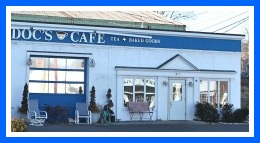
What’s Up With Doc’s

In the winter of 1997, Yvonne Dougherty rose early every morning to drive her son Peyton to Staples swim team practice.

On the way back she’d stop by Juba’s — the coffee shop in Peter’s Bridge Market, near her home — for a jolt of caffeine to start the day.

Then she got a job there.  It paid $7.50 an hour — but she quickly fell in love with the coffee business.

On September 11, 2000 she took over Juba’s lease.  For an investment of just a few thousand dollars, she had a steady business.  She took in $900 a day, with virtually no overhead.

Three and a half years later, the new owners of Peter’s Bridge “threw me out,” she says.

In less than a month, she opened a new place in a former boating just across Riverside Avenue.

Yvonne called it Doc’s, in honor of her last name — pronounced “Dockerty.”

Yvonne Dougherty, outside Doc's.

Her landlord — Sam Gault — was “phenomenal,” she says.  He kept her rent low, and helped any way he could.  He told her she could probably stay for 2 or 3 years.

Yvonne spent plenty of money — $250,000, she estimates — complying with town regulations.  She had to change the parking lot, and put in a sidewalk.

But customers — including, importantly, many commuters — loved Doc’s.  For much of the decade, she averaged $1,500 a day.

Then the economy tanked.  Starting in the fall of 2008, business tailed off precipitously.  The opening of a similar place — Cocoa Michelle — closer to the train station may also have hurt.

A year ago, construction began on the Saugatuck redevelopment project.  Winter — always slow — was particularly harsh.  Between road closures on Riverside Avenue, bad weather that kept people home, and uncertainty about whether Doc’s would stay open, business dropped 30 to 40 percent.

(Interestingly, Yvonne says, the new Dunkin’ Donuts at the site of the old Juba’s had no effect.)

Doc’s owner second-guesses herself for many of her problems.

“Even though I have an MBA from the University of Virgina — back in the Stone Age — I didn’t have a clue to market Doc’s.  Or even brand it,” she says.

“I missed the opportunity to be on the web.  And I could have rented out this place for parties more than I did.”

Yvonne adds, “When someone walks in your shop, they have to know what you’re selling.  I’ve got lots of tchotchkes here, but I think they distract people.  Some of my charm came back to bite me in the butt.”

Starbucks, she says, “may be sterile and boring.  But you know what they’re selling.”

Doc’s “would have been far more successful if I’d known I was going to be here for 8 years,” Yvonne says.  “I would have put in a kitchen.  I would have designed everything much better.”

With close to 2,000 square feet — 10 times her space at Juba’s — she says, “It was probably too much.”

Yvonne adds, “I was a one-woman show.  I learned you have to work on your business, not in it.”

The 2nd phase of Saugatuck’s redevelopment starts soon.  A retail/residential/office mix will replace the buildings in and around Ketchum Street — including Yvonne’s.

Doc’s last day is November 12.

“I wish I had a plan for what’s next,” Yvonne says.  She’s found a potential location in Southport — but she needs a partner.

Perhaps, she says, she can open Doc’s as a smaller space inside existing stores — the way she started, with Juba’s inside Peter’s Bridge.

But Peter’s Bridge is gone, and Yvonne can’t think of any other place in town that make sense.  “That’s my challenge — to find something that works,” she says.

She will miss her customers.  Many have been very loyal.

“I see people in town, and I think, ‘that’s a medium latte,” she says.  “That’s a pretty bizarre skill.”

Meanwhile, the clock ticks for Doc’s.

“I’ve got to figure out something soon,” Yvonne says.

Occupy Westport

No, the Occupy Wall Street protest — which has spread to cities from Boston to San Francisco — has not yet come to 06880’s Main Street.

However, that did not stop Derek Pell — a Westporter in the 1960s and ’70s — from resurrecting an “occupy”-related photo on his ZoomStreet “art, culture, photography and noir” blog.

Derek wrote:

In the spirit of the recent Occupy demonstrations spreading across the land, here’s a photo (my first)  shot in 1969.  It shows artist Miggs Burroughs demonstrating outside the Westport Arts Center, where his paintings had been excluded from the inaugural exhibition.

The image recently resurfaced in a documentary on WAC.

I’m also responsible for creating that crude sign.

Art indeed.

Derek’s been attracted to this sort of stuff all his life.  According to Miggs, Derek — “using nothing more than a press pass from Fairpress” [a Westport weekly newspaper] — ended up in the front row of photographers at the Watergate hearings, and getting published in Rolling Stone, Newsweek and others.

Power to the painters.  The people.

And the photographers.

Fresh From The Farm

The folks running Wakeman Town Farm are finishing their fundraising drive.

But they’re not letting grass produce grow under their feet.  They’re also busy organizing upcoming events — all the way through the summer.

Weekend gardening workshops for adults will start “sooner rather than later.”

In November Erin Ostreicher, a rising star in the world of flower arranging, hosts a Thanksgiving Centerpiece workshop.  Events include cornucopias, hollowing out pumpkins to fill with flowers, spilling over with gourds and flowers, and more.

December brings a wreath-making workshop, with perhaps a holiday tea and tree trimming event.

Wakeman Town Farm will soon hum with activity.

Looking further ahead, a summer “Junior Farmer Camp” for kindergarteners through 2nd graders (called “Homesteaders”) will include animal husbandry (aka collecting eggs from nesting boxes, plus feeding chickens, bunnies and goats); tending a garden, harvesting veggies and turning them into delicious snacks, and making crafts from whatever the Homesteaders grow.

The camp’s 3rd through 5th graders will do all of the above activities, along with a more intensive botany/animal biology curriculum.  They’ll start plants from seed; do succession planting, harvesting and trellising, and enjoy arts and crafts that are age appropriate for this “more mature” set.

Middle school “apprentices” start before the summer.  Youngsters sign up for the full year (as an after-school activity), with the option of staying on throughout the summer.  They’ll learn about farming from seed to harvest — and all things in between.

High school internships — including the special last-quarter-of school senior internship program — will also continue.

Parks and Rec is promoting many of the Town Farm activities.

Who says there’s nothing new under the sun?

Welcome To Mill Valleyport, Connectifornia

By Dan Woog and Liz Greer

Famous people — including fictional TV characters — live here.

Downtown is grappling with the loss of mom-and-pop shops.

Real estate is expensive.

Residents are affluent, worldly, well educated, and overwhelmingly white.

The politics lean toward the liberal.

Welcome to Westport, Connecticut — and Mill Valley, California.

Separated at birth? Mill Valley, California...

They may not be exact replicas of each other.

But they’re close.

Joggers, bikers, yoga practitioners, nature walkers:  check.

A much-loved library, highly regarded schools, community theater and arts festival:  check.

Texting while driving:  big check.

There are differences, of course.  While both have spectacular views, Westport counters Mill Valley’s canyons and redwoods with lush greenery and Colonial-era stone walls.

Mill Valley’s 20-minute commute to San Francisco blows Westport’s hour-long (with luck) ride to New York City out of the water (the Sound, not the Bay).

...and Westport, Connecticut.

For every Jack Kerouac who lived in Mill Valley, Westport’s got an F. Scott Fitzgerald.

Mill Valley has been home to Dana Carvey, Jack London, Jerry Garcia, Huey Lewis and Robin Williams.

Westport residents have included Paul Newman, Robert Ludlum, Ashford and Simpson, and Michael Bolton.

B.J. Hunnicutt of “M*A*S*H” lived in Mill Valley, supposedly.

“I Love Lucy'”s Ricardos called Westport home, fictionally.

West has a hyperlocal blog, “06880.”  Mill Valley has a hyperlocal blog, “Mill Valley Life.”  They share the same combination of celebrity and aargh-itude.

In fact — former Westporter Rod Serling would appreciate this — “06880” is the creation of Dan Woog.  Who visits, and has close friends in, Mill Valley.

And “Mill Valley Life” is the creation of Liz Ewen Greer.  Who lived in Westport, way back in the 1960s.

DEE-DEE dee dee DEE-DEE dee-dee…

(Today’s post appears simultaneously in “06880” and “Mill Valley Life.”)

Fribbles And Friendly’s

I first heard of Friendly’s at sleepaway camp.

To an 11-year-old, there was no greater thrill than leaving the confines of Robinson Crusoe for the “big city”:  Sturbridge, Massachusetts.  Every once in a while, counselors piled us into a hay truck for an outing to the iconic Bay State ice cream shop.

After weeks of camp food, nothing beat an “Awful Awful”:  a milkshake that was “awful big, awful good.”

Awful Awfuls eventually gave way to Fribbles.  (NOTE:  Two alert readers have written in to correct me.  They say that “Awful Awfuls” were sold by Newport Creamery, and Friendly’s’ shakes have always been Fribbles.)

Friendly’s eventually made its way to Westport.  For a generation of young people, the restaurant in Playhouse Square was the place to go to celebrate — after a dance, a play, a game — or just hang out.

Already an adult during the Westport Friendly’s days, I never got it.  The place always seemed dirty.  The menu was stodgy.  No matter how uncrowded it was, the service was excruciatingly slow.

But Friendly’s was a defining memory for many who grew up here, just as it was for me at summer camp.

Sure, there’s a Friendly’s close by — just over the Southport line.  (It used to be a Farm Shop.)  But it never gained the groove of the Playhouse Square store.

To Westporters today, Friendly’s is just a memory.

That soon may be the case all over New England.

The announcement that the company has filed for bankruptcy protection — and plans to close 63 of its nearly 500 restaurants — revived memories for hundreds of Westporters.  Several emailed me, asking if I planned to write about it.

I hadn’t — not at first.  But the more I heard from former Friendly’s fans, the more I realized I had to say something.

So here it is:

I’m still waiting for the tuna melt I ordered.

During the Carter administration.