Jono Walker’s family — the Bennetts — settled in Westport in the 1700s. They lived on South Compo Road through the early 21st century.
Jono is in Pennsylvania now, but his roots here remain strong. The other day, Googling for background info on a piece he’s writing, he found a few “06880” posts about Bald Mountain. He sent along this excerpt from his longer story.
Skonk!
My snowball splattered the middle of another Redcoat’s roof. Not a bad shot.
Snow-packed Imperial Avenue was directly below the steep hill I perched on top of. It was harder than you’d think for this wily Minuteman, on his home terrain, to hit the hapless British soldiers. I’d been at it for half an hour, and hadn’t made a perfect shot — the driver’s side windshield — but the accuracy of my sniper fire on that blustery February morning was steadily improving.
The site of this ambuscade was Bald Mountain, a 90-foot promontory overlooking the Saugatuck River. The name always confused me. The rounded top of the bean-shaped hill was covered in towering hemlocks, looking nothing close to bald.
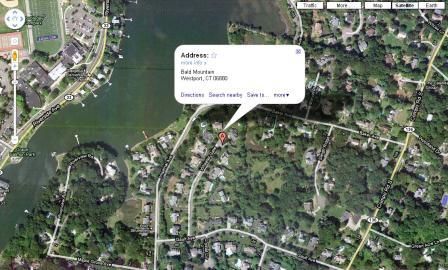
From its summit I peered over the brow, at the Gault Field Little League diamond covered in snow. Directly across the river, red-bricked Bedford Junior High and gold-bricked Assumption Church gleamed in the morning sun.
Upriver, I saw the stand of trees surrounding the Woman’s Club and police station. Further away, just over the roof of the Fairfield Furniture Store on the far side of the river, was Old Hill. 200 years earlier 1,000 Minutemen dug in, lying in ambush hoping to wreak havoc on an advancing column of Redcoats.
The Gaults were just starting to gouge out the eastern perimeter of Bald Mountain in those days, felling trees and mining the moraine for sand and gravel. It would take 20 years to flatten the place, at which point they paved a road and built a dozen McMansions on the level ground that had been a rolling hill ever since the last Ice Age.
For thousands of years the Paugussett Indians maintained a fishing and trading post in the “faire fields” and salt marshes around Bald Mountain. They called the place Machamux (“the beautiful land”).
In 1661 the Paugussetts were hoodwinked into selling a portion of their lands east of Bald Mountain (today’s Green’s Farms) to the newly established town of Fairfield for 13 woolen coats, plus a little wampum.

A member of the Paugussett tribe.
It only took another decade or so for the rest of Machamux — from today’s Sherwood Island west to the Saugatuck River, and north to the Aspetuck River — to be appropriated by colonists. By the early 1680s all of modern-day Westport was settled by dozens of industrious freemen and their burgeoning families.
Among them were my ancestors Thomas, James and John Bennett. They were granted nearly 1200 acres. The land they “improved” ran on either side of today’s South Compo Road, from roughly the Post Road south to what was once called Bennett’s Rocks (the jagged granite outcropping now bisected by Narrow Rocks Road).
Within their property was a steep-sided hill rising from the marshy banks of the Saugatuck River. They eventually cleared it for pasture, and it became known as Bald Mountain.
At 10 years old I knew nothing about this history, beyond a vague awareness of that patriotic military action atop Old Hill. So there I was, armed and ready — a brave patriot using his insider’s knowledge of the local landscape to defend his homeland from the foreign invader.

Bald Mountain.
The enemy approached: a bright red Studebaker negotiating the wide turn around the base of Bald Mountain. My snowball landed with a splatter more spectacular than I could have dreamed, right on the driver’s side of the windshield.
The car skidded along the snow bank. Out sprang the driver, scanning the hillside. He was a surprisingly young soldier — and mad. When he spotted me high above him he shook his fist, swore, dashed across the road and up the hill.
But — like his hapless forebears — this man’s entire military strategy (and his attire) were ill-suited to the wilds of the new world. The enemy was angered and dangerous, fully capable of rendering me to shreds, yet dressed in slippery business shoes, he was completely outfoxed.
I watched his 3 vain attempts to scale the formidable redoubt. Then I calmly turned, melting into the deep and shadowy woods, unbowed and ready to fight another day.

Jono Walker, back in his soldiering days.


