
In 2001, Tom Feeley noticed a family gathered outside his beautiful Compo Beach bungalow. He introduced himself, and invited them in.
They were Jean McKernan and her family. Jean had lived there — 12 Fairfield Avenue — back in the day. Her father bought the house just before the 1929 crash.
The McKernans owned it for almost 50 years. Today it is owned by Tom and Sandy Feeley.
Now — after many years of living in and loving it — the Feeleys have placed the bungalow on the market.

Tom and Sandy Feeley’s house today.
The website about the property includes fascinating recollections by Bob McKernan — Jean’s brother. Here are a few.
Nelson McKernan — a rising young banker, and Bob and Jean’s father — bought the cottage in 1928, for $5,000. A bit of modernization made the summer of 1929 a fine one.
Fairfield Avenue was not paved. Every few days a spreader rolled through, putting calcium chloride on the dirt road to absorb water and keep dust down. Chemicals got into cuts Bob and his siblings suffered from shells on the rocky beach, and stung worse than acid. But his skin was tough, and he often walked barefoot into town.
That first year there were wooden bathhouses on Westport Avenue. But they burned that winter, and the land was turned into a parking lot. Buses arrived regularly at the corner, dropping off and picking up bathers.
Wooden bathhouses on the beach lasted much longer. Kids climbed to the rooftop porch, looking over the crowd.

The old Compo bathhouses, located between what is now the lifeguard shack and the white pavilion. Note the upper deck, where Bob and his friends scoped out the beach — and which now encircles the current pavilion.
There was always activity on the street. Many Irish families gathered together. At night adults played bridge, or sat on the porch and talked. From Bob’s bedroom he heard Florrie Carroll play the piano, as everyone sang.
The vegetable man came by with his truck. So did the ice man, with his 300-pound blocks.
Bob’s father was president of the Compo Beach Improvement Association. The group sponsored swimming races, and built 2 diving floats offshore. They were the site of huge King of the Hill fights, with plenty of fun (and a few injuries).

These 2 pages in “Westport…A Special Place” show Compo Beach in the 1930s. Note the boats, floats, canoes, men wearing suits — and rocks, where the sand is today.
After sending away for boxes of rockets and firecrackers, kids shot them off, shot them at each other, and blew up Mrs. Rae’s mailbox.
Neighbors vied for the best 4th of July displays. The Lanes — including sons Paul (future Staples football coach) and Chubby (future owner of the beach concession) — had the best, Bob says.
Before more houses were built, a wide, grassy backyard was the site of many croquet, badminton and softball games. Later, when the town tried to solve the problem of high tidal flows by installing pipes and a 1-way valve by the Minuteman statue marsh, water became polluted and tall grasses grew. The soil turned to muck, the yard to uselessness.
One corner of Fairfield and Soundview was owned by Sam Roodner, a Norwalk developer. His castle-like stone house represented money and power. His mailbox was never blown up.
The other corner, owned by the Toomeys, was wooded for years. Kids played war games there — and always got poison ivy.
Without winterization, few of the residents stayed year-round. But long-lasting friendships were common. Bob remembers many — including “the worshipped-from-afar, unapproachable, but so wonderfully named Sauncy Frost.”
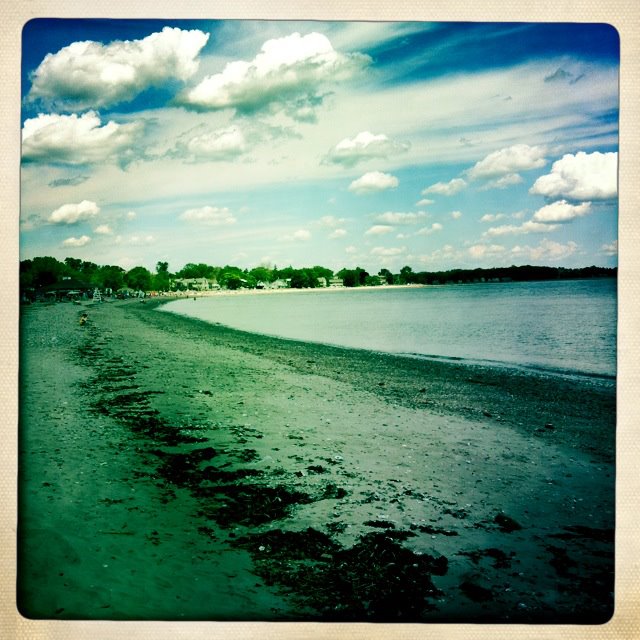
Compo Beach, looking toward Schlaet’s Point
There was no jetty at Schlaet’s Point (Hillspoint Road); it came in the 1950s. A rocky spit there was filled with clams. Bob and his friends walked out at low tide with rakes and buckets, picking soft-shells to be steamed at home.
Crabs were a problem when swimming in anything but high tide.
In those days, with the beach varying in sand depth from year to year, tides varied dramatically. Sometimes, high tide reached the seawall. Low tide extended hundreds of yards.
For diversion, kids swam in the big pond at Old Mill. A longer walk was to Saugatuck, across the railroad bridge. It was the perfect height for diving into the river below.
Eventually, Bob’s childhood ended. War came. But 12 Fairfield Avenue, and the beach, united the family and their friends every summer.
“Post-war parties were wilder, romances were deeper,” Bob recalls.

A welcoming sign at 12 Fairfield Avenue.
He and his new wife moved back to the cottage, to await the arrival of Bob Jr. Bob Sr. insulated it, for the winter.
It was almost useless. A 2-burner kerosene heater in the living room provided the only real warmth. But the McKernans stayed.
“Then came more permanent roots, more marriages, more babies,” Bob says.
“Visits replaced living at Compo. From those overnights or longer stays came the memories our children have of their beach days in the ’50s and ’60s.”
Finally — 36 years ago — Bob’s mother put the beloved house up for sale. “It left our hands, but not our hearts,” Bob says.
For years, Tom and Sandy Feeley have loved the bungalow — and the neighborhood — just as the McKernans did.
Let’s hope the new owners continue that wonderful Compo tradition, for decades to come.
(Click here to view the listing — including Bob McKernan’s story about growing up in the house by the beach.)
The friendly porch at 12 Fairfield Avenue, today.
