Category Archives: Teenagers

From Beach To Best: 60 Years Of Teen Radio

WWPT-FM is the best high school radio station in the country.

That’s not just my opinion. Staples’ “PT” earned that John Drury Award honor last year — to go with similar “Best High School Radio Station in the Nation” trophies in 2011, ’17 and ’18.

WWPT 90.3 picks up plenty of other Drury trophies each year too, for everything from news features and public affairs, to sports and radio dramas.

The station draws a wide audience. Live sports are particularly popular. They’ve launched the professional careers of sportscasters like D.J. Sixsmith, Eric Gallanty and Cam Manna.

Celebrating at the 2010 John Drury Awards ceremony (from left): advisor Mike Zito, and students Eric Gallanty, DJ Sixsmith, Brendan Rand and Jake Chernok.

But listeners may not realize that WWPT is more than 50 years old.

Or that a radio station featuring Westport teenagers stretches back to the Eisenhower administration.

Pam Docters knows.

And now anyone who pays $9.03 0n Amazon (yes, the price is deliberate — get it?!) can read all about that storied history.

Docters — a 1978 Staples graduate, and proud ‘PT alum — has just published “Radio Whoopie at Compo.” The slim, 49-page paperback tells the story of the station, in the words of those who were there. And with an impressive number of archival photos.

It focuses on the late 1950’s through ’80s. The pioneers who Docters spoke with were the most fervent WWPT alums, she says.

The story begins with  Stuart Soroka. He hung a speaker outside his bedroom window on Wake Robin Road, and hosted a “radio show.”

That evolved into a 100-megawatt AM station — called WWPT, for “Westport” — at 1160: “The Sound on the Sound.”

Soroka, Gordon Joseloff and others broadcast from the YMCA and Compo Beach, with a transmitter the size of a cereal box.

Teenagers at Compo Beach, listening to “The Sound on the Sound.”

They attracted the attention of the New York Times, World Book Encyclopedia, Scholastic Magazine — and the Federal Communications Commission, which reluctantly shut them down.

Soroka — a 1961 Staples graduate — went on to became a noted Boston weatherman. Joseloff had a career as a CBS News correspondent, then served 2 terms as Westport’s first selectman.

This July 1961 New York Times story alerted the FCC to the existence of the unlicensed radio station. 

In 1968, Keith Satter and others built an AM transmitter that broadcast throughout Staples, from what had once been a storage room. WSRB — for “Staples Radio Broadcasting” — is believed to be the first high school radio station in Connecticut.

In the early 1970s it evolved into WWPT-FM. At 110 to 330 watts, it was the 12th high school radio station in the country.

The designer of the original 1970s logo is unknown. It’s still used today.

Docters uses interviews with former staff members like Dennis Jackson, Mark Potts and Larry Perlstein to describe the growth of the station: its antenna at the old Nike missile site on Bayberry Lane; live broadcasts from the Yankee Doodle Fair, and of Candlelight Concerts; coverage of Board of Finance, Board of Education meetings; an interview with former Stapleite Charlie Karp, who had played with Jimi Hendrix but was excited that his new band’s music was being played on “this little station.”

In 1975, WWPT sponsored a fundraising concert in the Staples auditorium with the James Gang, and an up-and-coming English musician named Peter Frampton.

On Election Day 1977, ‘PT scooped all the other local media with the local results. Station members headed to polling places across town, and called in the results via pay phone.

Marta Flanigan waits for election results, in the WWPT studio.

Chuck Davis and Neil Hartman built a robust sports department. WWPT aired football, soccer, basketball and baseball games. They scored press passes from the Yankees, Giants, Knicks, Whalers (and Bridgeport Jai-Alai), and interviewed top athletes.

Davis went on to work at Sports Illustrated; Hartman headed to Comcast SportsNet. Another member, Jon Stashower, became a noted ESPN radio anchor.

Photos in Pam Docters’ book show (top to bottom) Chuck Davis and Neil Hartman interviewing Cosmos soccer stars Giorgio Chinaglia and Pele, respectively.

Thanksgiving fundraising marathons became legendary. With pitches from famous New York DJs like Don Imus, Cousin Brucie and Murray the K, plus celebrities like Howard Cosell, Frank Gifford, Jim McKay, Dave Winfield, Jack Lemmon and Ben Vereen, students raised thousands of dollars each year.

1977 fundraising marathon poster.

WWPT was a formative experience for Docters, and her love for it is clear in her book.

She tells “06880” about her long days at the station. “We were in the lower 9 building, away from everything. We never, ever saw an adult. We were independent, and responsible. We MacGyvered everything. Fixing the tower at 11 p.m., whatever — we made it work.”

Docters remains “in awe” of her predecessors. “They were there before anyone, in radio. It’s phenomenal what they did. You couldn’t recreate that today. There are so many rules and regulations now.”

40 years after graduating, 1978 WWPT members (from left) Malcolm Doak, David Schaffer, Laurel Rech, Chuck Davis, Doug Meny and author Pam Docters enjoyed a tour of the 2018 studios.

She knows “Radio Whoopie at Compo” will not be a big seller. That’s fine.

Docters just wanted to preserve WWPT’s remarkable history. She donated copies to the Staples and Westport libraries, and current station advisor and radio production teacher Geno Heiter.

That’s right: Radio is now a legit Staples class.

It’s come a long way from the outlaw transmitters at the beach and the Y; closed-circuit broadcasts that could only be heard in the cafeteria; then gangs of teenagers hanging out all day and night, playing records and planning shows and fixing transmitters.

Pam Docters is proud of the role she played. Dennis Jackson, Larry Perlstein and all the others she interview for her book are too.

And in that great radio station in the sky, Stuart Soroka and Gordon Joseloff are listening and smiling too.

(“o6880”  regularly covers Staples High School, Westport teenagers, our town’s history — and much more. If you enjoy stories like these, please click here to support our work. Thank you!)

2025 John Drury Awards.

Unsung Heroes #418

Staples High School’s many talented actors, musicians and athletes get plenty of press — and well-deserved praise

Plenty of others do equally admirable work, far beyond the spotlight.

Today we salute Natalia Garment, Neha Singh and Jessie Zhang.

The highly motivated, self-starting seniors created SpeakEasy. The student-run organization supports language learners, and increases access to multilingual education.

They promote biliteracy through free tutoring. They’ve hosted a fundraiser at Toquet Hall.

Now they’ve partnered with the Westport Library.

Next month, SpeakEasy offers free beginner Spanish, Mandarin and French classes for students ages 6-9 at the Library.

Group members have earned the Connecticut Seal of Biliteracy, and have experience teaching peers and younger students. Families may sign their child up for individual sessions using this link.

SpeakEasy has also designed a special “Biliteracy Bookshelf,” at the entrnace of the Library’s children’s section. Prior to lessons, families are encouraged to visit the display.

Natalia, Neha and Jessie: You are our Unsung Heroes of the week. Congratulations!

Or — as you already know how to say: Félicitations! ¡Felicidades! Gōngxǐ!

From left: Neha Singh, Jessie Zhang and Natalia Garment, at their Westport Library display.

(“06880” is proud to honor Unsung Heroes — and tell many other tales of town too. Please click here to support your hyper-local blog.)

“Students Speak”: Sharing Grades Adds Extra Stress

“Students Speak” offers a platform for Westport students to speak out about issues of importance to them.

Ella Turner is a sophomore at Staples High School. She serves Inklings as paper editor and editorial board member, and is part of the Graphic Design Club. Last summer, Ella explored media writing at Vogue Summer School and investigative journalism with the New York Times program.

Ella has studied at Alvin Ailey’s dance intensive in New York. She is a member of the senior company at Westport’s Academy of Dance, performing shows like “The Nutcracker.” Ella writes:

I quit tennis when I was 10 years old.

As someone who couldn’t stand the stress of constant competition, I told my mom that competitive sports just weren’t for me and started a career in dance.

After a while though, my little self realized that in any activity, there would be a level of healthy competition. I slowly adjusted, realizing that it could actually push me rather than hinder my progress.

Ella Turner

At school however, I loved to be in competition with myself. That meant harder classes and more stress. As most Staples students do, I would stress about tests, then worry about the grade I got.

You’d think that would be the end of it. However, once I receive my grade, I am forced to add another level of stress to the already mountain-high stack: the stress of telling others how I did.

Grade sharing is a common occurrence at Staples, to the point where I share and compare my grades with classmates in every class. For most students, it is the norm. It is customary that the second you receive a grade, you feel obligated to share it.

Even when I try to avoid disseminating my grade, I’m often asked outright by others. Sharing grades is now a part of the academic process at Staples, and I, like countless other students, don’t bat an eye at it. But recently, I have  wondered why this is the case.

Some of the blame for the increasingly public nature of grades at Staples is also one of my unfortunately cherished pastimes: checking PowerSchool. Despite the ease that technology has created, students having full access to their grades at any time of day is a risky power. Rather than avoiding the question, or avoiding discussing grades altogether, there’s always the ability to “just pull it up!” — a phrase I am sadly guilty of.

A significant portion of the pressure to share grades stems from the desire for comparison. The culture at Staples is undeniably a feeling of constant preparation for college and the workforce. This leads to yet another feeling that each grade is the defining factor in a student’s future success.

This culture not only enables unnecessary anxiety, but also creates an underlying sense of competition, the kind that can drag a student’s self esteem far down without them even realizing. If they get a bad grade, they need the reassurance that it was still an average or above average grade, and that they are not falling behind others in the constant race to an unknown finish line.

Once a grade is out in the open, whether positive or negative, there are serious underlying consequences that students put on themselves. If my classmate aces an English essay, there becomes this expectation that they are good at English and should be living up to the bar they set for themselves. Effort becomes judged by a letter rather than time and energy. And once stereotypes and expectations are made, breaking those assumptions can feel impossible.

It’s understandable that comparing grades with peers can be exciting, and many people don’t feel uncomfortable with that level of openness. But it’s also important to take into account that many people need a level of privacy when it comes to grades, whether they say it out loud or not.

Rather than asking “What did you get?,” forcing students to reply with a letter grade, try instead “How was the test?” or “How did you do?” This will enable students who are uncomfortable to respond indirectly, which provides a sense of comfort that as of now, not many students have.

As a sophomore who has 2 more years at high school, that means I will be comparing and sharing my grades, whether I am comfortable or not with the idea.

As a community and a school, I believe it is important that we take a step back and reassess the motives for constant grade sharing by asking ourselves: Is sharing your grades for the benefit of others, or the benefit of your self-validation?

(To submit a “Student Speaks” — or for questions about this feature — email 06880blog@gmail.com. We will work with students — at Staples, private schools or home-schooled — to help craft their story. Anonymity, if requested, is assured.) 

(If you enjoy this feature — or anything else on “06880” — please click here to support our work. Thank you!)

Town Officials React To Rise In Teen Parties

Teenage parties have long been part of Westport — and American — life.

But several recent ones have caused local leaders to take notice.

An email sent yesterday on behalf of 1st selectman Kevin Christie — and signed by Superintendent of Schools Thomas Scarice, Police Chief David Farrell, and 4 other town officials who work with youth — said that since September, Westport Police have responded to 7 “large scale” parties, each with over 100 teenagers.

One had “several hundred teens, including middle school students.”

(Stock photo)

When they were shut down, “many teens walked in the dark to reconvene at other homes and local businesses.”

Several young people were hospitalized for “severe alcohol intoxication.” Arrests were made for assault and “social hosting.”

Police and Christie call this “a troubling rise in large, unsafe gatherings of youth where alcohol and other substances are present.”

Police Captain Jillian Cabana adds, “This is a larger problem than just a year ago. Social media like Snapchat can quickly turn a small gathering into a large, unmanageable event. We encourage residents to call us for assistance when a situation is beyond their control.”

Police cite risks, including driving under the influence, walking in streets in the dark, alcohol poisoning, potential for assault, and risk of property damage.

The Westport Prevention Coalition — whose members include parents and professionals, with representatives from the Aspetuck Health District, Positive Directions, the Police Department, Westport Public Schools, and Westport Human/Youth Services — urges “parents to talk with their teens now, and make clear safety plans together.”

Kevin Godburn, director of Westport Youth Services, recommends teaching children “refusal skills” starting at an early age. “It’s also critical to have an agreed-upon exit strategy for risky situations,” he says.

Parents are also at risk. Connecticut’s Social Host Law holds adults responsible when youngsters consume alcohol or use cannabis on their property – even if the adults were unaware that it was happening.

Social hosting is punishable by up to a year in prison —  with fines of up to $2,000 per youth involved.

However, Positive Directions prevention director Margaret Watt says, “It’s not just about following the law. Research shows that early substance use can damage teens’ brain development, and increase the risk of mental illness and addiction.”

The Police and Westport Prevention Coalition encourage parents to “create their own zero-tolerance policies for underage drinking and cannabis use.” The Coalition offers free resources such as Operation Parent books, lock bags for safe storage of prescription drugs and adult-use marijuana, and liquor stickers to deter access to alcohol at home.

For more information, email Watt (mwatt@positivedirections.org) or Godburn (kgodburn@westportct.gov).

In addition to Christie, Farrell and Scarice, the email was signed by:

  • Elaine Daignault, director, Westport Human Services
  • Kevin Godburn, program director, Westport Youth/Human Services
  • Luci Bango, director of health, Aspetuck Health District
  • Margaret Watt, prevention director, Positive Directions — The Center for Prevention & Counseling

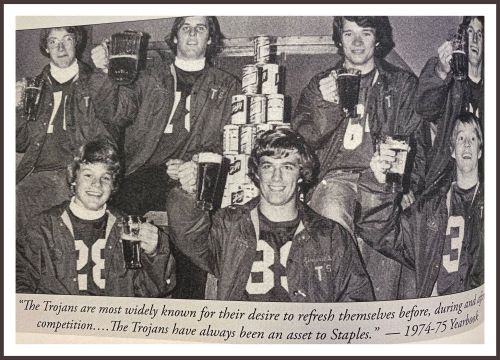
In the 1970s, the legal drinking age in Connecticut was 18. This photo appeared in the 1975 Staples High School yearbook.

Unsung Heroes #413

Among Westport’s many holiday traditions, none is more beloved than the Candlelight Concert.

For 85 years — ever since 1941, a few days after Pearl Harbor — the Staples High School music department’s gift to the town has thrilled and inspired audiences.

Musicians — singers, and orchestra and band memories — cherish it as one of the highlights of their school lives. Many return as alumni, to bask in its magic.

Two women — now in their 80s — traveled from Oklahoma for last weekend’s Candlelight. Decades after graduating, in 1961 and ’63, they smiled with joy through the traditional “Sing We Noel” processional, the “Hallelujah Chorus” finale with dozens of alumni joining the stage, and so much in between: the beautiful Jewish tune “Al Shlosha”; the percussive Nigerian song “Ogo ni fun Oluwa”; a haunting rendition of “Stille Nacht”; complex works by Prokofiev, Rutter and Tchaikovsky; creative student ensembles, and more.

It was one of the best Candlelight Concerts ever — a high bar, indeed.

But few members of the appreciative audiences knew what it took to produce this year’s show.

Though they worked since school began, Candlelight preparations never really begin until Staples Players’ fall show ends.

This year’s production — “Les Misérables” — was an especially enormous undertaking. Many of the actors are also singers; all the music teachers played in the pit orchestra.

The final curtain fell just 19 days before the first concert.

Exhilarated but exhausted, they pivoted immediately to Candlelight.

And — because of the way the calendar fell this year — they had one less week than usual to do it.

Meanwhile, Orphenians — one of the concert’s centerpieces — entered their busiest time of the year. They sing at the Town Hall tree lighting, Holiday Stroll, and for organizations all over Westport.

Every adult and young person involved in Candlelight was pulled a thousand different ways, these past few weeks.

But they — along with others who handled sound and lighting, plus tremendous volunteers from the Staples Music Parents Association — pulled together.

I can’t imagine the effort it took. I do know that for all who were fortunate enough to be there, the results were well worth it.

So to townwide arts coordinator Steve Zimmerman; directors Jeri Brima, Carrie Mascaro, Kevin Mazzarella, Lauren Pine, Caitlin Serpliss and Mary Gardner; every young musician, and everyone else who had a hand in the 2025 Candlelight Concert: Bravo! 

You are this week’s Unsung Heroes.

Although this week, “unsung” is definitely not the right world to use!

From left: Carrie Mascaro, Caitlin Serpliss, Kevin Mazzarella, Jeri Brima, Lauren Pine. (Photos/Dan Woog)

(“06880” is proud to honor Unsung Heroes — and tell many other tales of town too. Please click here to support your hyper-local blog.)

Pics Of The Day #3161

A few more images, from this weekend’s spectacular Candlelight Concert.

The concert begins.

The view from the stage, before the “Hallelujah Chorus.”

Alumni join current singers for the finale. (All photos/Dan Woog)

The audience rises, as the orchestra, band and choral groups — joined by alumni singers — perform the “Hallelujah Chorus.” (Photo/Jennifer Petrosinelli)

“Sing We Noel…”

A little more brass and percussion in “Sing We Noel.”

Classical works, longtime favorites, plus selections from around the world, played and sung with skill, passion and joy.

Staples High School’s 85th annual Candlelight Concert — the first of 3 weekend shows — thrilled and inspired a full house last night.

As always, it was the Music Department’s gift to the town.

As always, it was the greatest gift of the holiday season.

“06880” photographer Lynn Untermeyer Miller — a former Candlelight Concert performer herself — shares these images, from a night of wonder.

Staples Class of 1961 graduate Lucy Weberling (above) and her sister Janet (SHS ’63) traveled from Oklahoma, just for this year’s Candlelight Concert. (Photo/Dan Woog)

Longtime Candlelight stalwarts: former Staples principal John Dodig, and Jackie-of-all-trades Alice Addicks.

Directors (from left) Carrie Mascaro (orchestra), Caitlin Serpliss an Kevin Mazzarella (band), Jeri Brima (orchestra) and Lauren Pine (choral), after the “Hallelujah Chorus.” (Photo/Dan Woog)

(All photos/Lynn Untermeyer Miller unless otherwise noted)

“Students Speak”: Collateral Damage From Cellphone Ban

Recently, “06880” introduced a new feature. “Students Speak” gives Westport students a voice on any issue important to their lives.

Will Enquist

Today, Will Enquist looks at Staples High School’s “cellphone ban.” It actually includes more than phones.

A Staples High School senior, managing editor of Inklings, and a member of both the Westport Youth Commission and “06880” board, he enjoys reading the Wall Street Journal, and watching the New England Patriots “slowly regain relevance.”

He plans to major in political science, and contribute to his college’s newspaper. Will writes:

As I took refuge from a chill fall breeze inside the warm halls of Staples High on November 5, I was greeted with a sight unseen over the past decade: Not a single student was using their cell phone.

On that day a “bell-to-bell” cellphone ban, first proposed by Superintendent Scarice and later approved by the Board of Education, was implemented.

Despite the student body’s fervor in the days leading up to the phone ban, my Wednesday was rather typical. Like many Staples students, my phone has never really been a distraction in class. However, during my lunch period I first noticed one of its unintended consequences.

As I sat down in the library, I put in my AirPods – equipped with noise cancellation – to block out the buzz during lunch, a volume comparable to Madison Square Garden during the NBA playoffs.

I was 90 seconds into Beethoven’s 6th Symphony and my calculus homework when a faculty member politely asked that I remove my wireless headphones.

I was suddenly reminded of one of the less reasonable stipulations of the ban: In addition to cellphones and smartwatches, students are prohibited from using wireless headphones during the school day.

Interestingly, it is this aspect of the policy — the ban on widely popular wireless headphones like AirPods — that has spurred the most criticism. Students and teachers alike express confusion about why devices that often complement or enhance learning have been strictly forbidden.

Before I continue, I should note that I am a supporter of the phone ban. I believe the superintendent and Staples administration have pursued it with every intention of improving school culture, focus and academic achievement.

However, I believe prohibiting the use of wireless headphones is a significant misstep in the design of the policy.

The administration’s central argument for banning wireless headphones, as I understand it, is that students who might still have their phones on them (in violation of the new policy) could use their headphones to have incoming notifications read to them.

This is not consistent with how I know Staples students to use wireless headphones. Before the ban headphones were most often used for listening to music, canceling out distracting background noise, and listening to teacher-assigned videos or podcasts – all legitimate uses of the technology that support learning.

I have never known of a student using wireless headphones to secretly receive notifications, especially considering that responding to any notification would require verbally dictating a message into their headphones, something immediately apparent to any teacher.

The misuse the policy aims to prevent appears far less common than the productive and legitimate uses it now restricts.

The ability to watch educational videos, listen to music, and cut out distracting ambient noise has been vital to my productivity during school hours and, by extension, my academic success.

Shortly after learning about the new restrictions on wireless headphones, I began researching wired alternatives with active noise cancellation. However, most headphones advertised as “wired” with noise-canceling capabilities are expensive wireless models that include a wired option.

While my summer job may equip me with the means to afford this option, it feels awfully wasteful and fiscally irresponsible to squander that money when I already own perfectly good AirPod Pros that the policy now restricts.

Ultimately, the goal of the phone ban is one I genuinely support: create a school environment where students are more focused on and connected to their classroom community.

For the phone ban to be effective, however, it must accurately differentiate between tools that detract from learning and those that support it. For the vast majority of students, wireless headphones fall into the latter category.

(To submit a “Student Speaks” — or for questions about this feature — email 06880blog@gmail.com. We will work with students to help craft their story. Anonymity, if requested, is assured.) 

(“06880” is your hyper-local blog. Every day, we bring you news, events, opinions, photos and much more. But we can’t do it without the support of our readers. Please click here to contribute. Thanks!)

Generation SOS: Saving Young Lives — One Story At A Time

In 2012, Jim Hood suffered a parent’s worst nightmare: His son Austin died of an accidental drug overdose. He was 20 years old, and a student at Loyola University in New Orleans.

Here in Westport, Jim and his wife Julia — Austin’s stepmother — felt unbearable pain. Austin had been a wonderful young man, and a brilliant musician. He had a loving heart, a keen wit and a hopeful spirit.

His parents also felt helpless. During Austin’s struggles with addiction, Julia says, “There is so much I wish I had understood differently.” As they tried to help their son with his addiction issues, they felt as if they’d been dropped into a foreign city. They had no maps, and did not speak the language.

Jim Hood, and Austin.

Jim Hood, and Austin.

They did not fully understand that addiction is a disease– not a choice or a personality trait. They did not realize that an addict’s brain is “hijacked, and chemically altered.”

Nor did the Hoods know that drug addiction is often tied to mental health challenges. Every year, over 5 million American teens and young adults are diagnosed with a serious mental health challenge. More than 200,000 die from drug overdoses and suicide — 5 times the number killed in automobile accidents.

A dozen years later, Hood’s grief has not lessened. But he draws solace from the fact that through Generation SOS — a non-profit he serves as CEO — he is helping keep countless young people alive.

And sparing them and their families the pain he still suffers, every day.

Austin Hood

Generation SOS was founded several years ago in New York. Six high school students died of accidental overdoses within a few weeks. The schools’ lack of response was shocking — “a sad example of the shame and stigma surrounding addiction and overdose,” the website says.

The organization offers peer-to-peer mental health support to teens and young adults at middle schools, high schools, colleges, places of worship, and community organizations nationwide,

All services are free. “We can’t let money get in the way of saving lives,” says Hood.

Young speakers share their addiction and recovery stories. They’re raw, filled with anxiety and loneliness. Yet each speaker’s story includes courage and hope.

They reach young audiences in a way that other speakers — older adults, teachers, those who counsel “Just say no” — cannot.

Two Generation SOS speakers, and an attentive audience.

Hood is inspired every day by the impact those speakers have.

Recently, Generation SOS was invited to Long Island’s Huntington High School. It was their first-ever all-school assembly.

It was planned for one period. Ten minutes in, the assistant principal extended it for as long as needed. It lasted almost 2 hours.

When the speaker ended, dozens of students lined up at microphones. One student spoke about coming to school high every day. Others talked about suicidal ideation, and cutting.

“Fifty or 60 kids asked gut-punch questions,” or made compelling comments, Hood says.

Finally, students headed back to class. But another 35 to 40 remained. Some shared stories with Hood and the speaker that they’d never told anyone.

“It was heart-wrenching,” Hood recalls. “These kids bared their souls to strangers. We told them to get help, that there’s no shame in an illness.”

Generation SOS has been invited back — this time with a Spanish speaker. (Hood notes that more than 90% of the time, they’re asked to return. When they do, someone often says, “You saved my life.”)

When students go home and tell parents what they’ve heard, “their eyes are opened,” Hood says. Many parents “would rather have a sex talk” than one about substance abuse and mental illness, he says.

Here in Westport, Staples High’s “Get Real Day’ last year included 2 assemblies. “You could hear a pin drop,” Hood says.

Hood coordinates the efforts of Generation SOS’ Connecticut chapter. It has established partnerships with Staples’ Teen Awareness Group, Weston High School, and other public and private schools in the state and Massachusetts.

Last week they signed a partnership with New York Edge. They provide after-school and summer activities to over 30,000 young people, in more than 100 schools in all 5 boroughs and Long Island.

Generation SOS evolved from a earlier organization co-founded by Hood. Facing Addiction launched in 2015, with 50,000 people on Washington’s National Mall. Joe Walsh, Steven Tyler and Sheryl Crow performed; Surgeon General Vivek Murtphy and Senator John Portman spoke; Presidents Obama and Bush, plus Paul McCartney and Ringo Starr appeared on video.

Jim Hood

Hood builds on that work. “Many people acknowledge that mental health and substance abuse/addiction/overdose crises are terrible when they strike an unfortunate family — but they are like lightning. They think it doesn’t happen to many people,” he says.

“But they are much more similar to a few bad weather days that spin out of control. Suddenly, your life hangs in the balance.

“If only we could get more people to understand that, and open their hearts, minds and (in time) wallets, so we can end this silent war that is stealing a generation of our youth.”

Generation SOS’s CEO says, “I’ve never worked this hard in my life.”

He does so in memory of his son Austin. And because he knows there are countless other Austins out there.

“”We lose 400 to 500 kids to drugs and alcohol every day,” Hood says. “And those are just the deaths.

“So many other kids live in isolation. They feel like losers. They don’t realize other people feel the same.”

When they hear real-life stories — from real-life people, their age or just a few years older — who once felt that way, for the first time they have hope.

Their generation’s SOS is being heard.

(To learn more about Generation SOS, click here. For their Instagram, click here.)


“Les Mis”: Thanks For The Magic

The 2-week, 10-show run of Staples Players’ “Les Misérables” has ended.

All those lucky enough to see it are talking about it.

They will be, for quite a while.

Rachel Markus speaks for many. She says:

Ten shows. Hundreds of costumes. Countless hours of rehearsals. Technical learning, testing, set building, painting, prop making, wigs, makeup, meals for 70+ students, rides to and from Staples, publicity runs, student and professional musicians providing the score, a successful food drive, and — by my estimate — over 8,000 tickets sold.

Ten thousand lives touched.

My gratitude is unbridled. To the firector and producers, to the entire Staples Players cast and crew, to the Players parents who volunteer in every imaginable way, and to the former Players parents who continue to show up — taking on major roles like costuming — simply for the love of theater, students, and the staff and advisors who guide them.

It truly takes a village.

Thank you to the local businesses and benefactors who donated funds and meals, helping make this production possible and giving students the fuel they needed to rehearse “just one hour more.”

Thank you to every patron who came, cried, cheered and celebrated the passion and dedication behind this majestic, epic run — one that rivaled professional productions. This community values the arts. It expects excellence, rewards it, and spreads the word when a show cannot be missed.

Staples Players’ “Les Misérables” was more than a testament to teamwork or the power of music and drama to move us. It was months of quiet, unsung sacrifices that culminated in roughly 1,650 minutes of transformation and transcendence. No one sat in a suburban high school auditorium — together, we were transported to 19th-century France, into a world of love, pain, loss, and revolution.

To everyone in 06880 and beyond who contributed to this unforgettable theatrical run: You are the heroes.

(All photos/Kerry Long)