
Organizers of last month’s fascinating presentation on easing the toxic achievement culture so prevalent in Westport promised it would not be a one-off event.
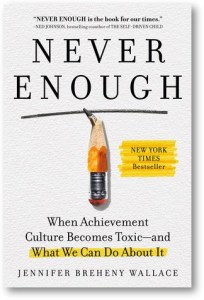 Members of the Westport Public Schools and Westport Together vowed to continue discussions on ways to address the relentless pressures felt by Westport kids, following Jennifer Wallace’s SRO talk.
Last week, nearly 2 dozen middle and high school parents met for the first follow-up, in the Staples library. The goal was to gain specific ideas from parents.
After sharing personal stories of raising children in a high-achievement culture, they broke into small groups to discuss “what messages are our kids hearing at school, in the community, online, and in society about what matters most in the world.”
Among the themes that emerged:
- Students often believe their worth is determined by acceptance by a college with the lowest possible acceptance rate.
- Many students believe they matter if they take AP and/or Honors-level classes, succeed in sports, etc., to the point where they take pride in who works the longest hours and sleeps the least.
- It feels as if every student activity is about resumé-building. Nothing is done for fun, and students rarely try something new.
- Tutoring and coaching begins in elementary school. Parents who choose not to use these services worry their children will be at a disadvantage. Parents call it “an arms race.”
The next question was: “What actions can you take to make your home a ‘mattering’ place?”
Parents offered ideas like:
- Schedule non-negotiable family time together, and establish family traditions like board games, creating a family music playlist, family meals and/or family meetings.
- Be willing to set up “guardrails” — putting appropriate boundaries around taking on activities and higher-level classes, and ensuring children get sufficient sleep and downtime.
- Emphasize family values, both through what parents say in conversations and by setting examples through their own actions (for example, how they manage stress and set their schedules).
- Share failures regularly, so children see that adults can fail, learn and move on.
- Support children in stopping an activity if it is too time-consuming, and not something they genuinely enjoy.
- Limit conversations about grades, focusing instead on effort expended and the learning process. Avoid excessive checking of PowerSchool (the online gradebook).

Online tools offer parents instant access to their children’s grades.
Staples school counselor Sarah Magilnick felt “energized” by parents’ insights and engagement.
“I would love to inspire my students to be their most authentic selves, where they navigate a world without feeling pressured to be someone that dee in their core isn’t filled with joy or aligns with their personal values,” she said.
Jeff Doornweerd, a Staples physical education teacher and Link Crew advisor who facilitated the program with Westport Youth Services program director Kevin Godburn, Staples student support specialist Allison Follett, and members of Staples’ school counseling staff, was heartened that “many parents recognize that there is a problem that many of our students are struggling with, and are open and willing to work towards finding solutions.”
School counselor Kim Curran added, “We all want Westport to be a place where everyone feels that they matter. The common goal of raising individuals who will contribute to the world in meaningful ways to both themselves and others was something we all shared.”
Parents expressed an interest in continuing the conversation, and joining efforts to reduce the negative impact that “achievement culture” has on Westport youngsters.
A similar meeting, following up on Jennifer Wallace’s talk, took place for elementary school parents yesterday.

“Tutoring and coaching begins in elementary school.”
You need not wait that long. Don’t forget about the fine private preschools in town whose tuition rival that of the finest universities.
I’m so happy I left Westport in the early 80s and tho I live ten miles away I never go back… The entire culture feels toxic to me … Our attractive house of three thousand sq. ft was knocked down and an eight thousand sq ft.butt ugly “statement” was squeezed onto the lot after the trees were all cut down… Same for the other houses on the cul de sac. The town drivers “own” the road, cut one off for a parking spot….and the town has adopted the values and aggressive rituals of Gotham… Nothing will bring it back and it’s not an improvement for the better. Happy I lived there before the selfish toxicity smothered it’s once genteel spirit.
Westport is a very desirable town that people want to live in. Westport is diverse. Westport has a fantastic library. fantastic beach. Westport is full of blue collar and white collar people. please keep in mind that imperfection and ignorance are all over the world.
One would need to live in Westport in the 1950s and 1960s to understand what Mr. Boyd is saying.
In addition to everything described above from Dan, the most compelling piece to Jennifer Wallace’s argument is the why. Why is this achievement culture happening?
At first glance, it would be easy to blame parents. But she digs deeper. It becomes an economic argument. An argument about scarcity, i.e. there are fewer college spots now than there were 30 years ago….therefore, we are creating the best opportunity for our child. With that comes specialization, building out a resume, etc. Her research shows it is happening nationally. We are now living in a moment where kids in high-achieving towns are considered an “at-risk group”. That is why the concept of Mattering is also the message for this moment. The Mattering message doesn’t stop at children, it’s for their caregivers and adults. It’s worth the read and discussion.
we live in a global world and economy. In order to sustain a quality way of life requires income. Sitting quietly by reading and philosophizing won’t get you there.