
Disturbed after finding discarded books in the Westport Library’s dumpster, alert reader Dylan Stableford recently wrote to “06880”:
The first time I noticed some library books in there I thought, that’s odd. Why wouldn’t they sell them, or donate them to Goodwill or a used book store? But figured it was just a lazy employee/one-time thing.
The next time, there were more books. And the next time, even more — sometimes 2/3 full.
These were not old and overworn books. Some were essentially new. I even grabbed two (Jon Stewart’s “America: The Book” hardcover, and a nice paperback copy of “In Cold Blood”). Yesterday, the dumpster was full.

(Photo/Dylan Stableford)
I asked someone at the front desk about it. They said they didn’t know but took my information and would get back to me. No one did.
My question is: Why? Why not donate them to, say, a school library in town? Or Goodwill? Or store them for an eventual book sale? Seems like an operational breakdown (at best) or laziness (at worst).
I asked Westport Library Bill Harmer for an answer. He quickly said:
Thank you for sharing your concerns with us regarding our book recycling process.
While we cannot specifically address the books mentioned, it’s likely that the books found in the dumpster were those declined by our dedicated book sale volunteer team.
We are truly appreciative of the generous donations of thousands of gently used, good-condition books, which are ideal for resale. We meticulously sort, price and store tens of thousands of these books for our book sale events, and the Westport Book Shop.
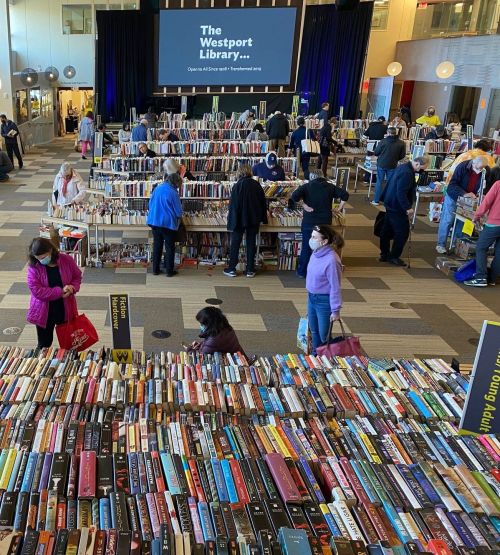
Thousands of books are available at regular Westport Library sales. (Photo/Dan Woog)
Unfortunately, we receive unsuitable books on a daily basis. These may be too damaged, exposed to humid conditions resulting in mold or mildew, filled with excessive margin notes or underlinings, or carry a strong odor of cigarette smoke.
Occasionally, even books that appear to be in good condition may have absorbed unpleasant odors due to storage with other books in less favorable conditions.
Furthermore, our book donation center operates from 9 a.m. to 4 p.m., Mondays through Saturdays. Despite clear signage urging patrons not to leave books outdoors when the center is closed, books left outside overnight or on Sundays are exposed to the elements and must be recycled, as we advertise.
Our book sale has a clearly defined policy, accessible on the Westport Book Sale Ventures website, which outlines materials we do not accept, including most encyclopedias, test-prep books over 3 years old, Time-Life series books, and magazines. Occasionally donors, after having their contributions declined for these reasons, may unfortunately choose to improperly dispose of books in our dumpsters.
It’s vital to understand that the books withdrawn from our Westport Library collection are removed for various reasons, such as damage, non-circulation, outdated content and various other factors.
When a book is no longer in use due to damage, outdated information, or low demand, we prioritize responsible and environmentally friendly disposal methods. Recycling is one of those methods, helping us minimize our environmental impact. Our goal is to maintain a relevant and high-quality collection for our patrons. Recycling enables us to make space for new and valuable resources.

Stacks downstairs, at the Westport Library.
Also of note: We send books that are no longer in frequent circulation but are in good condition to Better World Books, which sells them to support educational, literacy, and other programs. Better World Books also donates books to charity. We get a small amount of money back when we send books to them.
Transporting these materials to Goodwill or other charities poses logistical challenges. Unfortunately, we lack the capacity to deliver them to alternative locations. Moreover, these organizations typically lack the resources, including staff and facilities, to manage the collection and processing of these books. Even when we extend invitations to charities to collect books for free at the end of our sales, very few organizations take us up on the offer.
We hope this explanation sheds light on our book management practices. Please don’t hesitate to reach out if you have any further questions or concerns.
(Readers often ask questions of “06880.” Answering them is one more feature of our hyper-local blog. Please support our wide-ranging work, by clicking here. Thank you!)

Dylan’s question is pertinent,
I would expect that the Westport Library could get volunteers that would be more than happy to deliver the books to schools that need them.
Local residents are very generous and many are looking for projects that are not time sensitive and that would only require a short period of time.
It would be worth an inquiry.
Books can be shipped to 3rd world countries. There are many foundations that would take them
I think the library could do better. There are so many libraries that do not have the resources of the Westport library and who focus solely on books. (No multimedia programs, no speaker programs, no concerts). It is possible to identify a few libraries needing books and establish a contact there who might be willing to come pick up books. I.e.Bridgeport libraries come to mind. I will volunteer to find a few libraries that need books if library staff don’t have time to do so!!
Are books also donated to Darien Book Aid? Where there is a will there is a way. Throwing away books is not a solution.
Geez, this is a world class facility. They’ve been doing this a long time. I think they know what they’re doing.
(As Mr Johnston says . . .)
I like dumpster-diving as much as anyone; however, not taking into account the library’s tireless team of expert sorters looking for a home for every donated book misses the big picture.
For a related perspective, check out the Strand’s dumpsters in NYC. 😉
I think the question needs to be asked as to whether or not this guy should have been dumpster diving in the first place. What if he scratches his leg and picks up a raging infection like a flesh eating virus or something? I also think that for a person who is expected to safeguard books not destroy them that Bill Harmer needs to give some serious thought to securing the dumpster against unauthorized infiltrators. Now that we’ve settled that critical issue can Bill or Jen provide an update on WTF happened to the good old tile donor wall that’s been sitting in taxpayer paid commercial storage for over a year now? Perhaps the monthly stipend that’s footing the bill for that stupid, insensitive and uncalled for move could be redirected to the “Save Lymon Fund” that was good for photo ops and clicks six months ago but has fallen from favor.
Some of the books that the library recycles due to low demand and outdated content are the most fun to read. I use older books, such as those with broken leather covers, for art projects. I understand that there is now limited space for book storage, book sales, and the book store. I wish there was a way that the public could go through the books prior to putting them into the recycling dumpster. Also, it might just be me, but I cry a little inside when I see the volunteers walk over and throw them “away.”
Having worked for a number of years as a volunteer at our library, I can tell you that how they handle damaged (etc) books is vastly superior to most other places.
It’s a common cry throughout major cities and their suburbs: “Where can I donate my books? Nobody will take them!” When I tell friends in NY and L.A. about the program here in Westport they comment on how lucky we are.
Our library has researched many avenues for the books they have to toss. Most of the suggestions here have been thought of and investigated. The best (and really only) solution is recycling.
I understand that it’s painful to see books tossed in a dumpster, but I can tell you that if they were offered for sale instead, they wouldn’t be purchased. As Bill Hamer explained, most either stink – are heavily marked – have pages torn out – etc.
Our library is excellent. Let’s thank them for everything they offer us – including the great book sales and the wonderful used book store. If it weren’t for them, almost all those books would end up in a dumpster somewhere.
(Sorry – typo – Bill Harmer, of course)
As a volunteer at Darien Book Aid I can attest to the poor condition of many donations we receive. Some people are really just dumping books on us. Having said that, there are plenty of people who contact us first to see if we are interested which is very helpful. For the books which aren’t a good fit for our “destination chain”, we have used Discover Books which picks up books directly from us and we have recently heard about Bay State Books which does this for the Darien Library. It should also be noted that many libraries and schools donate to us the books that they no longer want in their stacks for one reason or another. I guess it is a good thing that people still care about books.
Treasures WILL be missed in any triage process.
No magazines? What to do with several sets of THE NEW YORKER (1945-through 1965)? Toss them as they are JUST magazines? There goes 1st publications of John Hershey’s Hiroshima, Hannah Arendt on Eichmann, Nabokov, Shirley Jackson, Muriel Sharp, 90% of J.D. Salinger, the last of James Thurber, not to mention Chas. Addam’s cartoons and painted covers, etc. etc. etc. All valuable and all re-saleable.
A dumpster rescued, slightly warped-by-humidity but signed, limited-numbered book (150 copies) by a well known West Coast poet ($60 on eBay.)
No old text books? How about ANY edition, especially pre-1949, of Benjamin Graham’s SECURITY ANALYSIS? (Best investment Warren Buffet ever made.)
And whatever happened to WPL’s 1st editions of CARRIE and ONE HUNDRED YEARS OF SOLITUDE, the latter of which I took off the WPL new book shelf and read the 1st paragraph and have never forgotten the 1st line. (Both $$$$ in any condition.)
Yes, books can be HAZARDOUS to your health. Certainly old leather ones when “red rot” sets in. I can’t even handle those without gloves and an N95 mask. And, yes, one bad apple can spoil the rest.
Libraries must have policies. There are a LOT of books out there, and people want to read the newer ones, and then what do you do? And the greater Westport area is a “book rich” area for collecting and eBay reselling, i.e. you can make a living off of library sales, library freebies, estate sales — and, yes, “dumpster diving.”
Now, I see that foregrounded book in the dumpster picture and think “Huh, I don’t have ANY of Samuel Eliot Morison’s best-selling and classic multi-volume series on the USNavy in WW2.
Is that a Little Brown 1st edition or a book club?” and would have grabbed it. I know how to get a book de-smoked — it’s a long process, though, and you have to “value” the book in some fashion; I’ve a Shelby Foote THE CIVIL WAR trade boxed set like that, but then I’m a U.S. historian. (The Morison book has no real eBay RESALE value IF it is a BOOK CLUB edition, but as a “freebie,” yes, its a great read based on after-action reports; that’s why it’s a classic history.)
Alas, unlike the WPL, some libraries have NO inside re-sale place. The Concord Free Public in Concord, Mass. (Emerson sat on the 1st board of directors) does not. The old building was as small as the original Jessup in Westport. Even with 2 re-builds, there’s no space for WPL-like resale shelves at CFPL! (Its annual June sale is front-lawn massive.)
CFPL has one area in a short corridor off a side-entrance that it uses for freebies of library discards, triaged donations and what not (an 1887 postcard from Moscow Square to the well-known local Beecher family used as a bookmark). I have sold stuff from there on eBay just by highlighting CFPL old ownership labels–ornate and beautiful. Took home for free a multi-volume set of William Makepeace Thackery LETTERS (second-set deaccessioned, but not saved for the annual sale. I asked. They said, Nope, take it).
As conscientious and quality-oriented as both CFPL and WPL are, they HAVE to address a range of issues and audiences, as Mr. Harmer has detailed above, in some structured fashion. Doing so will result in Devaluation of the Product. Alas. And because of that, things get missed. (Chuck Yeager memoir signed on the 2nd free-page, so not seen by a volunteer, and so into the last day $5-per-bag bag.) There’s only so much volunteers can be asked to remember to “look out for.”
Your job, if you accept it, is to rescue as many “valuables,” as many “treasures” as you can. And dumpster-diving is one way to do that. (Raises me hand.) (Oh, FYI. There are laws against doing so. A Dan Woog-reported police citation might await you. For a pre-1800 edition of THE FEDERALIST PAPERS? Worth it.)
There is a diner in Union, CT where you can pick free three used books with any ordered meal. It might be a solution for WPL’s problem too. Just create a few shelves in the cafe and let people pick the book that can’t be sold otherwise.
Hey Dylan,
Enjoyable chatting you this morning.
As a further for-instance, may I suggest/ask that you chat with the specific Goodwill you mentioned, get their detailed feedback on the books that they stock, and like to receive?
I’ll keep an eye on this for your further feedback.
Regards,
John Karrel