

Alert “06880” reader Scott Smith writes:
The backwash of Superstorm Sandy lingers in our community — personally now in beachfront neighborhoods, in fuller view at Compo and along Main Street where, surprisingly, some shops are still shuttered a month after the fact.
Then there are places around town caught somewhere in the middle of our public/private introspection of what Sandy wrought. Burying Hill is one of them. The pocket park and beach remained closed until this week, its entrance along a curve of Beachside Avenue gated shut.
Last weekend — while it was still closed — I parked near Green’s Farms railroad station and hiked up the low-lying road along New Creek that leads to the beach. It was my 2nd furtive trip to Burying Hill since the storm.

Burying Hill Beach shows extensive post-Sandy damage.
I can happily report that a Kowalsky bulldozer has scraped away the 2 feet of sand that washed over the parking lot. But a much bigger, longer and costlier job remains: repairing the seawall at the base of what I’ve always figured is the actual Burying Hill.
Sandy gouged deep into the hillock, nearly taking with it the tidy little bathroom building on top of the seawall.
Though a chain link fence and lots of orange ribbon surrounding the ugly gash is now gone, who knows when the park will be be repaired.
Westport is so blessed with public amenities, Burying Hill hardly ever enters into the conversation of “town jewels.” Fine by me, because being the least trammeled shoreline around makes it a particularly good place for impromptu wave-watching, private sunsets, unfettered jaunts with the dog in winter, rock-turning for crabs in summer and, especially, beachcombing.

Burying Hill, before the storm.
People mull over the sand in all seasons and for all kinds of reasons. I seek beach brick, polished by the surf and sand into streamlined pieces of all shapes and sizes. Over the past few years I’ve taken home enough pieces of beach brick to fill a pathway in my garden. I like how the ocher hues contrast with the dirt. The bricks soak up water like a sponge yet drain like gravel, and they will last forever, more or less. Plus, it’s free –though I do have some guilt for choosing salvage rights over a more altruistic “leave things be.”
As an architectural artifact, beach brick marks our progress as New World residents along this shore of the Sound. My favorite find is a pale yellow-orange variety flecked with bits of shell and straw. Surely these pieces date from the pre-Industrial Era, when brick was formed of hand-dug clay and any old beach sand, and padded with salt marsh grass.
Much of the brick I find no doubt derives from seawalls or steps leading down to the beach that failed to stand the test of time. But who knows how long or far each piece has been tumbled by each tide, how whole it was before being ground down to a pebble, or from what man-made thing it came from?
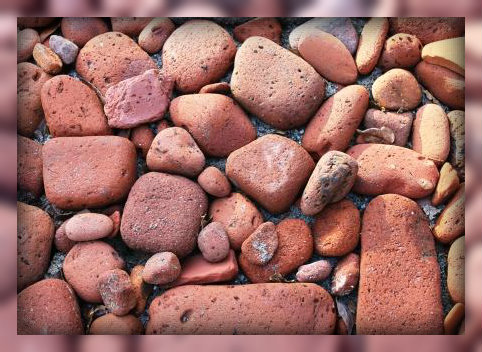
Scott Smith’s “beach bricks.”
Some of the brick I find is charred on one side — the chimney from an old settler’s cabin? Is it from some swanky seaside patio that got sucked into the sea? Or is it just detritus from a load of fill dumped at the water’s edge back when we valued our beaches differently?
And why is it called Burying Hill Beach, anyway?
One thing’s for sure: Each storm uncovers a fresh haul of sea-burnished brick that catches my eye and fills my coat pockets, and Sandy upheaved a mother lode. And who knows where all that brick from Compo’s bathhouses will wash up…
But I digress. And that’s the best thing about beachcombing at Burying Hill. It invites stray thoughts as I work my way down the beach, feeling like a peasant with privileges as I pass along the high seawalls of the Beachside Avenue estates. However grateful I am for this public access to our shoreline, I never quite overcome the feeling that I’m a trespasser, sneaking across someone’s own private horizon.
I’ve gone as far as the point to the east on the far side of the public beach, but only at the lowest of tides, scooting through and around the old pilings that jut out into the sea. Like boating on the Sound, to enjoy Burying Hill Beach one must abide by the tidal charts. In any event, it’s a good long walk to the far point and back, especially with beach brick weighing you down. I will miss those walks this winter, I suppose.

Beachside Avenue got pounded by Hurricane Sandy. (Photo courtesy of Fine Shell Art Blog)