Fred Cantor does not see the glass as half empty or half full. In his eyes, it always overflows.
Fred finds joy wherever he lives. A longtime Manhattan resident, he loves the city.

Fred Cantor, in his Fresh Meadows hat.
In his pre-teen years — the 1950s and early ’60s — he lived in Fresh Meadows. That pocket of northeastern Queens — centered on a housing development built for World War II veterans, which Lewis Mumford described in the New Yorker as “perhaps the most positive and exhilarating example of large-scale community planning in this country” — is the focus of Fred’s new book.
He and co-author Debra Davidson have chronicled the history of their neighborhood in Fresh Meadows, a photo project that’s part of the “Images of America” series.
But this story is not about Queens or Manhattan. It’s about Westport, and what Fred has learned growing up here, then returning to live full time.
(Full disclosure: Fred is one of my oldest and best friends from high school. He’s also a frequent commenter on “06880.”)
“I am fortunate to have grown up in 2 special hometowns,” Fred says.
“Each has given me an appreciation for the other that I might not otherwise have — especially regarding some things many people take for granted here in Westport.”
In Westport — where he moved in 1963 — Fred says that he immediately noticed “the beauty of the stone walls,” something notably missing from Fresh Meadows. To this day, he still marvels at the sight.
Fred finds beauty too at Compo Beach. “I was always taken with the sweeping crescent shape, leading out to the green expanse of Sherwood Island,” he says.
Long Beach– his beach in Queens — was “your typical straight line of sand facing the water.”
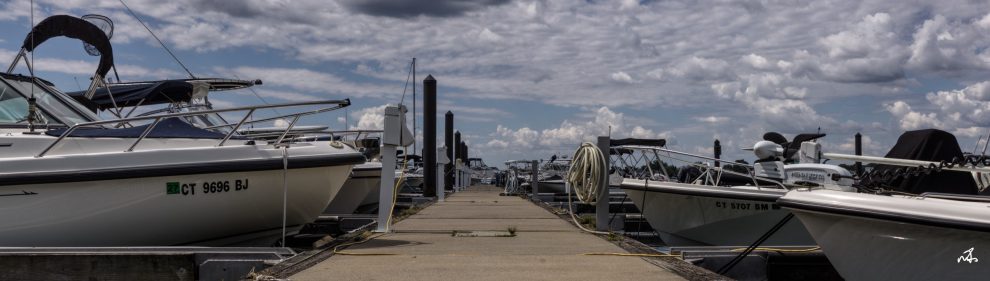
The view at Longshore — looking out on the marina to Cockenoe and beyond — was “so different than anything I had experienced in Queens,” he says.
“I still enjoy that view when I’m at the Longshore pool. It’s like being at a great vacation resort.”
Fred wonders if people who grew up here appreciate that in the same way.

Sid, Pearl and Fred Cantor, at home in Westport.
He says he always thought of “the open area and architecture in the area of Toquet Hall and the old Westport Bank & Trust (now Patagonia) as quintessential small-town America, and an old-fashioned town square.”
That too is far different from what he had — and loved — in Queens.
Plus, Fred says, “when we moved here there was a corner drug store, Thompson’s, where Tiffany’s is now located. It had a lunch counter that served milkshakes.” He felt like he’d walked onto the set of “Leave it to Beaver.”
Living in Westport gave Fred an appreciation of how he could walk to nearly everything in Fresh Meadows — a direct result of the community’s site plan. In Westport, he depended on his mother for rides.
In Fresh Meadows Fred lived in a small 2-bedroom, 1-bath apartment — and was quite happy. That experience, he says, “taught me that you really don’t need a big home or a lot of possessions to truly enjoy life.” To this day, he says, “I have never lived in a big house.”
Of course, Fred wonders what might have happened if his parents had not made the move.
“Chances are I wouldn’t have discovered soccer or The Remains” — 2 of his passions.
And, he says, “I probably would not have been accepted at Yale, since the local high school in Fresh Meadows had nowhere near the reputation that Staples did.”
 The fact that Fred (an attorney) conceived and worked on a variety of diverse creative projects as an adult — producing a play and a movie, writing a book, co-writing a song paying tribute to former Red Sox pitcher Bill Monbouquette — “is probably in some way a reflection of having grown up in Westport, where there has always been such an emphasis on the arts,” Fred says.
“Obviously, the move to Westport as a kid enriched my life in so many ways.”
Fred concludes: “This is probably way more info than you needed. But all of this has gotten me to do a lot of reflecting on this lately.”
Actually, Fred’s insights are perfect. All of us are a reflection of when and how we grew up — and where.
Not all of us are lucky enough to have both a Fresh Meadows, and a Westport, in our lives.
(Click here for a New York Daily News story on Fred Cantor’s new book.)
